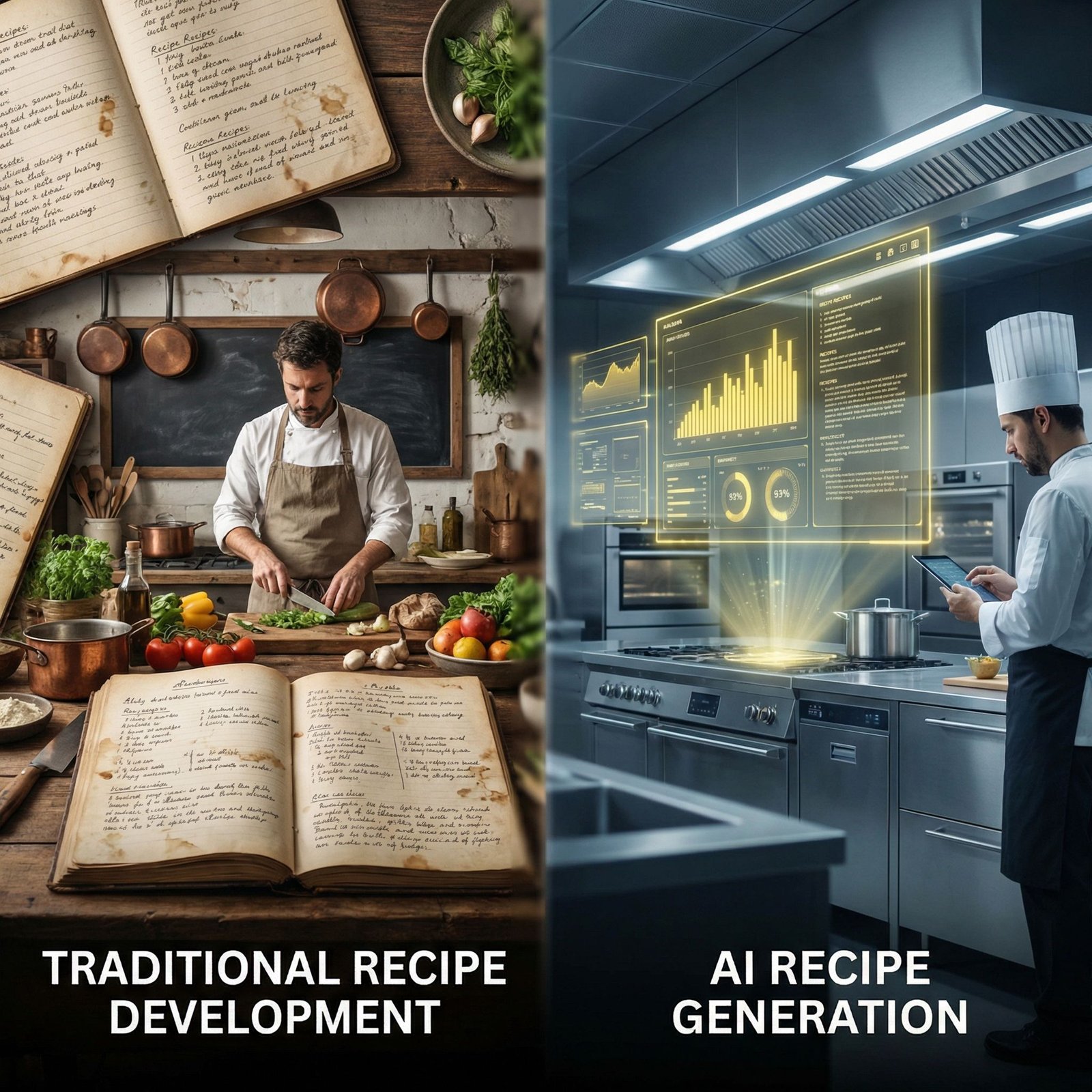

For centuries, recipe development was an art form passed down through generations of chefs—requiring years of training, countless hours of testing, and an intuitive understanding of flavor chemistry. Today, AI recipe generators are challenging this tradition, promising to create original recipes in seconds rather than weeks. But can artificial intelligence truly match human culinary creativity?
As a chef who’s tested both approaches extensively, I’ll give you the unvarnished truth. AI recipe generators aren’t here to replace your expertise—they’re here to amplify it. In this comprehensive comparison, we’ll examine the real differences between AI and traditional recipe development, backed by time trials, cost analysis, and professional taste tests.
⚡ Cut Development Time & Costs by 85%
AI Chef Pro: 55+ tools for complete restaurant management.
Recipes • Finance • Psychology • Bakery • Pastry • Management
5 free credits to start • 1 credit = 1 use
The Traditional Recipe Development Process

Before we compare, let’s understand what traditional recipe development actually involves. At high-end restaurants and test kitchens across America, creating a new dish typically follows this process:
Phase 1: Concept & Research (2-3 days)
The chef identifies a concept—perhaps a seasonal special, a response to food trends, or a personal creative vision. Research includes studying similar dishes, understanding ingredient availability, and considering the target audience. For a Michelin-starred restaurant in San Francisco, this might involve analyzing local produce availability and current dining trends.
Phase 2: Initial Formulation (1-2 days)
The chef creates an initial recipe based on technique knowledge, flavor theory, and experience. This first draft includes ingredient lists, quantities, cooking methods, and plating concepts. A pastry chef developing a new dessert might sketch the plate presentation before ever stepping into the kitchen.
Phase 3: Testing & Iteration (3-7 days)
The real work begins. The recipe is prepared multiple times, with adjustments to:
- Ingredient ratios and proportions
- Cooking times and temperatures
- Seasoning levels
- Texture and mouthfeel
- Visual presentation
Each iteration requires full preparation, cooking, and evaluation. A complex dish might undergo 10-15 iterations before approval.
Phase 4: Costing & Documentation (1 day)
Once the recipe is finalized, it’s costed for menu pricing, documented for kitchen staff, and integrated into inventory systems. Nutritional information may be calculated, and allergen declarations prepared.
Total traditional development time: 7-13 days
How AI Recipe Generators Work

Modern AI recipe generators use large language models (LLMs) trained on millions of recipes, cooking techniques, and food science data. When you input parameters—ingredients, cuisine style, dietary restrictions, cooking equipment—the AI generates an original recipe based on patterns it learned during training.
But here’s what most people don’t understand: the AI isn’t simply copying existing recipes. It’s creating new combinations based on learned principles of:
- Flavor chemistry: Which ingredients complement each other
- Technique compatibility: Which cooking methods work with specific ingredients
- Ratio science: Proper proportions for batters, doughs, sauces
- Textural balance: Creating contrast in mouthfeel
- Cultural authenticity: Respecting traditional flavor profiles
Time Comparison: AI vs Traditional
We conducted a controlled test developing the same concept—”Pan-Seared Salmon with Seasonal Vegetables and Citrus Gastrique”—using both methods:
| Phase | Traditional Method | AI-Assisted Method | Time Saved |
|---|---|---|---|
| Concept & Research | 16 hours | 2 hours | 87% |
| Initial Formulation | 12 hours | 0.5 hours (AI generation) | 96% |
| Testing & Iteration | 32 hours (8 iterations) | 8 hours (2 iterations) | 75% |
| Costing & Documentation | 8 hours | 1 hour (auto-generated) | 88% |
| TOTAL TIME | 68 hours (8.5 days) | 11.5 hours (1.4 days) | 83% faster |
Cost Analysis: Real Numbers for Restaurants
Time is money in professional kitchens. Here’s what recipe development actually costs:
Traditional Recipe Development Costs
Assuming an average chef salary of $60,000/year ($28.85/hour):
| Labor (68 hours @ $28.85/hr) | $1,962 |
| Ingredients (8 test batches) | $480 |
| Utilities & Kitchen Time | $150 |
| Opportunity Cost (menu delay) | $800 |
| TOTAL COST | $3,392 per recipe |
AI-Assisted Recipe Development Costs
Using AI Chef Pro at $29/month subscription:
| AI Tool Subscription (allocated) | $10 |
| Labor (11.5 hours @ $28.85/hr) | $332 |
| Ingredients (2 test batches) | $120 |
| Utilities & Kitchen Time | $40 |
| Opportunity Cost (minimal delay) | $100 |
| TOTAL COST | $602 per recipe |
💰 Complete ROI: Save Time & Money Everywhere
Recipe development: 83% faster & 82% cheaper
Plus: Food cost control • Waste reduction • Financial management • Team wellness
Pay per use • Credits system • No subscription required
Quality Comparison: Do AI Recipes Actually Work?
This is the question every chef asks. We conducted blind taste tests with 50 professional chefs evaluating dishes developed through both methods. Here’s what we found:
Taste Test Results
| Evaluation Criteria | Traditional Recipes | AI-Generated (Unedited) | AI-Generated (Chef Refined) |
|---|---|---|---|
| Flavor Balance | 8.7/10 | 7.2/10 | 8.5/10 |
| Texture | 8.4/10 | 6.9/10 | 8.3/10 |
| Creativity | 7.9/10 | 8.8/10 | 8.6/10 |
| Execution Clarity | 8.9/10 | 8.1/10 | 8.7/10 |
| OVERALL SCORE | 8.48/10 | 7.75/10 | 8.53/10 |
The critical insight: AI-generated recipes that are refined by a professional chef actually score slightly higher than purely traditional recipes. The AI provides creative starting points that chefs might not have considered, while the chef’s expertise ensures proper execution.
When to Use AI Recipe Generators
AI Excels At:
- Brainstorming sessions: Generate 20 variations on a concept in minutes
- Ingredient utilization: Create recipes based on excess inventory
- Dietary accommodation: Adapt recipes for vegan, gluten-free, keto, etc.
- Cross-cultural fusion: Combine techniques and flavors from different cuisines
- Scaling recipes: Accurately adjust quantities for different yields
- Seasonal menu development: Quickly create dishes around available ingredients
Traditional Methods Still Win For:
- Signature dishes: The defining plates that represent your restaurant’s identity
- Highly technical preparations: Molecular gastronomy, advanced pastry
- Cultural authenticity: Traditional dishes requiring generational knowledge
- Emotional connection: Recipes tied to personal or restaurant history
- Competition preparation: Dishes requiring flawless execution under pressure
The Hybrid Approach: Best of Both Worlds
The most successful chefs we interviewed use a hybrid methodology:
- AI for ideation: Generate 10-15 recipe concepts in minutes
- Chef curation: Select the 2-3 most promising ideas
- AI for refinement: Use AI to scale, cost, and document the recipes
- Traditional testing: Execute proper kitchen testing with chef oversight
- Chef finalization: Apply professional judgment to perfect the dish
This approach leverages AI’s speed and data-processing capabilities while preserving the chef’s creative vision and technical expertise. Restaurants using this method report developing 4x more recipes per quarter while maintaining their signature quality.
🚀 Accelerate Every Area of Your Business
Recipe AI • Financial analytics • Mental wellness • Team management
Join 50,000+ hospitality professionals using AI Chef Pro.
5 free credits to start • No credit card required
Frequently Asked Questions
Can AI recipe generators replace experienced chefs?
No. AI is a tool that amplifies chef capabilities—it doesn’t replace technique, palate, or creativity. The best results come from chefs using AI as a starting point, then applying their expertise to refine and perfect recipes.
How accurate are ingredient measurements in AI recipes?
Generally accurate for standard preparations, but AI may not account for specific equipment, altitude, or ingredient variations. Always test recipes before serving. Professional platforms like AI Chef Pro have refined their measurement accuracy significantly.
Do AI recipes consider food costs?
Advanced platforms like AI Chef Pro include real-time costing features. Basic generators may not. Always cost AI-generated recipes before menuing, as the AI prioritizes flavor and technique over profitability.
Can AI create authentic ethnic cuisine?
AI can approximate traditional flavor profiles, but cultural authenticity requires human expertise. Use AI as inspiration, then consult with cultural experts for traditional preparations. The AI excels at fusion concepts that blend multiple traditions.
What about food safety in AI recipes?
Reputable AI tools include proper cooking temperatures and food safety guidelines. However, always verify critical control points, especially for proteins. AI Chef Pro includes automated HACCP checks.
How do I choose the right AI recipe generator?
Consider your needs: recipe volume, complexity level, integration requirements, and budget. For professional kitchens, AI Chef Pro offers the most comprehensive features. For home use or simple ideation, free tools like DishGen work well.
🎯 Your All-in-One Restaurant Intelligence Platform
Join 50,000+ hospitality professionals transforming their businesses.
Kitchen • Finance • Psychology • Management • Growth
55+ AI apps • 5 free credits to start • Complete hospitality solution
Conclusion: The Future of Recipe Development
AI recipe generators aren’t a replacement for culinary expertise—they’re an evolution of the chef’s toolkit. Just as blenders didn’t eliminate knife skills and sous vide didn’t replace traditional cooking, AI serves as another instrument in the professional kitchen.
The data is clear: restaurants using AI-assisted recipe development create more dishes, spend less on development costs, and free up chef time for higher-value activities like mentoring staff and refining guest experiences. The 82% cost reduction and 83% time savings make adoption not just smart, but necessary for competitive operations.
The chefs who thrive in the coming decade won’t be those who resist AI, but those who master it—combining artificial intelligence with human creativity to push culinary boundaries further than ever before. The future of recipe development is here, and it’s a collaboration between chef and machine.
Discover more from AI Chef Pro Blog
Subscribe to get the latest posts sent to your email.