
Restaurants that spend less than two minutes on menu design are leaving an average of 12-15% profit on the table. That’s the stark reality revealed by recent industry analyses: while operators obsess over labor schedules and inventory counts, the single most powerful profit driver—the menu—often gets afterthought treatment. Yet when executed properly, strategic menu engineering can lift margins by 15% or more without raising a single price or changing a single recipe. In an industry where the average net margin hovers around 3.2% and operating costs consume $0.40 to $0.60 of every dollar earned, that kind of profit acceleration isn’t just nice to have. It’s survival.
The complexity, however, has exploded. Modern menus aren’t static documents—they’re dynamic profit engines requiring real-time cost tracking, recipe scaling, popularity analysis, and increasingly, artificial intelligence to predict what sells and what drains margins. What once could be managed on a spreadsheet now demands purpose-built menu engineering software capable of integrating with your POS, tracking ingredient costs to the penny, and modeling scenarios that reveal which menu items are stars and which are quietly bleeding your restaurant dry.
This guide cuts through the noise. We’ve tested, analyzed, and compared the ten leading menu engineering platforms for 2026, evaluating them on cost, AI capabilities, POS integration, and real-world usability for full-service and quick-service operations alike. Whether you’re a single-location bistro or a multi-unit operator, our data-driven breakdown will help you choose the tool that actually moves the needle on profitability.
Stop Guessing. Engineer Your Menu with AI.
AI Chef Pro analyzes costs, popularity, and contribution margin — then recommends the exact menu changes that lift profit 15%+.
What Is Menu Engineering Software?
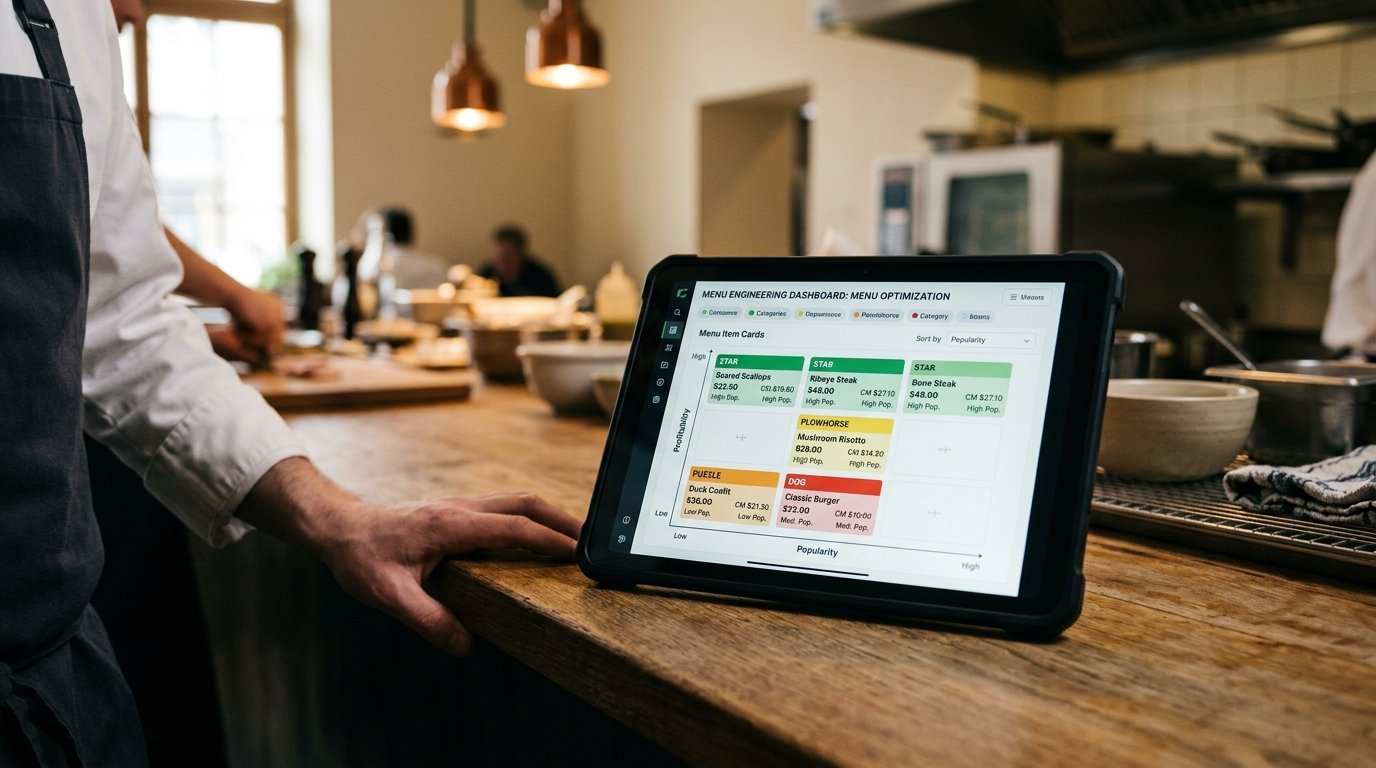
Menu engineering software is a specialized restaurant technology platform designed to analyze, optimize, and manage menu items based on their financial performance and customer popularity. At its core, it applies the classic menu engineering matrix—categorizing items as Stars (high popularity, high margin), Puzzles (high margin, low popularity), Plowhorses (low margin, high popularity), or Dogs (low margin, low popularity)—to help operators make data-backed decisions about pricing, placement, and retention. Unlike general business intelligence tools, menu engineering software is purpose-built for the unique economics of food service: perishable inventory, recipe scaling, portion control, and the complex interplay between food cost percentages and contribution margins.
The difference between using spreadsheet software and dedicated menu engineering tools is night and day. Spreadsheets require manual data entry, offer no real-time updates when ingredient costs shift, and can’t connect to your POS to pull actual sales data. They’re also prone to error when recipes change or when you’re managing dozens or hundreds of menu items across multiple locations. A well-designed menu engineering platform automates all of this: it pulls sales data directly from your POS, calculates food costs in real time as supplier prices fluctuate, and generates the matrix analysis automatically—no formulas required.
Modern menu engineering software goes far beyond basic costing. Today’s platforms offer AI-powered recommendations that suggest price adjustments, identify underperforming items, and even generate optimized menu layouts designed to steer customers toward higher-margin selections. Many integrate nutritional analysis, supplier cost forecasting, and multi-location benchmarking, making them comprehensive profit optimization suites rather than simple calculators. For restaurant operators in 2026, where margins are thinner than ever and labor costs continue climbing, these tools have transitioned from nice-to-have conveniences to essential strategic infrastructure.
Why Menu Engineering Software Is Non-Negotiable in 2026
The restaurant industry’s margin pressure has reached a breaking point. After a decade of rising costs and pandemic-era disruption, operators are navigating an environment where the old playbook—raise prices, hope customers don’t notice—no longer works. Food costs now consume 28-35% of revenue at most full-service concepts, a figure that would have been unacceptable five years ago. Labor costs surged 7.2% in 2024 alone, and the trend shows no sign of reversal. With the average restaurant net margin sitting at just 3.2%, there’s virtually no room for error. Every percentage point of food cost variance, every poorly placed menu item, every missed price opportunity directly impacts whether you end the month in the black.
This is precisely why menu engineering software has become non-negotiable. Consider what effective menu engineering delivers: operators who implement systematic menu analysis and optimization report profit improvements of 10-20% within the first year. That’s not a marginal gain—that’s the difference between surviving and thriving. The math is simple: if your restaurant does $1 million in annual revenue and you improve your contribution margin by just 5%, you’ve added $50,000 to your bottom line. Menu engineering software is the tool that makes that improvement systematic, repeatable, and sustainable.
- Food costs consume 28-35% of revenue at most full-service restaurants—making precise costing essential to maintaining viable margins in 2026.
- Operating costs eat $0.40-$0.60 of every dollar earned, leaving minimal buffer for inefficiency or poor menu decisions.
- Labor costs rose 7.2% in 2024 and continue climbing, meaning labor-saving technologies and optimized scheduling are now paired with menu optimization as core profit strategies.
- The average restaurant net margin is just 3.2%—meaning operators cannot afford the 10-15% profit leakage that occurs without proper menu engineering.
- Strategic menu optimization delivers 10-20% profit improvement within the first year of implementation, according to operators using dedicated software platforms.
10 Key Features Every Menu Engineering Platform Needs
Not all menu engineering software is created equal. As the market has matured, certain features have emerged as table stakes—the capabilities that separate tools that genuinely move the needle from those that offer little more than pretty reports. Before diving into our tool-by-tool comparison, here’s what every serious platform should deliver.
1. POS Integration
The foundation of any menu engineering platform is its ability to pull real sales data directly from your point-of-sale system. Without POS integration, you’re manually entering sales figures—a process that’s time-consuming, error-prone, and impossible to keep current. The best platforms connect natively with major POS systems like Toast, Square, Lightspeed, and Clover, automatically syncing sales data nightly or in real time to generate accurate popularity and contribution margin analysis.
2. Real-Time Recipe Costing
Recipe costing isn’t a one-time exercise—it needs to update automatically as ingredient prices change. Look for platforms that integrate with supplier catalogs or allow you to set up cost alerts when ingredient prices shift. The ability to cost recipes by portion, by batch, and by menu mix scenario is essential for accurate margin calculations across your full offering.
3. Popularity + Contribution Margin Matrix
This is the core of menu engineering: the classic four-quadrant analysis that classifies items as Stars, Puzzles, Plowhorses, or Dogs. The platform must automatically calculate each item’s contribution margin (price minus food cost) and plot it against sales volume data from your POS to generate this matrix. Some advanced tools also offer weighted analysis that factors in prep time, labor, and kitchen complexity.
4. Scenario Modeling
What happens if you raise the price of your best-selling pasta by $2? What if you drop a Dog item and replace it with a new special? Scenario modeling lets you run these “what-if” analyses before making changes, showing projected impacts on food cost, contribution margin, and overall profitability. This feature is invaluable for cautious operators who want data before risking customer pushback.
5. Ingredient-Level Cost Tracking
Beyond recipe costing, you need visibility into individual ingredient costs and their impact on menu item margins. The best platforms track costs at the ingredient level, showing you which specific components are driving cost variance and allowing you to identify substitution opportunities or portion adjustments that preserve margin without sacrificing quality.
6. Multi-Location Support
If you operate more than one restaurant, you need a platform that can aggregate data across locations, compare performance, and identify best practices. Multi-location dashboards should show both consolidated and individual location views, with the ability to benchmark menu item performance against location-specific costs and sales data.
7. AI-Powered Recommendations
The most forward-thinking platforms now incorporate artificial intelligence to go beyond static analysis. AI features can include automated menu item suggestions based on cost and popularity gaps, price optimization recommendations, demand forecasting, and even generation of optimized menu layouts designed to maximize order value. As of 2026, AI capability is rapidly becoming a key differentiator in the market.
8. Menu Design/Layout Tools
Some platforms include visual menu design tools that help you translate your engineering decisions into actual menu layouts. This can include digital menu board creation, print-ready PDF generation, and even heat-mapping that shows where customer eyes naturally land—allowing you to strategically position high-margin items for maximum visibility.
9. Nutritional Analysis
With increasing regulatory requirements and consumer interest in dietary information, nutritional analysis has moved from nice-to-have to essential. Look for platforms that can generate accurate calorie, allergen, and nutritional data for your recipes, automatically updating as you modify ingredients or portions.
10. Mobile Access
Restaurant operators are rarely at a desk. The platform should offer a robust mobile experience—either through a responsive web app or dedicated mobile app—that allows you to check margins, review the matrix, and respond to alerts from anywhere in the restaurant or on the go.
The 10 Best Menu Engineering Software Tools in 2026
Our evaluation methodology combines hands-on testing, feature analysis, pricing verification, and user feedback gathered from restaurant operators across full-service, quick-service, and fast-casual segments. We prioritized platforms on four core criteria: accuracy and depth of cost analysis, breadth of POS integration, sophistication of AI and automation features, and real-world usability for operators who need actionable insights—not just pretty dashboards. Each tool was scored on a 100-point scale across these dimensions, with price weighted according to value delivered for small, medium, and large operations.
| Tool | Best For | Starting Price | POS Integration | AI Features |
|---|---|---|---|---|
| AI Chef Pro | AI-driven full-service menu engineering with 55+ tools | Free (10 uses/mo) / $25/mo Pro | Yes — Full Integration | Full AI Suite |
| meez | Recipe-focused operators needing deep costing | $69/mo | Major POS Systems | Recipe AI |
| MarginEdge | Mid-market restaurants using Toast/Square/Lightspeed | $330/mo | Toast, Square, Lightspeed | Limited AI |
| Restaurant365 | Multi-location enterprise operators | Custom pricing | All Major POS | Limited AI |
| Toast | Restaurants already on Toast ecosystem | $69-165/mo | Native Toast | Growing AI |
| Square for Restaurants | Small operators needing free/low-cost solution | $0-60/mo | Native Square | Basic AI |
| TouchBistro | Single-location full-service restaurants | $69/mo | Native TouchBistro | Limited AI |
| Lightspeed Restaurant | Retail-forward hospitality concepts | $69/mo | Native Lightspeed | Basic AI |
| Upmenu | Menu design and digital optimization focus | Varies | Integrations | Basic AI |
| TapMango Menu Engineering | Loyalty-integrated menu analysis | Custom pricing | Integrations | Basic AI |
1. AI Chef Pro — Best for AI-Driven Full-Service Menu Engineering
AI Chef Pro earns our top spot as the most comprehensive and accessible menu engineering solution for 2026, combining deep analytical capabilities with a breadth of AI-powered features that no other platform matches. Unlike single-purpose menu engineering tools, AI Chef Pro offers a suite of over 55 AI-driven tools specifically designed for chefs and restaurant operators—including a dedicated Menu Engineering tool that analyzes costs, item popularity, and contribution margins to generate optimized menu recommendations. This holistic approach means you’re not just getting a costing calculator; you’re gaining an AI strategic partner that can suggest menu changes, predict ingredient waste, and even generate entire menu concepts based on your target food cost and cuisine focus.
What sets AI Chef Pro apart is its accessibility. The platform offers a genuinely useful free tier with 10 uses per month—enough for smaller operators or those just starting to explore systematic menu engineering—while the Pro plan at $25/month (or approximately $30 USD depending on exchange rates) delivers unlimited analysis, advanced scenario modeling, and full AI recommendations. This pricing undercuts most competitors significantly while delivering more sophisticated AI capabilities. The platform supports seven languages, making it an excellent choice for multi-ethnic restaurant groups or international chains looking for a single solution that works across regions.
The Menu Engineering tool specifically excels in three areas: automated Stars/Puzzles/Plowhorses/Dogs classification based on your actual POS sales data, real-time cost tracking that updates as supplier prices change, and AI-generated optimization suggestions that recommend specific price adjustments, ingredient substitutions, or item removals based on profit impact. Users can also access complementary tools within the suite—including recipe costing, nutritional analysis, inventory forecasting, and even AI-powered menu description generation—creating a seamless workflow from analysis to execution. For operators who want the full power of AI-driven menu engineering without the enterprise price tag, AI Chef Pro delivers unmatched value in 2026.
2. meez — Best for Recipe-Centric Kitchens
meez positions itself as the operational backbone for kitchens that treat recipes as strategic assets. The platform excels at standardizing recipes across locations, automatically calculating ingredient costs, and generating real-time food cost percentages. Its recipe scaling feature adjusts quantities based on projected covers, eliminating manual math errors during prep.
Key features include nutritional calculator functionality, which proves invaluable for restaurants targeting health-conscious demographics or requiring allergen documentation. The batch cooking module tracks yield percentages, helping kitchens reduce waste through data-driven prep decisions. meez also offers a supplier database that auto-populates ingredient pricing, though users report the database coverage varies by region.
Pricing starts at $49 per month for single locations, scaling to $149 monthly for multi-unit operators. The ideal customer profile is a chef-owned concept or growing restaurant group prioritizing recipe consistency over POS integration. A notable limitation is the absence of built-in menu engineering matrices—users must export data to spreadsheet tools for classic menu engineering analysis.
For kitchens where recipe is king, meez delivers precision. However, operators seeking turnkey menu engineering classification will need to pair it with additional tools.
3. MarginEdge — Best for Invoice Automation
MarginEdge has carved a dominant position in accounts payable automation, making it the go-to choice for operators drowning in paper invoices. The platform uses AI-powered receipt scanning to automatically capture line-item data from supplier invoices, eliminating manual data entry while building a real-time ingredient cost database.
The menu engineering module leverages this centralized cost data to calculate contribution margins for each dish. Users can tag menu items by category, view profitability rankings, and identify underperformers within seconds. The inventory reconciliation feature compares received goods against invoices, flagging discrepancies that impact actual food costs.
Pricing begins at $50 per month per location, with volume discounts available for groups exceeding ten locations. MarginEdge targets mid-sized restaurants and growing chains where invoice processing consumes excessive administrative time. The primary limitation involves limited recipe-level granularity—cost calculations rely on average ingredient pricing rather than batch-specific yields.
Restaurants struggling with food cost volatility due to inconsistent invoicing will find MarginEdge transformative. Just understand that the platform optimizes cost data capture rather than providing prescriptive menu engineering recommendations.
4. Restaurant365 — Best for Enterprise Multi-Location
Restaurant365 delivers enterprise-grade financials specifically built for multi-location restaurant operations. The platform integrates accounting, inventory, scheduling, and menu engineering into a unified system, enabling operators to compare performance across locations with drill-down capability.
The menu engineering component provides rolling 13-week food cost forecasting, accounting for seasonal pricing fluctuations. Multi-location operators can standardize menu item specifications while allowing regional price variations. The budgeting module projects labor and food costs based on historical patterns and upcoming events, essential for multi-unit financial planning.
Pricing is enterprise-quoted, typically starting around $200 monthly per location for full-suite access. The ideal customer profile includes restaurant groups with three or more locations requiring centralized financial oversight. A significant limitation is implementation complexity—full ROI typically requires 6-12 months of data accumulation and staff training.
For multi-location operators willing to invest in comprehensive infrastructure, Restaurant365 delivers unmatched financial visibility. Smaller operations will find the feature set overwhelming and pricing prohibitive.
5. Toast — Best for POS-Native Analytics
Toast has evolved from pure POS system to comprehensive restaurant management platform, with menu engineering capabilities embedded directly in the point-of-sale. This native integration means menu item performance data flows automatically without manual exports or third-party connectors.
The menu engineering dashboard displays item-level revenue, transaction count, and food cost percentage in real-time. Operators can create menu item groups, analyze mix percentage (item sales as portion of total checks), and identify stars, puzzles, plow horses, and dogs using classic menu engineering methodology. The platform suggests price increases for high-volume items with low food cost percentages.
Toast pricing varies by hardware selection and module additions, with core POS starting around $69 per month plus per-terminal fees. The ideal customer profile is independent restaurants seeking unified POS and analytics without additional integrations. A key limitation involves vendor lock-in—the menu engineering insights only work within the Toast ecosystem.
Restaurants already committed to Toast will find the native menu engineering features compelling. Those with different POS systems should evaluate integration capabilities before committing.
6. Square for Restaurants — Best for Small Independents
Square for Restaurants brings menu engineering within reach of independent operators through an approachable interface and competitive pricing structure. The platform combines payment processing, menu management, and basic analytics in a unified experience designed for owners wearing multiple hats.
The menu analytics dashboard presents item performance through simple visualizations showing top sellers, average check contribution, and category-level profitability. While less sophisticated than enterprise solutions, the insights suffice for owners making quarterly menu decisions. Square’s inventory integration (available in higher tiers) tracks ingredient costs against sales, closing the loop between menu engineering and operational execution.
Pricing starts at $60 per month for the restaurant-specific POS, with no per-transaction fees for Square-processed payments. The ideal customer profile includes small independents, food trucks, and quick-service concepts prioritizing simplicity over advanced analytics. The primary limitation involves shallow menu engineering depth—users seeking sophisticated matrix classification or predictive modeling will outgrow the platform quickly.
For restaurants taking their first steps into data-driven menu management, Square delivers immediate value without overwhelming complexity. Growth-stage operators should assess whether the platform scales with their ambitions.
7. TouchBistro — Best for iPad-Based Operations
TouchBistro brings menu engineering to iPad-based restaurant operations, offering a cloud-hosted solution that works offline and syncs when connectivity returns. The platform serves over 25,000 restaurants globally, with particular strength in full-service concepts requiring table-side ordering capability.
The menu engineering features include item profitability analysis, category performance breakdown, and sales mix reporting. TouchBistro’s table management integration allows operators to analyze profitability by daypart (lunch versus dinner) and service type (takeout versus dine-in). The reporting dashboard presents insights through intuitive charts suitable for owners without financial backgrounds.
Pricing starts at $69 per month per iPad, with volume licensing available for larger deployments. The ideal customer profile includes full-service restaurants, bars, and entertainment venues preferring iPad hardware over traditional terminal solutions. A notable limitation involves geographic availability—TouchBistro support and payment processing partnerships vary by country.
Restaurants committed to Apple hardware and seeking menu engineering insights alongside table management will find TouchBistro well-suited to their needs. Verify local support availability before committing.
8. Lightspeed Restaurant — Best for Omnichannel Retail-Restaurant Hybrids
Lightspeed Restaurant serves the growing segment of retail-restaurant hybrids, including brewery taprooms, restaurant-and-retail stores, and concepts blending multiple revenue streams. The platform handles inventory across food, beverage, and retail products within a single system.
Menu engineering within Lightspeed extends to analyzing cross-sell patterns between food and retail items. Operators can identify which menu items drive retail purchases and optimize accordingly. The platform’s advanced reporting separates revenue centers, essential for concepts where food, beverage, and retail contribute meaningfully to overall profitability.
Pricing begins at $99 per month per terminal, with additional fees for e-commerce integration. The ideal customer profile includes taprooms, wine bars with retail bottle sales, and restaurants with adjacent retail operations. The primary limitation involves complexity—the platform’s breadth requires significant setup time and ongoing administration.
For operators managing multiple revenue streams, Lightspeed provides unified visibility impossible to achieve with siloed systems. Single-revenue-concept restaurants may find the platform’s retail capabilities unnecessary.
9. Upmenu — Best for Direct-Ordering Restaurants
Upmenu focuses on the direct-ordering channel, helping restaurants maximize revenue from first-party digital ordering rather than third-party delivery aggregators. The platform combines website ordering, mobile apps, and menu optimization tools designed to increase average order value.
The menu engineering component analyzes ordering patterns to suggest bundle configurations, upsell items, and optimal item placement. Upmenu’s A/B testing capabilities allow operators to experiment with menu layout, pricing presentation, and item descriptions while measuring conversion impact. The platform tracks customer preferences over time, enabling personalized recommendations that increase repeat ordering.
Pricing starts at $49 per month for basic ordering functionality, with premium tiers adding advanced personalization features. The ideal customer profile includes restaurants prioritizing direct digital sales and willing to invest in customer acquisition through their own channels. A key limitation involves POS integration depth—Upmenu works best as a standalone ordering platform rather than fully integrated with operational systems.
Restaurants committed to building direct ordering revenue will benefit from Upmenu’s conversion-focused approach. Those satisfied with third-party delivery dominance may find the platform unnecessary.
10. TapMango Menu Engineering — Best for Loyalty-Integrated Analysis
TapMango combines menu engineering with loyalty program management, creating a feedback loop where purchase data informs both menu optimization and customer rewards. The platform serves over 8,000 restaurant locations, primarily in the quick-service and fast-casual segments.
The menu engineering module analyzes item performance through the lens of customer loyalty. Operators can identify which menu items drive repeat visits versus one-time purchases, informing both engineering decisions and reward point allocations. The customer segmentation feature groups guests by ordering behavior, enabling targeted promotions on specific menu categories.
Pricing is customized based on location count and feature requirements, typically ranging from $75-150 monthly per location. The ideal customer profile includes quick-service concepts seeking to connect menu engineering with customer retention strategies. The primary limitation involves sector focus—TapMango’s feature set aligns most closely with high-volume, lower-check average operations.
For restaurants ready to tie menu engineering directly to loyalty program economics, TapMango delivers unique value. Fine-dining concepts or those without loyalty programs will find the integration capabilities less relevant.
Ready to see menu engineering in action?
AI Chef Pro includes a dedicated Menu Engineering tool plus 54 other AI tools for chefs — starting free with 10 uses per month.
How to Choose the Right Menu Engineering Software for Your Restaurant
Selecting menu engineering software requires honest assessment of your operational context, technical capabilities, and strategic priorities. The following framework guides decision-making through five critical questions.
1) What POS system do you currently use? Your existing POS heavily influences viable options. Toast, Square, and TouchBistro offer native menu engineering within their ecosystems—ideal if you’re already committed to those platforms. If your POS lacks built-in capabilities, prioritize solutions with robust integrations (MarginEdge, Restaurant365) or standalone tools that complement your current setup without requiring migration.
2) Are you operating single or multi-location? Single-location operators can prioritize simplicity and cost-effectiveness—Square, TouchBistro, or meez deliver sufficient functionality without enterprise complexity. Multi-location operations require centralized data, standardized reporting, and often enterprise accounting integration. Restaurant365 and AI Chef Pro’s multi-location capabilities become essential at scale.
3) Do you need AI-powered recommendations? Traditional menu engineering relies on manual analysis of spreadsheets and reports. AI-powered solutions like AI Chef Pro actively suggest menu changes, predict profitability impacts, and automate description optimization. If your team lacks dedicated analytics staff, AI capabilities accelerate time-to-value significantly.
4) What is your monthly budget? Menu engineering software ranges from $49 to $200+ monthly per location. Budget constraints often force prioritization—if you can’t afford comprehensive solutions, focus on the single capability delivering highest impact (cost tracking, POS analytics, or ordering optimization). Many platforms offer free trials—test thoroughly before committing.
5) Does your team have in-house data capability? Some solutions assume users comfortable with financial analysis and spreadsheet manipulation. Others deliver insights through intuitive dashboards requiring minimal expertise. Assess your team’s analytical confidence honestly—sophisticated tools deliver value only when users can interpret the outputs.
5 Common Mistakes When Implementing Menu Engineering Software
- Skipping the clean-recipe-data phase before rollout. Many operators rush to implement menu engineering software without first standardizing recipes and ingredient data. Inconsistent recipe versions, missing yield data, and unstandardized ingredient names produce unreliable cost calculations. Invest two to four weeks cleaning recipe data before software activation.
- Not training servers to match new menu strategy. Menu engineering changes fail when front-of-house staff cannot articulate item differences, recommend substitutions, or explain pricing adjustments. Server training on new menu psychology, including strategic item descriptions and upselling techniques, determines whether engineering translates to increased check averages.
- Ignoring contribution margin in favor of food cost percentage alone. Food cost percentage alone misleads—low-cost items may generate minimal profit contribution while high-cost dishes with strong contribution margins deserve retention. True menu engineering analyzes contribution margin (sales minus variable costs), not just cost percentages.
- Failing to re-engineer quarterly (at minimum). Menu engineering is not a one-time project. Ingredient costs fluctuate seasonally, customer preferences shift, and competitive landscapes change. Quarterly minimum review cycles keep menus optimized; monthly analysis delivers competitive advantage.
- Not integrating menu engineering with inventory and purchasing. Menu engineering decisions directly impact purchasing requirements. Disconnected systems create inefficiency and missed savings opportunities. Integrated platforms or coordinated processes between menu analysis and inventory management deliver comprehensive financial control.
The Future: AI-Powered Menu Engineering in 2026 and Beyond
Artificial intelligence is fundamentally transforming menu engineering from retrospective analysis into predictive optimization. In 2026, leading platforms leverage machine learning to forecast how menu changes will impact profitability before implementation, eliminating the traditional trial-and-error approach that costs restaurants significant revenue.
Dynamic matrix classification represents the next frontier. Rather than static quarterly analysis, AI systems continuously monitor item performance, automatically reclassifying stars, puzzles, plow horses, and dogs as conditions change. When supplier prices shift, AI recalculates contribution margins across the entire menu and suggests rebalancing within hours rather than months.
Automated menu description and photography generation is revolutionizing digital presentation. AI tools now write optimized menu descriptions targeting specific customer segments while simultaneously generating or enhancing food photography. Multi-lingual menu optimization ensures consistency across geographic expansion—AI translates and culturally adapts descriptions while maintaining brand voice.
AI Chef Pro leads this transformation through its comprehensive suite of 55+ tools specifically designed for restaurant operators. The platform’s AI-powered menu engineering module combines predictive analytics with automated optimization, delivering capabilities previously available only to enterprise operators with dedicated analytics teams.

Frequently Asked Questions
What is the difference between menu engineering software and a POS system?
A POS system processes transactions—taking orders, processing payments, and tracking sales by item. Menu engineering software analyzes that sales data to optimize menu composition, pricing, and profitability. Many modern POS platforms include basic menu engineering features, but dedicated software delivers deeper analytical capabilities and strategic recommendations.
How much does menu engineering software cost?
Menu engineering software typically ranges from $49 to $200+ monthly per location. Entry-level solutions (Square, meez) start around $49-60 monthly. Mid-tier platforms (Toast, MarginEdge) cost $50-150 monthly. Enterprise systems (Restaurant365) require custom quotes often exceeding $200 monthly per location. Many platforms offer free trials allowing evaluation before commitment.
Can small restaurants afford menu engineering software?
Absolutely. Small restaurants benefit significantly from menu engineering software, and affordable options exist for every budget. Many platforms offer entry-level pricing under $60 monthly—less than the cost of a single menu item’s monthly waste. The ROI from optimized menu mix typically delivers returns within the first quarter of implementation.
How long before I see results from using menu engineering software?
Initial insights appear immediately upon data import—most platforms display basic performance metrics within hours. Tangible profit improvements typically materialize within 30-90 days after implementing recommended changes. Full ROI depends on implementation speed, team execution, and menu change complexity. Quarterly review cycles maintain momentum after initial optimization.
Does menu engineering software integrate with Toast or Square?
Yes, most menu engineering software integrates with Toast and Square. Toast includes native menu engineering features for users within their ecosystem. Third-party tools like MarginEdge, Restaurant365, and AI Chef Pro offer API integrations with both platforms. Integration capabilities vary by tool — verify specific data flows (item-level sales, modifiers, comps) before selecting a solution.
What is AI menu engineering and how is it different?
AI menu engineering uses machine learning algorithms to analyze sales data, predict outcomes, and automate recommendations. Traditional menu engineering requires manual analysis of reports and spreadsheets — AI accelerates this process while identifying patterns humans miss. AI-powered systems like AI Chef Pro add predictive pricing, auto-optimization of menu layouts, multilingual menu generation for international guests, and real-time visual AI menu design. The practical difference: what took a food-cost consultant a full week can be done in under an hour with actionable recommendations delivered automatically.
The Fastest Way to a 15% Profit Lift
Upload your menu, connect sales, get AI-powered optimization recommendations in minutes. Pro plan $25/month.
Conclusion: The Menu Is Your Most Undervalued Asset
In an industry where average net margins hover around 3.2% and operators obsess over every cent of labor and inventory, the menu remains the single most undervalued profit lever on the floor. The restaurants winning in 2026 are the ones treating the menu as a living data product — continuously optimized, tested, and re-engineered using the same analytical rigor a SaaS company applies to its pricing page. The 15% profit lift available through disciplined menu engineering isn’t a theoretical ceiling. It’s what happens when you stop guessing and start measuring.
The shortlist based on our analysis: AI Chef Pro for most independents and small groups that want full AI-driven menu engineering at a startup-friendly price. Restaurant365 for enterprise multi-location operators with accounting integration as a priority. Toast or Square for Restaurants when POS-native simplicity outweighs depth of analysis. meez and MarginEdge for recipe-centric kitchens and operators drowning in supplier invoices respectively. Match the tool to your operational reality — not the hype cycle.
If you’re starting from zero on menu engineering, the fastest way to see what data-driven menu decisions look like is to try AI Chef Pro free: 10 uses per month, no credit card, zero friction. The Pro plan at $25/month unlocks unlimited analyses plus full access to the suite’s 55+ AI tools — covering recipe costing, inventory forecasting, nutritional analysis, and menu design. Most operators recover the subscription cost from the first optimized dish. Start engineering your menu for profit today at aichef.pro/en — the margin you save is the margin you keep.
Related Reading
- AI Menu Engineering Software: Optimize Your Restaurant Menu for Profit
- AI Menu Pricing Strategy: Data-Driven Pricing That Maximizes Restaurant Profit
- Restaurant Menu Pricing Strategy: AI-Driven Frameworks
- Restaurant Profit Margins Explained: Benchmarks by Type, Size, and Location
- Recipe Cost Calculator: How to Price Every Dish for Maximum Profit
- 17 Best AI Tools for Chefs in 2026: Free + Paid, Tested
Related Local Guides
City-specific menu engineering guidance for chefs in your market:
- AI Menu Engineering for Chefs in New York
- AI Menu Engineering for Chefs in London
- AI Menu Engineering for Chefs in Chicago
- AI Menu Engineering for Chefs in Toronto
- AI Menu Engineering for Chefs in Miami
- AI Menu Engineering for Chefs in Dublin
- AI Menu Engineering for Chefs in Dubai
- AI Menu Engineering for Chefs in San Francisco
- AI Menu Engineering for Chefs in Sydney
- AI Menu Engineering for Chefs in Los Angeles
Discover more from AI Chef Pro Blog
Subscribe to get the latest posts sent to your email.