The foodservice industry is undergoing a seismic transformation. Virtual kitchens—delivery-only restaurant concepts operating without traditional dine-in facilities—have emerged as the fastest-growing segment in hospitality, fundamentally changing how entrepreneurs approach restaurant ownership. Between 2024 and 2030, the virtual kitchen market is projected to expand from approximately $43 billion to $74.6 billion, representing a compound annual growth rate that outpaces virtually every other foodservice category. This explosive growth isn’t accidental; it reflects fundamental changes in consumer behavior, advances in delivery logistics, and the democratization of restaurant operations through artificial intelligence.
Artificial intelligence has become the critical differentiator between virtual kitchen failures and explosive successes. Where traditional restaurant launches required extensive market research, guesswork about menu selection, and months of trial-and-error optimization, AI now compresses these timelines from years to weeks while dramatically improving outcomes. From identifying underserved market gaps to optimizing food costs and predicting demand patterns, AI accelerates every phase of virtual kitchen operations—from initial concept development through scaling multiple brands. This guide walks you through the complete journey of launching a virtual kitchen with AI, providing actionable strategies and tools to transform your culinary vision into a profitable delivery-only brand.
Whether you’re an experienced restaurateur expanding into delivery-only concepts or an entrepreneur entering the foodservice industry for the first time, this comprehensive roadmap will equip you with the knowledge, frameworks, and AI-powered tools necessary to launch successfully and scale strategically. The virtual kitchen revolution is here, and those who leverage AI effectively will capture the lion’s share of this $74.6 billion opportunity.
Launch Your Virtual Kitchen with AI
AI Chef Pro provides 55+ tools to develop your concept, optimize your menu, and control food costs from day one. Start free.
What Is a Virtual Kitchen?
A virtual kitchen, also known as a virtual brand or cloud kitchen, is a restaurant concept that operates exclusively for delivery and takeout—no physical storefront, no dine-in seating, and no traditional front-of-house presence. These brands exist primarily in the digital realm, visible to consumers through delivery platform apps and online ordering systems, but they require physical kitchen infrastructure to prepare food that travels well to customers’ doors.
Virtual kitchens can operate from multiple facility types depending on scale and resources. Many launch from existing restaurant kitchens during off-peak hours, leveraging underutilized capacity to reduce overhead. Shared kitchen spaces offer another entry point, providing access to equipment and facilities without the capital commitment of a dedicated space. Larger operations may invest in purpose-built facilities designed specifically for delivery-only production, optimizing workflow for packing and third-party delivery logistics.
Understanding the distinction between virtual kitchens and ghost kitchens is essential for industry clarity, though the terms are often used interchangeably in casual conversation. A ghost kitchen refers specifically to the physical facility—the actual cooking space where multiple virtual brands can operate simultaneously. A virtual kitchen, conversely, is the brand concept itself, including the menu, branding, pricing, and market positioning. One ghost kitchen facility can host several virtual kitchen brands, each targeting different customer segments or cuisine types. This architectural separation between physical space and brand identity is what makes virtual kitchens so capital-efficient and operationally flexible.
This model fundamentally changes the economics of restaurant ownership. Without the overhead of prime real estate, extensive front-of-house staffing, or traditional marketing requiring street visibility, virtual kitchen operators can test concepts rapidly, iterate based on real customer data, and scale successful brands with dramatically lower capital requirements than traditional restaurant launches.
Phase 1: Concept Development with AI
The success or failure of any virtual kitchen is largely determined before the first order is placed—in the concept development phase. Traditional restaurant entrepreneurs often rely on intuition, personal preferences, or limited market observation when selecting cuisine types and brand positioning. AI transforms this process into data-driven decision-making, analyzing multiple data streams to identify optimal market positioning with unprecedented precision.
Analyzing Local Delivery Demand
Effective concept development begins with understanding what customers in your target delivery zone actually want—and more importantly, what they’re not currently getting. AI-powered market analysis tools can aggregate data from delivery platforms, social media trends, population demographics, and competitive landscapes to identify cuisine gaps. The most successful virtual kitchen launches target what researchers call “market whitespace”—high demand categories with insufficient supply or poor quality alternatives.
When evaluating potential markets, consider delivery radius limitations carefully. Most third-party delivery platforms guarantee optimal food quality within a 2-3 mile radius from the kitchen. This constraint means your concept must resonate strongly with customers within that geographic footprint. AI analysis should focus on this specific delivery zone rather than broader metropolitan trends. Tools that visualize demand density, peak ordering times, and average order values within your operational radius provide the foundation for concept validation.
Population density, income levels, age demographics, and lifestyle patterns all influence which cuisine types will perform well in your specific location. A virtual kitchen near a university campus will require different positioning than one serving suburban families or urban professionals. AI platforms can process these demographic variables alongside delivery platform data to generate concept recommendations ranked by projected revenue potential and competitive intensity.
Identifying Underserved Cuisines
Beyond broad cuisine categories, AI can identify specific subcategories and menu niches with strong demand but limited quality options. For example, rather than launching another generic pizza brand, AI analysis might reveal an underserved market for Detroit-style pizza, specific regional Mexican cuisines, or health-conscious fast-casual options with particular dietary specifications. These granular opportunities often present the strongest entry points for new virtual kitchen brands.
The analysis should examine not just what people order, but what they complain about. Review analysis of existing delivery restaurants in your zone—identifying common complaints about temperature, delivery time, portion size, or quality—can reveal opportunities to outperform established competitors through superior execution. AI-powered sentiment analysis tools can process thousands of online reviews to quantify these pain points systematically.
AI-Powered Competitor Analysis
Understanding your competitive landscape is crucial for positioning. AI competitor analysis goes beyond identifying who currently delivers in your zone—it analyzes their performance metrics, customer reviews, pricing strategies, and brand positioning to identify vulnerabilities and opportunities. Which competitors have strong ratings but high prices? Which have affordable options but poor quality perception? Where are the gaps between customer expectations and current offerings?
This competitive intelligence informs not just what cuisine to pursue, but how to differentiate. Differentiation in virtual kitchens typically comes from three sources: superior quality within an existing category, unique cuisine types not currently available, or dramatically better value positioning. AI analysis helps identify which differentiation strategy is most viable given your specific market conditions.
Menu Concept Validation
Before investing in equipment, ingredients, or branding, AI can validate your concept through simulated demand forecasting. These tools project order volume, optimal pricing, and revenue potential based on your concept parameters and market data. While projections are not guarantees, they provide a more informed foundation for investment decisions than traditional approaches relying on intuition alone.
The validation process should also consider operational feasibility. Certain cuisine types—those requiring complex preparation, specialized equipment, or extremely fast delivery timelines—may be ill-suited to virtual kitchen operations regardless of demand. AI analysis can flag these operational constraints, preventing costly launches in categories where execution excellence is nearly impossible.
Phase 2: Menu Design for Delivery
Menu design for virtual kitchens differs fundamentally from traditional restaurant menu development. Without the ability to deliver table-side explanations or immediate substitutions, every menu item must travel successfully, maintain quality during delivery transit, and arrive at the customer’s door ready to eat. AI tools have transformed this process, enabling operators to optimize menus for delivery performance rather than guessing which items might travel well.
Designing for Packaging and Travel
The physics of food delivery imposes strict constraints on menu design. Items that hold perfectly in a restaurant environment may arrive soggy, separated, or cold when traveling for 20-30 minutes in insulated bags. Successful virtual kitchen menus are engineered around travel performance, selecting and adapting recipes specifically for delivery conditions.
Sauces that separate during transport, crispy items that become soggy, delicate proteins that dry out—these common delivery failures can be anticipated and prevented through thoughtful menu design. AI tools can analyze thousands of recipes and delivery outcomes to recommend modifications that improve travel performance. Adding a sauce on the side, adjusting cooking times for doneness upon arrival, selecting heartier cuts that maintain texture—these small optimizations significantly impact customer satisfaction and review scores.
Gravies, dips, and wet components generally travel better when packaged separately from main proteins, allowing customers to combine them at their convenience. Fried items typically need to be cooked to order and well-drained to maintain crunch during transit. Rice and grain bases often perform better than bread-based items that become soggy or stale. These principles, combined with AI analysis of successful delivery concepts, inform optimal menu construction.
Optimizing Number of SKUs
Virtual kitchen menu size requires careful optimization. Too few items and customers have insufficient variety to order frequently; too many and operational complexity, food waste, and preparation inconsistencies increase dramatically. Industry research suggests the sweet spot for delivery-only concepts lies between 15-25 menu items, though this varies by cuisine type and target customer behavior.
This constraint forces difficult prioritization decisions. Every item must earn its place on the menu through either high margin contribution, customer appeal, or operational simplicity. AI analysis can project the revenue contribution and operational impact of each potential menu item, helping operators make informed decisions about what to include and what to exclude.
Cross-utilization of ingredients across multiple menu items reduces inventory complexity, improves food cost consistency, and minimizes waste from unused perishables. AI menu optimization tools can suggest item combinations that maximize ingredient utilization while maintaining customer appeal and differentiation.
AI Recipe Development and Scaling
Developing recipes that can be consistently reproduced at scale is a significant challenge for virtual kitchen operators, particularly those without extensive culinary backgrounds. AI recipe development tools can generate, modify, and optimize recipes based on desired flavor profiles, ingredient constraints, and production requirements. These systems analyze thousands of existing recipes to identify patterns and principles that can be applied to new concept development.
Scaling recipes from home-kitchen quantities to commercial production presents predictable challenges—spices become less impactful at volume, cooking times change, and equipment differences affect outcomes. AI scaling tools calculate precise ingredient adjustments and procedure modifications necessary to maintain consistent results at commercial volumes, reducing the trial-and-error that typically consumes significant time and capital during concept development.
The AI Recipe Scaling Guide provides comprehensive frameworks for translating recipe concepts from development to production, covering everything from equipment considerations to timing optimization.
Food Cost Optimization
Profitability in virtual kitchens depends heavily on food cost management. With delivery commissions eating 15-30% of revenue and competitive pressure limiting menu pricing, maintaining food costs below 30% is essential for sustainable operations. AI-powered food cost optimization tools analyze ingredient pricing, portion sizes, and recipe formulations to identify savings opportunities without quality compromises.
These systems track ingredient price fluctuations, suggest cost-effective substitutions when prices spike, and calculate the actual food cost of each menu item based on real prep data rather than theoretical recipe sheets. AI can also identify waste patterns—items frequently thrown away due to overproduction, spoilage, or prep errors—and recommend operational adjustments to reduce this margin erosion.
The AI Food Cost Calculator offers specific methodologies for reducing food costs through data-driven portion control, supplier optimization, and recipe engineering.
Menu Engineering for Maximum Profit
Menu engineering—the strategic positioning of menu items to guide customer choices toward high-margin selections—is particularly powerful in virtual kitchen environments where customers cannot be assisted by servers. Visual hierarchy, item grouping, descriptive language, and strategic pricing all influence ordering behavior.
AI menu engineering tools analyze customer ordering patterns to identify which items are frequently ordered together, which substitutions customers request, and which items generate the highest contribution margins. This analysis informs optimal menu positioning: high-margin items should be visually prominent, while lower-margin items should be presented as add-ons or sides rather than featured selections.
The AI Menu Engineering Software provides specific frameworks for optimizing menu layout, pricing psychology, and item placement for maximum profitability.
Phase 3: Kitchen Setup and Operations
With concept validated and menu optimized, attention turns to physical infrastructure. Virtual kitchen setup requires balancing operational efficiency, capital efficiency, and compliance requirements—decisions that will impact daily operations for the life of the business.
Equipment Needs for Virtual Kitchen
Virtual kitchen equipment requirements vary significantly based on cuisine type, but certain fundamentals apply broadly. Production equipment must handle your specific menu items efficiently while maintaining consistent quality. Cooking equipment—ovens, ranges, fryers, grills—should be sized appropriately for projected volume with enough excess capacity for peak periods.
Packaging and finishing equipment deserves particular attention in virtual kitchen operations. High-quality takeout containers, proper sealing equipment, and labeling systems are essential for both food safety compliance and customer experience. Many first-time virtual kitchen operators underestimate packaging costs, which can represent 8-12% of food costs—a significant margin impact.
Refrigeration and storage capacity must accommodate ingredient inventory requirements while maintaining proper temperature control for food safety. Insulated delivery bags, hot holding equipment, and pickup staging areas complete the operational infrastructure.
Equipment selection should consider not just current needs but expansion potential. Virtual kitchens frequently add menu items or even additional brands over time, requiring equipment that can accommodate this growth without immediate replacement.
Technology Stack Essentials
Modern virtual kitchen operations require integrated technology spanning multiple functional areas. Point-of-sale integration with delivery platforms manages incoming orders automatically, eliminating manual entry and reducing errors. Kitchen display systems (KDS) translate incoming orders into production tickets with proper prioritization and timing.
Inventory management systems track ingredient usage in real-time, triggering reorders when stock depletes and reducing waste from over-purchasing. AI-powered demand forecasting integrates with inventory systems to predict ingredient needs based on expected order volume.
The complete technology ecosystem for virtual kitchens includes delivery platform integrations, POS systems, KDS, inventory management, accounting software, and customer communication tools. The Ghost Kitchen Technology Stack Guide provides detailed recommendations for each component, including integration considerations and budget options.
Staffing for Delivery-Only Operations
Virtual kitchen staffing differs from traditional restaurants in the absence of front-of-house positions, but production demands remain significant. A typical virtual kitchen operation requires 3-5 team members during peak shifts, depending on order volume and menu complexity. Roles include production staff (cooks and prep), a lead/kitchen manager responsible for quality control and workflow, and floater positions that handle packaging, labeling, and delivery staging.
Staff scheduling must align precisely with delivery platform peak hours, which typically cluster around traditional meal times but may vary by market and cuisine type. AI-powered scheduling tools analyze historical order patterns to optimize shift coverage, ensuring adequate staffing during peaks while minimizing labor costs during slower periods.
Training programs must emphasize consistency and speed—qualities essential for delivery success but potentially less emphasized in traditional restaurant environments where table service creates different priorities.
Food Safety and Compliance
Virtual kitchen operators face the same food safety regulations as traditional restaurants, with additional considerations around delivery transportation. Proper temperature maintenance during transport, appropriate packaging for different food types, and clear labeling of ingredients and allergens are all regulatory requirements that apply to delivery-only operations.
Health department permits, food handler certifications, and facility inspections are prerequisites for legal operation. Insurance coverage specifically addressing delivery-only operations should be secured before launch. Many delivery platforms require proof of compliance before onboarding new vendors.
Establishing robust food safety protocols from day one—temperature logging, allergen tracking, FIFO inventory management, and sanitation procedures—protects customers and the business from both health risks and regulatory complications.
Need a Delivery-Optimized Menu?
AI Chef Pro helps you create menus that travel well, cost right, and sell. Recipe scaling, food cost analysis, and menu engineering — all AI-powered.
Phase 4: Launch Strategy
The transition from testing to live operations requires careful orchestration. A poorly executed launch can damage brand perception before it establishes momentum, while a strategic launch builds customer base and generates the positive reviews essential for platform visibility.
Soft Launch with Limited Delivery Zone
Intelligent virtual kitchen launches begin with controlled expansion, not broad market coverage. A soft launch restricts delivery zone to a small, manageable area—typically the 1-2 mile radius surrounding your kitchen where delivery times remain short and customer expectations are easier to exceed. This constraint allows operational refinement while building initial customer base.
During soft launch, focus obsessively on quality and consistency. Every order is a data point; every customer interaction is an opportunity to learn. Monitor delivery times, food temperatures upon arrival, customer feedback, and order patterns. Use this information to refine procedures, adjust menu items, and optimize preparation timing before expanding geographic coverage.
Soft launch duration varies based on operational maturity, but 2-4 weeks typically provides sufficient data to identify and resolve major operational issues. Premature expansion before stabilizing core operations amplifies problems and creates negative reviews that damage brand perception permanently.
Delivery Platform Onboarding
Major delivery platforms—DoorDash, Uber Eats, Grubhub, and regional players—require separate onboarding processes including documentation verification, quality assessment, and menu setup. Each platform operates with different fee structures, customer bases, and operational requirements. Strategic platform selection should consider your target customer demographics, cuisine type, and margin requirements.
Most virtual kitchens launch with 2-3 platforms initially, expanding as operations stabilize. Managing multiple platforms introduces complexity—different menu formats, pricing requirements, and customer service expectations—but also provides market diversification and reduces dependence on any single partner.
Platform onboarding timing should align with soft launch completion. You want live platform presence when your operations are ready for volume, not before you’ve resolved initial execution challenges.
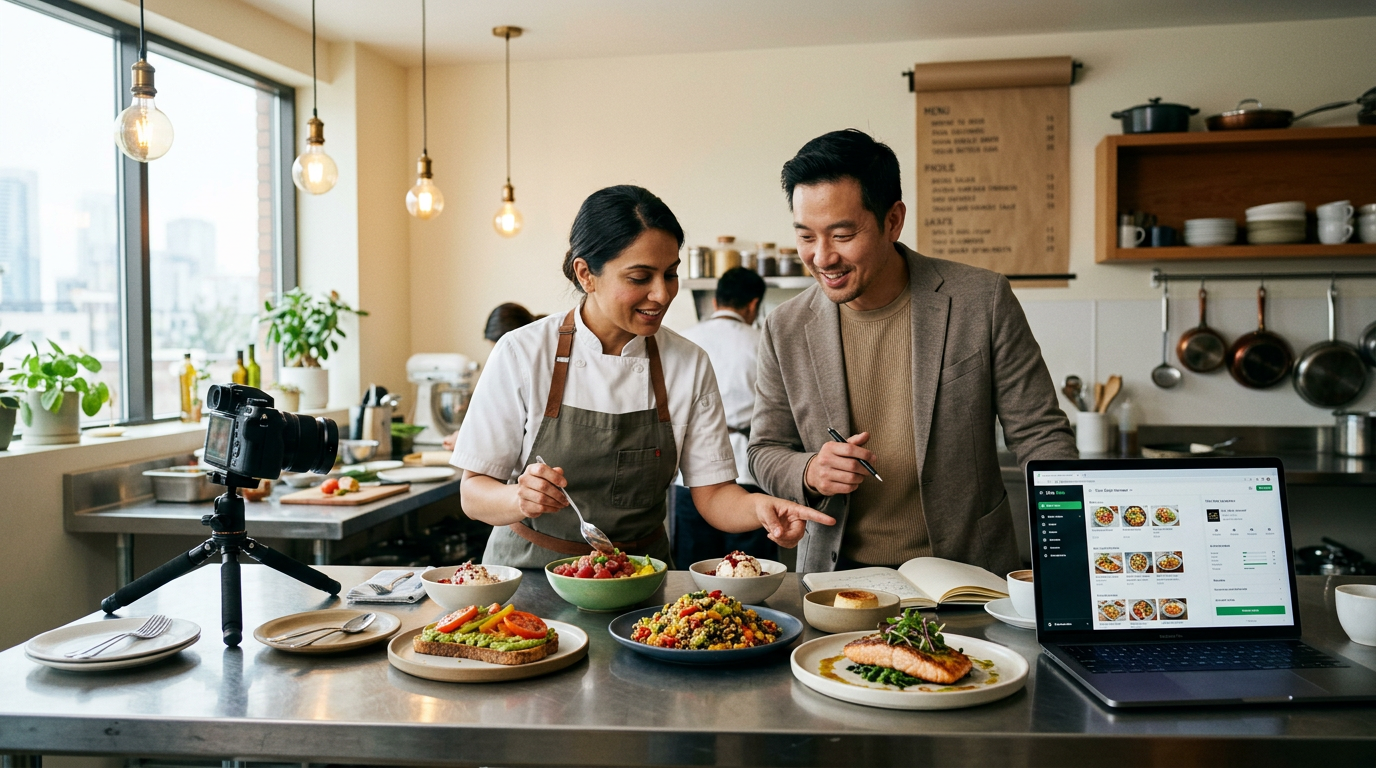
Food Photography That Converts
In the digital marketplace where customers cannot smell or taste your food, photography is your most powerful selling tool. Professional food photography that communicates quality, appetite appeal, and brand positioning directly impacts conversion rates—how many people who view your menu proceed to place orders.
Invest in professional food photography that showcases menu items in their delivery-ready form, presented as customers will receive them. This authenticity builds trust and reduces the disappointment gap between expectation and reality that leads to negative reviews.
Beyond hero shots, maintain consistent visual branding across all platform listings, social media, and marketing materials. Visual consistency builds brand recognition and professional perception.
First 30 Days Marketing Playbook
The first month of operations establishes patterns that influence long-term success. Your marketing playbook should prioritize activities that build initial customer base while establishing positive review momentum.
In-platform marketing—optimized menu descriptions, promotional offers, and featured placement requests—should begin immediately. Many platforms offer new vendor promotional placement that provides valuable initial visibility.
Off-platform marketing through social media, local community groups, and targeted digital advertising expands reach beyond platform users. Encourage first-time
Related Reading
- Ghost Kitchen Guide 2026
- 7 Cloud Kitchen Business Models
- Ghost Kitchen Technology Stack
- Dark Kitchen vs Ghost Kitchen vs Cloud Kitchen
- AI Menu Pricing Strategy
- Best AI Tools for Chefs 2026
Discover more from AI Chef Pro Blog
Subscribe to get the latest posts sent to your email.