The commercial kitchen landscape is undergoing a transformation unlike anything we’ve witnessed since the advent of stainless steel. The smart kitchen market is projected to reach $3.21 billion by 2033, growing at a compound annual growth rate (CAGR) of 12.4% according to industry analysts. This isn’t a distant vision of the future—it’s happening right now in kitchens across the globe, and the operators who embrace these technologies are pulling ahead of the competition at an unprecedented pace.
Consider this striking statistic: 73% of restaurant operators are currently investing in artificial intelligence and smart kitchen technologies, according to the National Restaurant Association’s 2026 Industry Outlook Report. These aren’t just large chains with massive capital budgets—mid-size operations, fast-casual concepts, and even emerging brands are leveraging intelligent systems to optimize every aspect of their back-of-house operations. From predictive inventory management that eliminates over-ordering to AI-powered cooking assistance that ensures consistent quality across every shift, the technology exists today to transform your kitchen into a connected, data-driven operation.
This comprehensive guide is designed specifically for commercial kitchen operators, executive chefs, and restaurant owners who want to understand not just what smart kitchen technology is, but how to implement it strategically for measurable return on investment. Whether you’re operating a 50-seat bistro or a 300-seat hotel banquet kitchen, the principles and technologies covered here will help you make informed decisions about where to invest, what to prioritize, and how to future-proof your operation against an industry that’s evolving faster than ever before. Let’s begin by establishing a clear understanding of what smart kitchen technology actually means in the commercial context.
Your Kitchen Deserves Smarter Tools
AI Chef Pro offers 55+ AI-powered tools built specifically for commercial kitchens — from demand forecasting to recipe scaling. Start free.
What Is Smart Kitchen Technology?
Smart kitchen technology refers to the integration of internet-connected devices, sensors, artificial intelligence, and cloud-based software platforms to automate, monitor, optimize, and control the various functions within a commercial kitchen environment. At its core, it represents the convergence of culinary equipment with digital intelligence—transforming traditional “dumb” appliances into connected systems that can communicate, analyze data, and make autonomous decisions to improve operational efficiency.
To understand this fully, we must first clarify the distinction between consumer-grade smart kitchens and their commercial counterparts. When a home cook purchases a smart refrigerator that can display recipes or order groceries, they’re engaging with consumer IoT (Internet of Things) technology designed for convenience and individual use. These devices operate on consumer networks, have limited data processing capabilities, and are built for environments with minimal operational complexity.
Commercial smart kitchen technology, by contrast, is engineered for the demanding, high-volume environment of professional foodservice. We’re talking about equipment that must operate continuously for 12-18 hours per day, maintain precise temperature tolerances across thousands of cooking cycles, integrate seamlessly with point-of-sale systems, inventory management platforms, and enterprise resource planning software, all while generating the data streams that operators need to make strategic decisions. The stakes are fundamentally different—a temperature deviation in a commercial walk-in cooler doesn’t just mean spoiled milk; it can mean thousands of dollars in product loss, potential health code violations, and reputational damage.
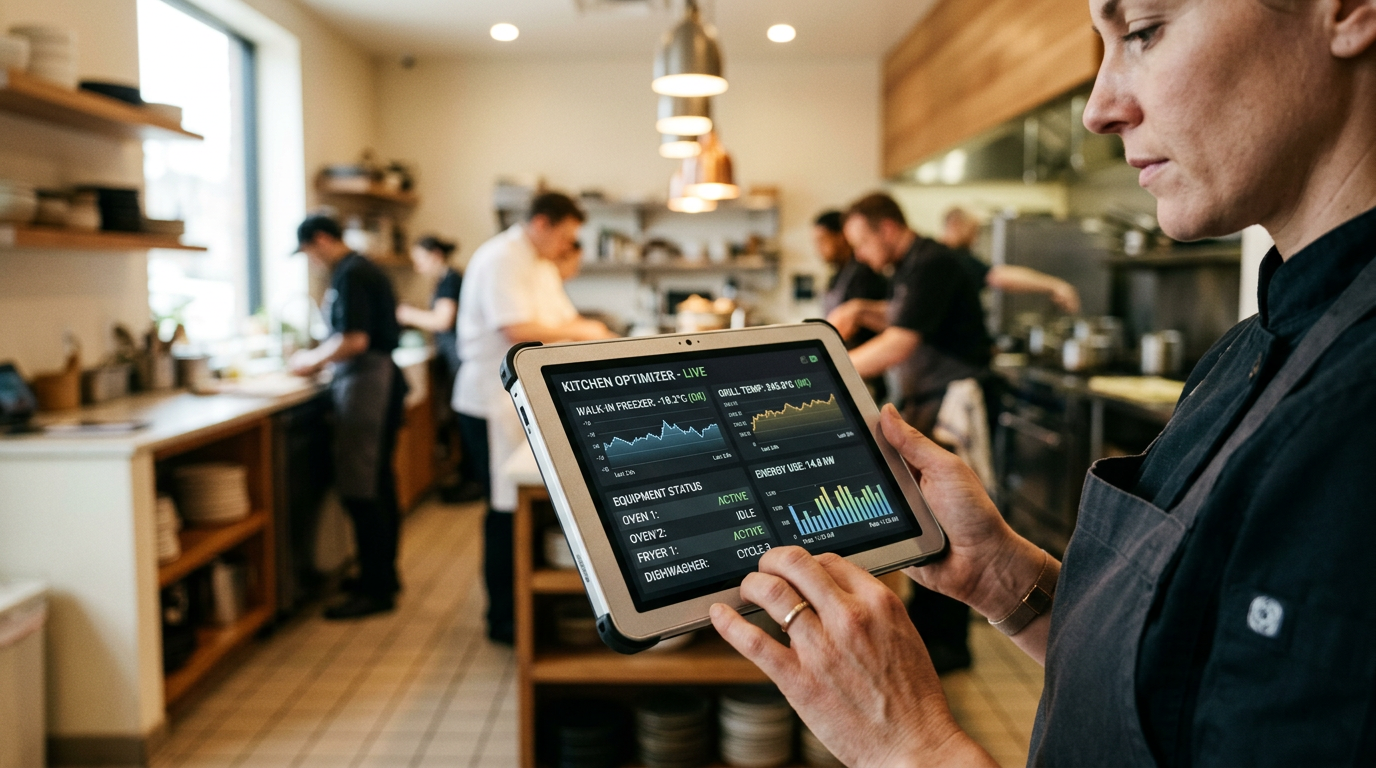
The connected kitchen ecosystem concept is perhaps the most important framework for understanding smart kitchen technology. Rather than viewing individual “smart” appliances as standalone purchases, the ecosystem approach considers how all these devices, sensors, and software platforms work together as an integrated whole. In a fully realized connected kitchen, a smart combi oven detects that a batch of roast chicken is cooking slightly faster than expected due to variations in fresh product temperature; it automatically adjusts cooking time and communicates with the kitchen display system (KDS) to update the ticket time for the corresponding table; simultaneously, it logs the production data to the inventory system, which calculates that another case of chicken will need to be ordered based on current sales velocity and predicted demand from the POS integration.
This level of integration represents the true promise of smart kitchen technology—not isolated automation, but a holistic operating system for the commercial kitchen that connects every function, optimizes every process, and generates the insights operators need to run profitable, efficient, and consistent operations.
The Business Case for Smart Kitchen Technology
For many operators, the decision to invest in smart kitchen technology comes down to one question: what’s the return on investment? The answer, supported by mounting evidence from operators across the industry, is increasingly compelling. Smart kitchen technology isn’t just about operational convenience—it’s about measurable, significant improvements to the bottom line across multiple key performance indicators.
Food waste represents one of the largest controllable costs in any commercial kitchen operation, typically accounting for 4-10% of total food purchases. Smart kitchen technology, particularly when combined with predictive analytics and inventory management systems, has demonstrated the ability to reduce this figure by 40% or more. How? By analyzing historical sales data, factoring in external variables like weather, local events, and day of the week, smart systems can predict demand with remarkable accuracy—allowing kitchens to prep precisely what’s needed, no more. When integrated with connected storage monitoring, operators receive real-time alerts about product shelf life, enabling them to prioritize ingredients approaching their use-by dates before they become waste. For a mid-size restaurant operation with $500,000 in annual food purchases, a 40% reduction in waste represents $20,000 to $50,000 in annual savings—a figure that compounds significantly over time.
Labor costs, which typically represent 30-35% of revenue in full-service restaurants, present another substantial opportunity for optimization. Smart kitchen technology enables 25% lower labor costs through several mechanisms. Optimized scheduling algorithms analyze historical sales patterns, upcoming reservations, and even external factors to create staffing schedules that match labor to anticipated demand with precision. During production, smart equipment reduces the need for highly skilled artisans to monitor every detail of every cook—intelligent combi ovens maintain precise cooking parameters automatically, smart fryers adjust oil temperature based on load size and product type, and inventory systems tell prep teams exactly what needs to be prepared and when. This doesn’t mean replacing skilled cooks with machines; it means enabling your team to work more efficiently and eliminating the waste inherent in overstaffing during slow periods or understaffing during peaks.
Let’s work through a concrete ROI calculation for a mid-size restaurant operation to illustrate the financial potential. Consider a 120-seat full-service restaurant with average check of $45 and annual revenue of approximately $1.8 million:
- Food waste reduction (40%): Assuming a 6% baseline food cost ($108,000), a 40% reduction saves $43,200 annually
- Labor optimization (25% reduction in overtime/overstaffing): With labor at 32% of revenue ($576,000), a 25% reduction in excess labor costs represents approximately $25,000-40,000 in annual savings
- Energy savings: Smart equipment with induction cooking and heat recovery systems typically reduces utility costs by 15-25%, translating to $8,000-15,000 annually for most mid-size operations
- Equipment longevity: Predictive maintenance extends equipment life by 20-30% and reduces emergency repair costs by an estimated $5,000-10,000 annually
Total annual savings: approximately $81,000-108,000. Against an initial smart technology investment of $150,000-250,000 (depending on scope), most operators will see full ROI within 18-36 months, with ongoing annual savings thereafter. These figures don’t even account for the revenue opportunity costs of improved consistency, faster ticket times, and the ability to operate at higher capacity without proportional labor increases.
Energy savings from smart equipment deserve particular attention, both for their financial impact and their role in sustainability initiatives. Induction cooking systems, for example, are approximately 90% energy efficient compared to 40-50% for gas burners, with heat concentrated directly in the cookware rather than lost to the surrounding environment. Smart ventilation systems with demand-controlled exhaust adjust fan speed based on cooking activity, reducing HVAC loads significantly. Heat recovery systems capture waste heat from cooking equipment and refrigeration systems to preheat water or warm the kitchen space, further reducing utility consumption. Many jurisdictions now offer tax incentives, rebates, or expedited permitting for operations that can demonstrate investment in energy-efficient commercial kitchen equipment—a financial benefit that stacks on top of ongoing utility savings.
Essential Smart Kitchen Equipment for Commercial Kitchens
Understanding the strategic benefits of smart kitchen technology is only half the battle. Operators need concrete guidance on which specific equipment categories and brands deserve investment. The following sections examine the essential smart kitchen equipment categories that form the foundation of a connected commercial kitchen, with specific features, benefits, and price ranges to inform purchasing decisions.
Smart Combi Ovens
The smart combi oven represents perhaps the most significant single investment a commercial kitchen can make in smart technology—and for good reason. As the workhorse of virtually any professional kitchen, the combi oven’s ability to roast, steam, bake, and grill makes it indispensable. Adding intelligence to this core piece of equipment multiplies its value exponentially.
Leading the market are manufacturers like Rational, with their iVario Pro and iCombi Pro lines, and Alto-Shaam with their vector series. These aren’t merely convection ovens with steam injection—they’re fully programmable cooking systems with internal sensors, cloud connectivity, and AI-driven cooking intelligence.
Key features and benefits:
- Intelligent climate control: Smart combi ovens maintain precise temperature and humidity levels (±1°F/0.5°C accuracy), automatically adjusting steam injection and fan speed based on load size and food type
- Connected cooking programs: Cloud-based recipe libraries with thousands of proprietary cooking profiles ensure consistent results regardless of operator experience level
- Self-cleaning systems: Automated cleaning cycles with intelligent detergent dosing reduce labor and chemical costs while ensuring compliance
- Production planning integration: Smart ovens can receive cooking schedules from inventory and prep management systems, automatically initiating preheat and staging cook cycles to align with anticipated demand
- Energy optimization: Advanced heat recovery and intelligent power management reduce energy consumption by 10-20% compared to previous-generation equipment
Price range: Smart combi ovens represent significant capital investment, with prices ranging from $18,000-45,000 for full-size (6-10 sheet pan capacity) units from major manufacturers. Countertop and half-size options start around $8,000-15,000. While premium pricing compared to traditional combi ovens (which typically run $10,000-25,000), the ROI from reduced labor, consistent quality, and energy savings typically justifies the investment within 18-24 months for high-volume operations.
Smart Refrigeration Systems
Walk-in coolers and freezers have long been among the most underperforming assets in commercial kitchens from a technology perspective—until recently. Smart refrigeration systems now integrate dense networks of IoT sensors, cloud monitoring platforms, and automated alerting to transform cold storage from a passive necessity into an active component of food safety and inventory management.
Systems from manufacturers like True Refrigeration, Perlick, and Beverage-Air now offer connected monitoring capabilities, while specialized IoT providers like Lyngsoe Systems and ColdChain Technologies offer retrofit solutions that can be installed on existing equipment.
Key features and benefits:
- Real-time temperature monitoring: Multi-point sensor arrays throughout walk-in units provide continuous temperature data with ±0.5°F accuracy, identifying hot spots and cold spots that single-probe monitoring misses
- Automated alerting: Instant notifications via SMS, email, or app when temperatures deviate from set parameters—even before they reach dangerous levels
- Door ajar detection: Sensors that detect and alert when walk-in doors remain open, preventing temperature spikes and product loss
- Compressor performance monitoring: Smart systems track compressor cycles, run times, and efficiency metrics, identifying potential failures before they cause product loss
- Inventory integration: Some systems integrate with inventory management platforms, enabling real-time visibility into stock levels and automated par level adjustments
Price range: New smart refrigeration units from major manufacturers typically cost 15-30% premium over standard equipment. A new 8’x10′ walk-in cooler with full IoT integration runs approximately $12,000-18,000. Retrofit monitoring systems from IoT providers, which include sensors, gateway hardware, and cloud platform subscriptions, typically cost $500-2,000 per unit depending on features, with monthly software subscriptions of $25-75 per month.
Induction Cooking Systems
Induction cooking has transitioned from a novelty reserved for boutique operations to a mainstream technology that major chains are adopting at scale. The technology uses electromagnetic fields to heat cookware directly, rather than heating the burner surface, resulting in dramatically faster heat-up times, superior temperature control, and significantly reduced energy waste.
Leading manufacturers in the commercial induction space include Vollrath, CookTek, and True Induction, with major kitchen equipment manufacturers like Duke and Southbend offering integrated induction options.
Key features and benefits:
- Precision temperature control: Induction ranges maintain temperature within ±1°F of setpoint, enabling techniques like sous vide, delicate sauces, and precise tempering that are difficult to achieve with gas
- Rapid heat response: Induction cooktops reach full power almost instantaneously, with boil times 50-60% faster than equivalent gas burners
- Energy efficiency: 90%+ energy transfer compared to 40-50% for gas, meaning dramatically lower utility costs and cooler kitchen environments
- Safety features: No open flame, automatic shut-off when cookware is removed, cool-to-touch surfaces, and no combustion byproducts
- Smart programming: Advanced units offer programmable cooking sequences, temperature ramping, and integration with recipe management systems
Price range: Commercial induction ranges and cooktops range from $1,500-8,000 per burner or unit depending on power output and features. A two-burner counter-top induction range suitable for à la carte cooking runs approximately $1,200-2,500. Full-size induction ranges with multiple burners and oven compartments start around $6,000-15,000. While the upfront cost exceeds comparable gas equipment, the energy savings, reduced ventilation requirements (many jurisdictions allow reduced exhaust hood sizing for induction), and precise cooking control deliver strong ROI for high-volume operations.
Smart Fryers and Grills
Deep frying and grilling represent two of the most technique-dependent cooking methods in the commercial kitchen—precisely the areas where smart technology delivers enormous value. Intelligent fryers and grills automate the variables that traditionally required experienced cooks to master, enabling consistent results from less skilled operators while optimizing consumption of expensive cooking media.
Smart fryer manufacturers include Frymaster (a Part of Illinois Tool Works), Henny Penny, and Pitco, while grill technology leaders include Alto-Shaam, Star Manufacturing, and the Taylor Company.
Key features and benefits:
- Automatic oil temperature control: Smart fryers adjust oil temperature based on load size, product type, and recovery time requirements, ensuring consistent cooking without operator intervention
- Oil life management: Intelligent systems monitor oil quality through conductivity, Total Polar Materials (TPM) measurement, and usage patterns, alerting operators when oil should be changed and optimizing oil life between changes (typically extending use by 30-50%)
- Production tracking: Smart fryers log production data—batches cooked, cook times, oil temperature curves—providing data for yield analysis and cost control
- Smart grill surfaces: Infrared and contact sensors on smart grills monitor surface temperature in multiple zones, automatically adjusting heat output to maintain consistent cooking temperatures regardless of product load
- Cook detection: Advanced systems can detect when product is placed on the grill and automatically initiate cooking programs
Price range: Smart commercial fryers range from $3,500-12,000 per vat depending on capacity and intelligence features. A 50-lb. vat smart fryer with oil management and cloud connectivity runs approximately $5,000-8,000. Smart grills with temperature monitoring and zone control range from $4,000-20,000 or more for larger configurations. The oil savings alone—typically $500-1,500 per fryer annually—often justify the premium within the first year of operation.
Smart Dishwashers
Commercial dishwashing represents one of the most labor-intensive and resource-heavy operations in any kitchen. Smart dishwashers address both challenges through intelligent cycle control, chemical management, and water/energy optimization. Leading manufacturers including Hobart, Jackson, and Meiko offer connected dishwasher systems with varying levels of intelligence.
Key features and benefits:
- Load-sensing technology: Smart dishwashers detect load size and soil levels, automatically adjusting water volume, wash time, and chemical dosing accordingly
Kitchen Automation and Robotics
The emergence of commercial kitchen robotics represents perhaps the most significant shift in how back-of-house operations function since the advent of the commercial stove. Smart kitchen technology commercial implementations now routinely include robotic systems capable of handling repetitive, physically demanding tasks that previously required dedicated human labor.
Robotic Cooking Systems
The landscape of robotic cooking has evolved dramatically, moving from novelty demonstrations to production-ready systems deployed in real commercial environments.
Miso Robotics Flippy has become the poster child for kitchen robotics, with its AI-powered robotic arm designed specifically for fry station operations. Flippy can operate continuously without breaks, maintain consistent oil temperature, and execute predictable cooking times that reduce product waste. Several major quick-service chains have integrated Flippy units into their workflows, reporting consistent quality improvements and reduced labor burden on repetitive tasks.
Spyce Robotics took a more ambitious approach, developing an entire robotic kitchen capable of producing up to 350 meals per hour from a compact footprint. Their system uses automated cooking bowls with precise temperature control, ingredient dispensing, and finishing mechanisms. While initially focused on grain bowls and similar format meals, Spyce demonstrated that robotic kitchens could achieve throughput numbers previously impossible in traditional layouts.When evaluating robotic cooking systems, operators should consider:
- Task specificity: Robots excel at highly repetitive tasks with consistent inputs. Grilling burgers, frying chicken, or assembling salads where ingredients follow predictable patterns offer the clearest ROI
- Menu compatibility: Robotic systems work best with menu items that don’t require complex hand-finishing or creative presentation
- Integration requirements: Most robotic cooking systems require dedicated space, specific utility connections, and integration with existing POS and KDS systems
Automated Prep Systems
Beyond cooking, significant advances have occurred in automated preparation equipment that handles the labor-intensive prep work fundamental to commercial kitchen operations.
Vegetable cutting and processing has seen substantial automation. High-volume operations now deploy equipment capable of slicing, dicing, julienning, and rip-cutting vegetables at rates exceeding what manual labor can achieve consistently. These systems integrate with inventory management platforms to automatically deduct prepared items from inventory counts.
Automated portioning equipment ensures consistent protein weights, reducing food costs while eliminating the variability inherent in manual portioning. Integrated scales and vision systems can sort and portion with tolerances of ±2 grams, translating directly to bottom-line improvements in food cost percentages.Robotic Dishwashing
Full dishwasher automation represents another frontier, with several manufacturers offering systems that automatically load, wash, sanitize, and stack dishes. These systems address one of the most labor-intensive positions in commercial kitchens while improving throughput consistency.
When Automation Makes Sense vs. When Human Touch Is Essential
Understanding the balance between automation and human intervention separates successful implementations from expensive experiments that gather dust in corners.
Automation makes sense when:
- Tasks are highly repetitive with minimal variation
- Physical demands create ergonomic concerns or injury risk
- Consistency directly impacts quality or cost
- Labor availability is constrained
- Throughput requirements exceed reasonable human capacity
Human touch remains essential when:
- Menu items require creative plating or presentation
- Recipes call for subjective timing based on visual cues
- Customer modifications and special requests are frequent
- Problem-solving and improvisation are regularly required
- Building rapport with team members drives culture
The most successful commercial kitchen automation strategies position robotics as tools that enhance human capability rather than replace human judgment entirely.
AI-Powered Kitchen Management
Artificial intelligence extends far beyond robotics, offering sophisticated management capabilities that transform how operators make decisions about purchasing, staffing, menu development, and daily operations.
Demand Forecasting and Predictive Ordering
AI-powered demand forecasting represents one of the highest-ROI applications of artificial intelligence in commercial kitchens. These systems analyze historical sales data, weather patterns, local events, seasonal trends, day-of-week patterns, and even social media activity to predict customer demand with remarkable accuracy.
Predictive ordering extends this capability by automatically generating purchase orders based on forecasted demand, current inventory levels, and vendor lead times. Operators report reductions in food waste of 15-30% simply by ordering more accurately, while simultaneously reducing stockouts that frustrate customers and harm reputation.
AI Recipe Scaling for Different Covers
When operations need to scale recipes from 50 covers to 500 for a special event, AI-powered recipe scaling ensures consistency and accuracy. These systems automatically adjust ingredient quantities while accounting for equipment constraints and timing modifications.
For operators managing multiple locations or frequently adjusting covers for events, our AI Recipe Scaling Guide provides detailed methodologies for maintaining quality at scale.
Staff Scheduling Optimization
Labor costs typically represent the largest expense in commercial kitchen operations, making efficient scheduling critical to profitability. AI scheduling systems analyze historical sales data, predicted demand, and staff availability to generate optimized schedules that match labor to anticipated workload.
Operators implementing AI scheduling report 25% lower labor costs through reduced overstaffing during slow periods while maintaining adequate coverage during peak times. These systems also account for labor law constraints, overtime rules, and staff preferences, generating schedules that satisfy both operational and regulatory requirements.
Menu Engineering with AI
Menu engineering—the science of designing menus to maximize profitability and guide customer choices—has been transformed by artificial intelligence. AI-powered restaurant kitchen technology platforms analyze sales data, plate costs, prep times, and customer preferences to identify optimal menu positioning.
These systems can model how price changes impact demand, which items to promote as anchors versus stars, and how menu layout influences selection patterns. The AI Menu Engineering Software guide explores these capabilities in depth for operators looking to optimize their menu strategy.
AI Chef Pro: Comprehensive Kitchen Intelligence
For operators seeking an integrated approach to AI-powered kitchen management, AI Chef Pro offers a suite of over 55 AI tools specifically designed for commercial kitchen operations. From demand forecasting and inventory optimization to staff scheduling and recipe development, the platform provides unified intelligence that connects disparate kitchen functions.
The platform’s free tier allows operators to explore capabilities with 10 uses monthly, while paid plans unlock full automation and integration features. This comprehensive approach addresses the fragmentation that often occurs when operators piece together multiple point solutions for different kitchen functions.
Running Your Kitchen on Gut Feeling?
Let AI handle demand forecasting, recipe scaling, and menu engineering while you focus on creating great food. Plans from €25/month.
Implementation Roadmap — 4 Phases
Implementing smart kitchen technology commercial systems requires a structured approach that builds momentum while managing risk. The following roadmap provides a practical timeline for operators regardless of operation size.
Phase 1: Audit and Assessment (Months 1-2)
The foundation of successful implementation begins with honest assessment of current operations and clear identification of pain points.
Activities during Phase 1:
- Document current workflows for all kitchen stations
- Identify bottlenecks, quality inconsistencies, and labor challenges
- Audit current equipment condition and compatibility with smart technologies
- Assess staff technological comfort and training needs
- Define success metrics for each implementation phase
- Establish baseline measurements for comparison
Budget guidance for Phase 1:
- Small operations (under $500K annual revenue): $0-2,000 — primarily staff time for documentation
- Mid-size operations ($500K-2M): $2,000-8,000 — may include consultant assessment
- Large operations ($2M+): $8,000-25,000 — comprehensive operational audit with technology assessment
Phase 2: Quick Wins (Months 3-4)
With clear understanding of priorities, Phase 2 focuses on implementations that deliver immediate, visible value while building organizational confidence in smart kitchen technology.
Recommended quick wins:
- Kitchen Display Systems (KDS): Replace paper tickets with digital displays that improve ticket accuracy and reduce wait times
- Temperature monitoring: Deploy IoT temperature sensors for walk-ins, coolers, and hot holding equipment with automated alerts
- POS integration: Ensure existing POS communicates effectively with prep stations and kitchen workflow
These implementations typically require minimal staff training while delivering measurable improvements in operational efficiency and food safety compliance.
Budget guidance for Phase 2:
- Small operations: $3,000-10,000
- Mid-size operations: $10,000-35,000
- Large operations: $35,000-100,000
Phase 3: Core Automation (Months 5-8)
With foundational systems in place, Phase 3 introduces more sophisticated automation that transforms kitchen operations.
Core automation implementations:
- Smart ovens and cooking equipment: Invest in combi ovens, convection ovens, and cooking equipment with IoT connectivity and automated programming
- Inventory AI: Deploy artificial intelligence for inventory tracking, par-level management, and predictive ordering
- Demand forecasting: Implement AI-powered forecasting that integrates with purchasing and scheduling
- Energy management: Smart utility monitoring that identifies waste and optimizes consumption
Budget guidance for Phase 3:
- Small operations: $15,000-50,000
- Mid-size operations: $50,000-150,000
- Large operations: $150,000-500,000
Phase 4: Full Integration (Months 9-12)
The final phase brings all systems together into a unified intelligent kitchen ecosystem.
Advanced implementations:
- Robotics integration: Deploy robotic equipment for identified high-ROI applications
- Predictive maintenance: AI systems that predict equipment failure before it occurs
- Unified dashboard: Single-pane-of-glass visibility across all kitchen operations
- Advanced analytics: Comprehensive reporting that connects operational data to financial performance
Budget guidance for Phase 4:
- Small operations: $25,000-100,000
- Mid-size operations: $100,000-300,000
- Large operations: $300,000-1,500,000+
This phased approach allows operators to realize benefits early while managing the organizational change that technology transformation requires.

Smart combi ovens with touchscreen controls and cloud connectivity deliver consistent results across every shift. Common Pitfalls to Avoid
The path to smart kitchen implementation is littered with cautionary tales. Understanding common mistakes helps operators avoid costly errors.
Over-Automating Too Fast
The enthusiasm surrounding kitchen robotics and AI capabilities leads some operators to implement too much, too quickly. When systems exceed organizational capacity to absorb change, staff resistance increases, utilization drops, and expected returns fail to materialize.
Recommendation: Follow the phased implementation roadmap and ensure each phase delivers measurable value before advancing.
Ignoring Staff Training
Sophisticated equipment becomes useless without staff capable of operating it effectively. Training often receives insufficient budget and time allocation, leaving expensive technology underutilized or improperly used.
Recommendation: Budget 15-20% of technology implementation costs for comprehensive training, with ongoing refresher programs.
Choosing Incompatible Systems
The excitement of acquiring individual smart devices often leads to a fragmented technology landscape where systems cannot communicate effectively. Data trapped in siloed systems provides limited value.
Recommendation: Before purchasing any technology, verify integration capabilities with existing systems and planned future purchases. Prioritize platforms with robust APIs and established integration partnerships.
Neglecting Cybersecurity
Connected kitchen equipment creates potential vulnerability points for cyber attacks. Restaurant chains have experienced ransomware attacks that crippled operations, while data breaches involving customer information carry substantial financial and reputational consequences.
Recommendation: Implement network segmentation that separates kitchen IoT systems from financial and customer data systems. Require strong authentication for all connected devices. Partner with vendors who prioritize security in their development processes.
Not Measuring ROI
Implementing technology without clear metrics for success makes it impossible to evaluate whether investments delivered expected value. This oversight often results from inadequate baseline measurement before implementation.
Recommendation: Establish clear KPIs before each implementation, measure baseline performance, and track results systematically. This documentation supports both ongoing optimization and future technology investment decisions.
Frequently Asked Questions
How much does smart kitchen technology cost for a small restaurant?
For small operations (under $500K annual revenue), a complete smart kitchen implementation typically ranges from $45,000 to $165,000 over 12 months, depending on scope. However, operators can begin with quick wins in the $3,000-10,000 range and expand gradually. Many technology providers offer leasing options that spread costs over time, making advanced capabilities accessible without large capital outlays.
What is the typical ROI timeline for smart kitchen technology?
ROI timelines vary by technology type. Quick wins like KDS systems and temperature monitoring often deliver returns within 6-12 months through improved efficiency and waste reduction. AI-powered demand forecasting and inventory systems typically show returns within 12-18 months. Kitchen robotics implementations generally require 18-36 months to achieve payback, though labor savings and consistency improvements can accelerate returns in high-volume operations.
Is smart kitchen technology viable for small restaurants?
Absolutely. Small restaurants often benefit disproportionately from smart technology because they have less capacity to absorb inefficiencies. Cloud-based solutions and as-a-service pricing models have eliminated the capital requirements that previously reserved advanced technology for large chains. Small operations can start with targeted implementations—perhaps demand forecasting combined with inventory management—then expand as benefits materialize.
How do I handle staff resistance to new technology?
Staff resistance typically stems from fear of job displacement or anxiety about learning new systems. Address these concerns directly by emphasizing how technology makes their jobs easier rather than replacing them. Involve team members in technology selection and implementation planning—staff often identify practical issues that managers miss. Provide comprehensive training with adequate time for practice before go-live, and celebrate early successes to build confidence in the new systems.
What cybersecurity measures should I implement for connected kitchen systems?
Essential cybersecurity measures include: network segmentation that isolates IoT devices from critical business systems; strong, unique passwords for all connected equipment; regular firmware updates from equipment manufacturers; employee training on recognizing phishing and social engineering attempts; vendor contracts that specify security responsibilities; and incident response plans specific to kitchen technology failures. Consider working with a cybersecurity professional to audit your kitchen technology infrastructure.
What is the best first investment in smart kitchen technology?
For most operations, a Kitchen Display System (KDS) delivers the best combination of immediate impact, manageable cost, and relatively simple implementation. KDS reduces ticket errors, improves communication between front and back of house, provides valuable data on station performance, and creates a foundation for further technology integration. Temperature monitoring represents another excellent first investment, particularly for operations that have experienced food safety challenges.
How does AI kitchen management improve profitability?
AI kitchen management improves profitability through multiple channels: reduced food waste through accurate demand forecasting and predictive ordering (typically 15-30% reduction); optimized labor scheduling that matches staffing to predicted demand (20-30% labor cost reduction); improved menu profitability through data-driven menu engineering; reduced equipment downtime through predictive maintenance; and enhanced consistency that improves customer satisfaction and repeat business. The combined impact often moves net margins by 3-8 percentage points.
Ready to Build a Smarter Kitchen?
Join hospitality professionals worldwide using AI Chef Pro to cut waste, optimize labor, and boost profits. Free tier available — no credit card required.
The Future of Commercial Kitchens Is Smart
The transformation of commercial kitchens through smart technology is not a distant vision—it is happening now, at every scale of operation, across every segment of the foodservice industry.
The operators who will thrive in the coming years are those who approach this transformation strategically, implementing technology that addresses genuine operational challenges while building organizational capability for continued evolution. The phased approach outlined in this guide provides a practical framework for managing this transformation without overwhelming resources or staff.
Smart kitchen technology commercial applications have moved beyond early-adopter experiments to proven, measurable implementations that deliver genuine competitive advantage. Whether through robotics handling repetitive prep tasks, AI optimizing purchasing and staffing decisions, or integrated systems providing unprecedented visibility into operations, the tools exist today to transform how commercial kitchens function.
The key is beginning—identifying those initial pain points where technology can deliver immediate value, implementing those quick wins successfully, and building momentum toward more comprehensive transformation.
For operators seeking a comprehensive platform to power their smart kitchen journey, AI Chef Pro offers the most extensive suite of AI tools specifically designed for commercial kitchen operations. With over 55 specialized tools covering every aspect of kitchen management—from demand forecasting and inventory optimization to recipe development and menu engineering—the platform provides unified intelligence that connects disparate functions into a coherent whole.
New
Related Reading
- AI Recipe Scaling: How to Scale Any Recipe Perfectly
- AI Menu Engineering Software: The Complete Guide
- AI Food Cost Calculator: Reduce Costs Instantly
- Best AI Tools for Chefs in 2026
- AI Menu Pricing Strategy: Data-Driven Pricing for Restaurants
- Restaurant Profit Margin Calculator
Discover more from AI Chef Pro Blog
Subscribe to get the latest posts sent to your email.