
Need Help Building Your Cloud Kitchen Menu?
AI Chef Pro offers 55+ AI tools for recipe development, food cost analysis, and menu optimization — perfect for cloud kitchen operators launching multiple brands.
Introduction: The Cloud Kitchen Revolution
The foodservice industry is undergoing a massive transformation, and at the heart of this revolution lies one concept that has completely changed how entrepreneurs approach restaurant businesses: the cloud kitchen. With the global cloud kitchen market projected to reach $74.6 billion by 2030, growing at a compound annual growth rate (CAGR) of approximately 12.5% from its current valuation, the opportunity for aspiring food entrepreneurs has never been more accessible.
This explosive growth represents more than just numbers—it signals a fundamental shift in consumer behavior, operational efficiency, and entrepreneurial possibilities. Traditional restaurant models require substantial capital investments, long-term leases, and significant operational overhead. Cloud kitchens, by contrast, offer a streamlined approach that eliminates many of these barriers while maximizing delivery radius and operational flexibility.
Whether you’re a seasoned chef looking to expand your reach, an entrepreneur seeking a low-overhead business opportunity, or an established restaurant brand wanting to diversify without the cost of additional brick-and-mortar locations, understanding the various cloud kitchen business models is essential to making an informed decision.
In this comprehensive guide, we’ll explore seven distinct cloud kitchen business models, examining the investment requirements, operational considerations, profit potential, and ideal candidates for each. By the end, you’ll have the knowledge necessary to choose the model that aligns with your goals, budget, and expertise.
What Is a Cloud Kitchen?
A cloud kitchen, also known as a virtual kitchen, ghost kitchen, or dark kitchen, is a commercial cooking facility designed exclusively for preparing food for delivery and takeout. Unlike traditional restaurants, cloud kitchens operate without a dine-in area, allowing operators to focus entirely on food production and fulfillment through third-party delivery platforms.
The cloud kitchen concept emerged from the convergence of several industry trends: the rise of food delivery apps like DoorDash, Uber Eats, and Grubhub; changing consumer preferences for convenience; and the need for restaurant operators to reduce overhead costs associated with traditional restaurant locations.
Key Characteristics of Cloud Kitchens
No Front-of-House: Perhaps the most defining characteristic is the absence of a dining room, bar, or traditional customer-facing area. This eliminates the need for front-of-house staff, decor, furniture, and the overhead associated with creating a pleasant dining environment.
Delivery-First Operations: Cloud kitchens are strategically located to optimize delivery times and coverage areas. Location decisions are based on demographic data, delivery radius optimization, and proximity to customer demand zones rather than foot traffic.
Lower Capital Requirements: Compared to traditional restaurants, cloud kitchens typically require 50-70% less initial investment. This makes them accessible to a broader range of entrepreneurs, including those with limited restaurant experience.
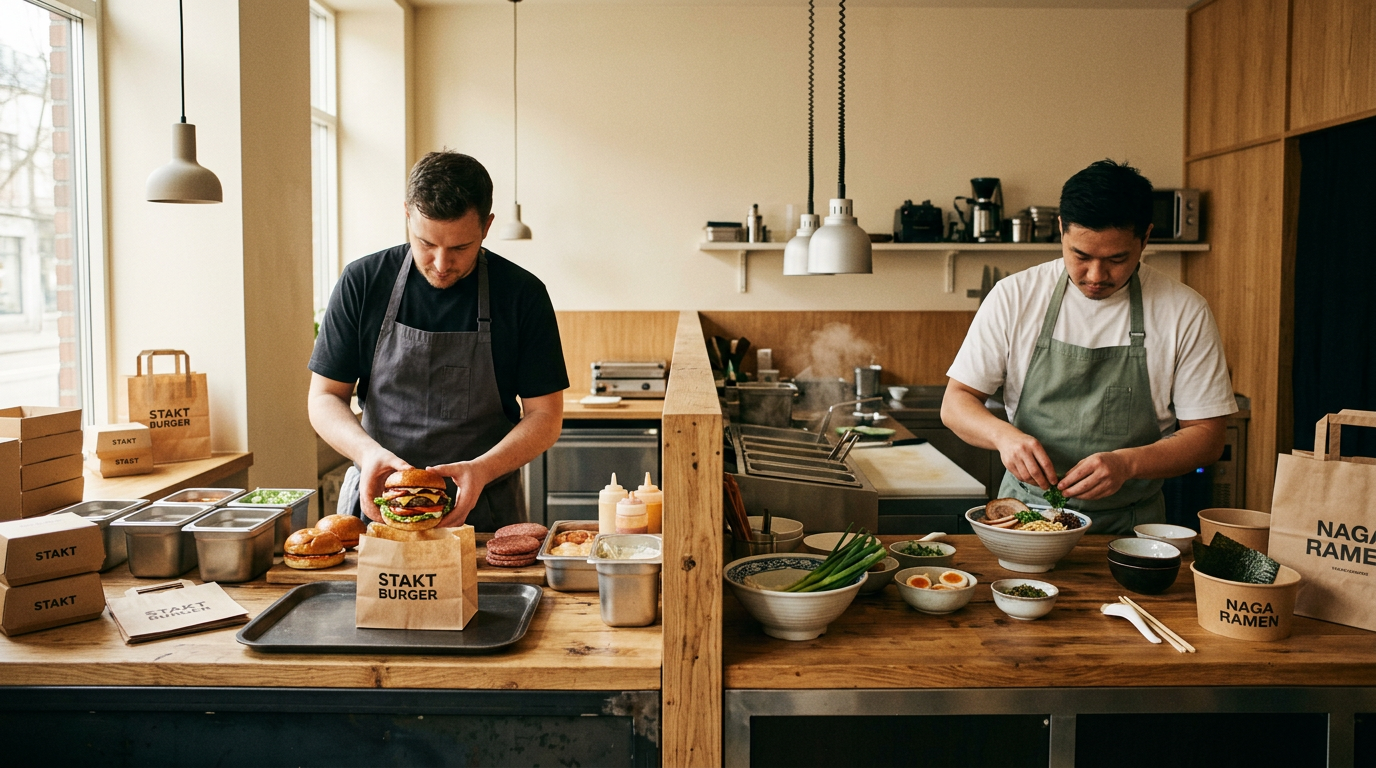
Operational Flexibility: Many cloud kitchen facilities allow operators to run multiple brands from a single kitchen, enabling menu diversification and risk mitigation without additional physical space.
Technology Integration: Cloud kitchens rely heavily on technology for order management, inventory control, and delivery coordination. Integration with multiple delivery platforms and point-of-sale systems is essential for operational efficiency.
Model 1: Single-Brand Cloud Kitchen
The single-brand cloud kitchen is the most straightforward entry point into the ghost kitchen industry. In this model, you operate one distinct restaurant brand from a dedicated kitchen space, focusing all your resources on building a recognizable menu and customer base for that single concept.
Startup Costs: $30,000 – $80,000
The initial investment for a single-brand cloud kitchen typically ranges from $30,000 to $80,000, depending on location, kitchen size, equipment needs, and brand development costs. This figure includes:
- Kitchen equipment: Commercial ovens, fryers, refrigeration, prep tables, and cooking utensils ($15,000-$35,000)
- Point-of-sale system: Technology infrastructure for order management ($2,000-$5,000)
- Initial inventory: Food supplies, packaging, and ingredients ($3,000-$8,000)
- Licensing and permits: Health permits, business licenses, and insurance ($2,000-$5,000)
- Branding and marketing: Logo design, menu photography, and initial marketing campaigns ($3,000-$7,000)
- Working capital: Funds to cover operations for the first 2-3 months ($5,000-$20,000)
Profit Margins: 15-20%
Single-brand cloud kitchens typically achieve profit margins of 15-20% once they reach operational maturity. These margins are influenced by several factors:
- Food costs: Typically 25-35% of revenue
- Labor costs: Generally 25-30% of revenue
- Platform fees: Delivery commissions of 15-30% per order
- Rent and utilities: Usually 10-15% of revenue
- Marketing: 5-10% of revenue for customer acquisition
The relatively healthy margins compared to traditional restaurants stem from lower overhead costs, reduced staffing needs, and optimized operational workflows focused on a single menu.
Pros of the Single-Brand Model
Focused Brand Identity: Operating a single brand allows you to develop a strong, recognizable identity in the market. Your marketing efforts, menu development, and customer experience all align around one cohesive concept, making it easier to build brand loyalty and recognition.
Simplified Operations: Managing one menu, one supplier relationship, and one brand strategy is considerably simpler than juggling multiple concepts. This simplicity translates to more efficient operations and easier staff training.
Easier Quality Control: With a focused menu, maintaining consistent quality becomes more manageable. Your kitchen team can perfect a smaller selection of dishes rather than spreading expertise across numerous menu items.
Lower Initial Investment: Compared to other cloud kitchen models, the single-brand approach requires the lowest capital outlay, making it accessible to first-time entrepreneurs and those with limited funding.
Direct Customer Relationships: Building a loyal customer base is more straightforward when you can direct all your attention to a single brand and its unique value proposition.
Cons of the Single-Brand Model
Limited Revenue Diversification: Relying on one brand means your success is tied to a single menu concept. If market preferences shift or your concept loses popularity, you have no other revenue streams to offset losses.
Smaller Addressable Market: A single brand typically appeals to a specific demographic or cuisine preference, limiting your potential customer base compared to multi-brand operations.
Slower Growth Trajectory: Building brand awareness and customer loyalty takes time. With only one concept, expanding your market presence requires organic growth or significant marketing investment.
Higher Risk Exposure: Any operational issue—food safety concern, negative review, or supply chain disruption—directly impacts your entire business without diversification protection.
Best For
The single-brand cloud kitchen model is ideal for:
- First-time restaurant entrepreneurs seeking a lower-risk entry point
- Established chefs wanting to test a specific concept before expanding
- Investors with limited capital who want to validate a restaurant concept
- Operators who prefer focused, manageable operations
- Those with a unique culinary concept that doesn’t require multiple brand variations
Model 2: Multi-Brand Cloud Kitchen
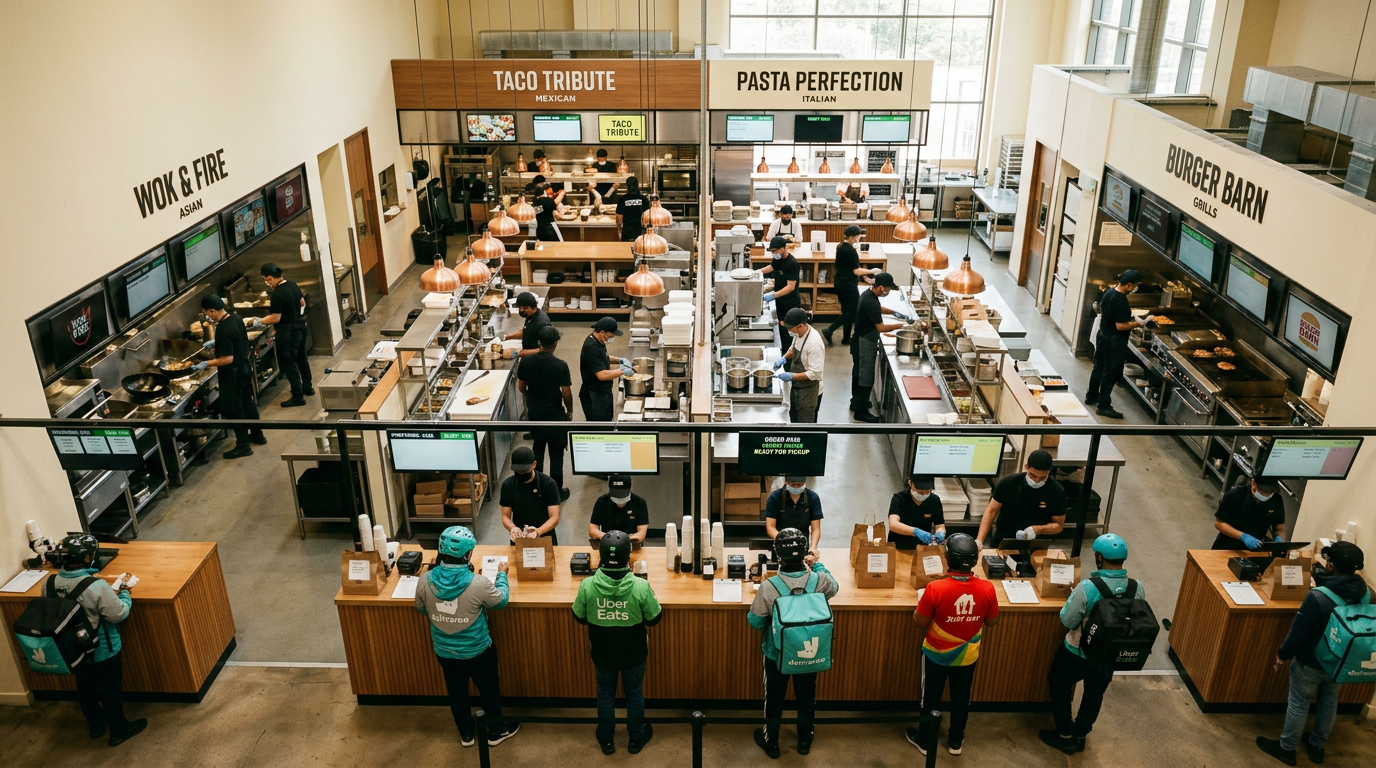
The multi-brand cloud kitchen model involves operating three to five distinct restaurant brands from a single kitchen facility. This approach maximizes the use of your kitchen space, equipment, and staff while diversifying your revenue streams and market reach.
Startup Costs: $50,000 – $120,000
The initial investment for a multi-brand cloud kitchen typically ranges from $50,000 to $120,000. While this represents a higher upfront cost than the single-brand model, the potential for increased revenue and risk mitigation often justifies the investment. The cost breakdown includes:
- Base kitchen infrastructure: Equipment and facility setup ($25,000-$50,000)
- Multiple brand development: Creating distinct brand identities, menus, and visual identities ($15,000-$30,000)
- Technology systems: Multi-brand POS and order management ($4,000-$10,000)
- Expanded inventory: Broader ingredient selection across multiple menus ($5,000-$12,000)
- Licensing and permits: Similar to single-brand, with potentially additional considerations ($3,000-$6,000)
- Working capital: Extended runway for multiple operations ($10,000-$25,000)
Profit Margins: Variable by Brand
Multi-brand operations can achieve overall profit margins of 15-25%, with significant variation between brands. Some concepts may generate 20%+ margins while others operate at 10-12%. The diversity allows operators to:
- Cross-subsidize struggling brands: Profits from successful brands can support underperforming concepts during development
- Optimize based on performance: Data-driven decisions about which brands to promote, modify, or discontinue
- Maximize equipment utilization: Different brands may require different cooking equipment, ensuring comprehensive use of your kitchen investment
Pros of the Multi-Brand Model
Revenue Diversification: Operating multiple brands significantly reduces risk by ensuring that poor performance from one concept doesn’t devastate your entire business. If one brand experiences challenges, others can compensate.
Increased Kitchen Utilization: A single kitchen operating three to five brands maximizes the use of your equipment, space, and staff. Peak production times may vary between brands, creating more consistent workflow throughout the day.
Broader Market Reach: Different brands can target different customer segments, cuisine preferences, and price points. This diversification expands your total addressable market and reduces dependence on any single demographic.
Operational Efficiencies: While managing multiple brands is more complex, certain efficiencies emerge—shared staff, consolidated purchasing, unified marketing infrastructure, and shared administrative functions.
Testing New Concepts: Multi-brand kitchens serve as excellent incubators for testing new concepts. If you have a new cuisine idea, you can launch it as an additional brand with minimal additional investment, gathering market data before committing fully.
Platform Leverage: Delivery platforms often offer reduced commission rates for operators with multiple brands or higher order volumes, improving your margin structure.
Cons of the Multi-Brand Model
Operational Complexity: Managing multiple menus, ingredient inventories, and brand identities simultaneously requires sophisticated operational systems and experienced management.
Higher Staff Requirements: You’ll likely need a larger, more versatile team capable of preparing diverse menu items across multiple brands.
Brand Dilution Risk: Spreading attention across multiple brands may result in none achieving full potential. Each brand requires dedicated marketing, quality control, and development effort.
Initial Capital Requirements: The startup costs are significantly higher than the single-brand model, requiring more capital or financing.
Supply Chain Complexity: Managing inventory for multiple brands with different ingredient requirements increases complexity and can lead to higher food costs if not managed efficiently.
Best For
The multi-brand cloud kitchen model is ideal for:
- Experienced restaurant operators looking to scale efficiently
- Entrepreneurs who want to test multiple concepts simultaneously
- Investors seeking to diversify risk while maintaining operational control
- Operators with experience in multiple cuisine types
- Those looking to create a “kitchen incubator” model for testing and launching new brands
Model 3: Hybrid Cloud Kitchen with Pickup
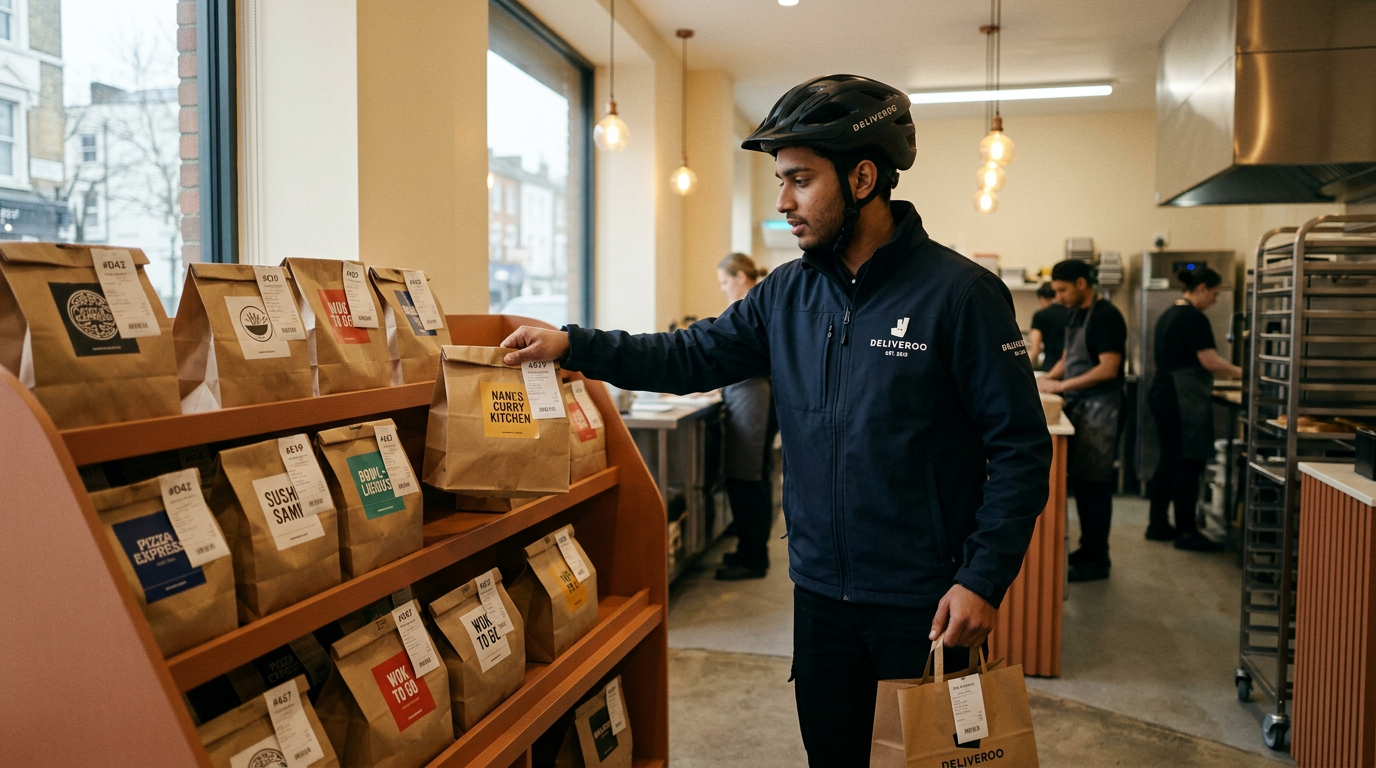
The hybrid cloud kitchen model incorporates a pickup counter or small walk-up window alongside the delivery-focused operations. This model bridges the gap between traditional restaurants and pure cloud kitchens, offering customers the option to order online for delivery or visit the location for pickup.
Startup Costs: $80,000 – $150,000
The hybrid model requires higher initial investment due to the addition of customer-facing infrastructure. Costs typically include:
- Kitchen equipment: Standard commercial kitchen setup ($25,000-$45,000)
- Pickup counter construction: Build-out of customer service area ($15,000-$35,000)
- POS system: Enhanced point-of-sale with pickup and delivery integration ($4,000-$8,000)
- Signage and branding: External signage to attract walk-up customers ($5,000-$12,000)
- Initial inventory and supplies: Similar to other models ($5,000-$10,000)
- Licensing and permits: May include additional requirements for customer access ($3,000-$7,000)
- Working capital: Extended runway for build-out period ($15,000-$35,000)
Profit Margins: 12-18%
Hybrid kitchens typically achieve margins of 12-18%, slightly lower than pure cloud kitchen operations due to the additional overhead of maintaining the pickup area. However, pickup orders often carry higher margins than delivery orders because:
- No delivery platform fees: Pickup orders bypass third-party delivery commissions (15-30%)
- Reduced packaging costs: Pickup orders may require less elaborate packaging
- Customer convenience premium: Customers may be willing to pay slightly higher prices for the convenience of quick pickup
Pros of the Hybrid Model
Revenue Stream Diversification: Adding a pickup component creates a third revenue stream alongside delivery orders from multiple platforms. This diversification improves financial stability and reduces platform dependency.
Reduced Platform Dependency: While delivery platforms are essential for cloud kitchens, the hybrid model provides an alternative revenue channel not subject to commission fees and platform policies.
Brand Visibility: A physical presence with signage and pickup area increases local brand awareness and provides marketing exposure that pure cloud kitchens lack.
Customer Data Collection: In-person pickup allows for direct customer interaction and data collection that can inform marketing and menu decisions.
Flexibility for Growth: The pickup component provides a foundation for potential future expansion into a full-service location if desired.
Same-Day Revenue: Unlike delivery-only operations that may take time to build volume, pickup customers can provide immediate revenue from day one.
Cons of the Hybrid Model
Higher Overhead: The pickup counter requires additional space, staffing, and operational considerations that pure cloud kitchens avoid.
Location Requirements: Finding a suitable location that works for both delivery logistics and pickup accessibility can be challenging and may increase real estate costs.
Operational Complexity: Managing both delivery and pickup orders simultaneously requires more sophisticated queue management and order coordination.
Space Trade-offs: The space devoted to the pickup area reduces kitchen production capacity.
Potential Customer Service Issues: In-person customer interactions introduce the possibility of service-related challenges not present in delivery-only operations.
Best For
The hybrid cloud kitchen model is ideal for:
- Operators wanting to reduce dependency on delivery platforms
- Locations with strong foot traffic or convenient parking
- Entrepreneurs who want to build toward a potential dine-in expansion
- Brands emphasizing quality and presentation that benefit from customer visibility
- Operators seeking immediate local revenue while building delivery volume
Model 4: Aggregator/Shell Kitchen
The aggregator or shell kitchen model involves operating a shared kitchen facility that leases space to multiple independent food brands. This model has been popularized by companies like CloudKitchens (founded by Travis Kalanick) and represents a turnkey solution for food entrepreneurs.
Startup Costs: $10,000 – $25,000 (as a tenant)
For operators leasing space within an aggregator kitchen, startup costs are significantly lower than other models:
- Kitchen rental deposit: First and last month’s rent ($2,000-$8,000)
- Equipment: Some facilities provide basic equipment; additional items may be needed ($2,000-$10,000)
- Initial inventory: Food supplies and ingredients ($2,000-$5,000)
- Licensing and permits: Health permits and business licenses ($1,000-$3,000)
- Branding and marketing: Brand development ($2,000-$5,000)
- Working capital: Minimal runway needed ($1,000-$3,000)
Note: Building your own aggregator facility requires capital of $500,000-$2,000,000+, which is a fundamentally different business model beyond the scope of this guide.
Profit Margins: Variable
Tenant operators within aggregator kitchens typically achieve margins of 10-20%, with variation based on:
- Rent structure: Monthly fees may be flat or percentage-based
- Shared services: Utilities, cleaning, and maintenance costs
- Platform commissions: Standard delivery platform fees apply
- Menu pricing: Ability to price for margin after rent considerations
Pros of the Aggregator/Shell Kitchen Model
Lowest Barrier to Entry: The aggregator model offers the lowest startup costs of any cloud kitchen approach, making it accessible to entrepreneurs with limited capital.
Turnkey Infrastructure: Facilities come equipped with commercial kitchens, storage, and often include utilities, cleaning services, and sometimes even basic equipment.
Flexible Leasing Terms: Many aggregator kitchens offer month-to-month or short-term leases, providing operational flexibility that other models cannot match.
Shared Resources: Operators benefit from shared reception staff, cleaning services, and sometimes even shared equipment for specialized cooking.
Location Access: Aggregator kitchens are typically located in areas optimized for delivery coverage, providing access to prime locations without the capital investment of a standalone facility.
Community Network: Operating alongside other food brands creates opportunities for collaboration, knowledge sharing, and potential cross-promotion.
Cons of the Aggregator/Shell Kitchen Model
Limited Control: Operators have less control over their environment, operating hours may be restricted, and shared spaces can create scheduling conflicts.
Brand Isolation: The shared facility model typically doesn’t allow for pickup customers or brand visibility beyond delivery orders.
Monthly Costs: While startup costs are low, ongoing rent in aggregator kitchens can be higher than long-term leases in standalone locations, potentially impacting long-term profitability.
Space Constraints: Kitchen space is often limited, restricting menu complexity or production volume.
Shared Reputation Risk: Negative incidents affecting other tenants in the facility could potentially impact perception of all operators.
Competition for Resources: Peak times may create competition for shared equipment and infrastructure.
Best For
The aggregator/shell kitchen model is ideal for:
- First-time entrepreneurs testing a concept
- Operators with limited capital seeking low-risk entry
- Food trucks or pop-ups looking to expand into delivery
- Established brands wanting to test a new concept or cuisine
- Operators seeking maximum flexibility with minimal commitment
- Seasonal or event-based food concepts
Model 5: Fully Integrated Cloud Kitchen
What Is a Fully Integrated Cloud Kitchen?
The Fully Integrated cloud kitchen business model represents the most comprehensive approach to virtual restaurant operations. In this model, the operator owns and controls every element of the food production and delivery process—from real estate and kitchen equipment to brand development, food sourcing, menu engineering, marketing, and last-mile delivery logistics.
Unlike other cloud kitchen business models where operators might lease shared kitchen space or outsource certain functions, Fully Integrated operators build their own dedicated facilities from the ground up. This complete vertical integration provides maximum control over quality, consistency, and customer experience, translating into premium pricing power and superior profit margins.
This model is particularly attractive to entrepreneurs with substantial capital reserves and extensive experience in the foodservice industry who are seeking to build lasting, scalable restaurant brands rather than temporary ventures.
Startup Costs and Investment Breakdown
The Fully Integrated cloud kitchen business model requires the most significant capital investment of any cloud kitchen approach. Startup costs typically range from $110,000 to $200,000, depending on location, facility size, and equipment specifications.
Here’s a detailed breakdown of typical startup expenses:
| Expense Category | Cost Range | Notes |
|——————|————|——-|
| Real Estate (lease deposits, renovations) | $30,000-$60,000 | First and last month rent, build-out permits, kitchen construction |
| Kitchen Equipment | $35,000-$75,000 | Commercial ovens, refrigeration, cooking stations, prep tables |
| Technology Infrastructure | $10,000-$20,000 | POS systems, order management software, kitchen display systems |
| Initial Inventory & Ingredients | $8,000-$15,000 | Opening stock, dry goods, proteins, produce |
| Branding & Marketing | $7,000-$15,000 | Brand development, logo design, initial marketing campaigns |
| Licensing & Legal | $5,000-$10,000 | Health permits, business licenses, insurance |
| Staffing (first month) | $15,000-$25,000 | Chef, line cooks, prep staff, managers |
The higher end of this range applies to operators establishing multiple kitchen lines or seeking premium positioning in metropolitan markets with elevated real estate costs.
Profit Margins and Revenue Potential
The Fully Integrated cloud kitchen business model delivers the highest profit margins in the industry, typically ranging from 25% to 35%. This exceptional profitability stems from several key advantages:
Elimination of Middlemen: By controlling the entire supply chain, operators capture margins that would otherwise go to shared kitchen operators, third-party delivery services, or franchise brands.
Premium Brand Positioning: Complete control over branding, packaging, and customer experience enables operators to command premium pricing that reflects their quality promise.
Operational Efficiency: Custom-built workflows optimized for specific menu categories reduce waste, minimize labor costs, and maximize throughput during peak periods.
Data Ownership: First-party access to customer data enables sophisticated marketing, menu optimization, and loyalty program development that drives repeat business and higher average order values.
A well-positioned Fully Integrated cloud kitchen can generate annual revenues between $500,000 and $1.5 million, with net profits ranging from $125,000 to $525,000 depending on location, concept, and operational excellence.
Operational Complexity and Management Requirements
The Fully Integrated cloud kitchen business model demands the highest level of operational expertise and management attention. Operators must possess or hire expertise across multiple domains:
Culinary Excellence: A skilled executive chef or culinary team capable of developing recipes that translate consistently in a commercial kitchen environment while maintaining food cost targets.
Supply Chain Management: Direct relationships with distributors and suppliers, inventory management systems, and quality control protocols for receiving and storing ingredients.
Workforce Management: Full responsibility for hiring, training, scheduling, and retaining kitchen staff—a significant challenge in the current labor market.
Financial Management: Complex bookkeeping, payroll processing, tax compliance, and financial reporting requirements that expand with business growth.
Marketing and Brand Development: Continuous investment in brand building, customer acquisition, and reputation management across multiple digital platforms.
This model is best suited for operators with prior restaurant management experience, strong financial backing, and the operational discipline to manage a complex, multi-functional business.
Best For
The Fully Integrated cloud kitchen business model is ideal for:
- Experienced restaurant operators seeking vertical integration and maximum control
- Entrepreneurs with substantial capital ($150K+) and long-term business horizons
- Operators targeting premium market segments with differentiated concepts
- Those building multi-brand portfolios under unified operational infrastructure
- Investors seeking scalable restaurant platforms with defensible competitive advantages
Model 6: Meal Kit Delivery
What Is a Meal Kit Delivery Model?
The Meal Kit Delivery model represents a distinct category within the cloud kitchen business model spectrum, combining elements of food manufacturing, subscription commerce, and direct-to-consumer logistics. In this model, operators prepare portioned, pre-measured ingredients and step-by-step cooking instructions, delivering complete meal kits to customers who prepare meals at home.
This cloud kitchen business model has experienced remarkable growth, driven by consumer demand for convenient home cooking solutions, increasing interest in culinary exploration, and the desire for reduced food waste. Unlike traditional restaurant delivery, meal kits appeal to customers seeking an experiential cooking activity rather than immediate meal consumption.
The subscription-based nature of this model provides predictable recurring revenue, while the preparation process allows for efficient batch cooking and optimized ingredient sourcing.
Startup Costs and Investment Requirements
Launching a Meal Kit Delivery cloud kitchen business model requires investments in specialized infrastructure and logistics capabilities. Startup costs typically range from $61,000 to $119,000, depending on production capacity and delivery scope.
| Expense Category | Cost Range | Notes |
|——————|————|——-|
| Commercial Kitchen Space | $15,000-$30,000 | Lease, deposits, and initial build-out for prep facility |
| Meal Kit Packaging | $8,000-$15,000 | Insulated boxes, ingredient containers, recipe cards, branding |
| Equipment (portioning, sealing) | $12,000-$25,000 | Portion scales, vacuum sealers, specialized prep equipment |
| Cold Storage | $8,000-$15,000 | Refrigeration and freezer capacity for ingredient storage |
| Technology Platform | $6,000-$12,000 | Subscription management, website, order processing |
| Initial Inventory | $5,000-$10,000 | Launch ingredients for first subscription cycle |
| Marketing & Branding | $7,000-$12,000 | Brand development, customer acquisition campaigns |
The lower end of this range applies to operators launching in smaller markets with limited delivery zones, while the higher end reflects operations targeting metropolitan areas with comprehensive delivery networks.
Pricing Structure and Revenue Model
Meal Kit Delivery operates primarily on a subscription basis, with weekly or monthly pricing structures. The cloud kitchen business model typically offers tiered pricing to accommodate different household sizes and dietary preferences:
| Tier | Weekly Price Range | Description |
|——|——————-|————-|
| Individual | $60-$75/week | Single serving, 3-5 meals |
| Couple | $80-$100/week | Two servings, 3-5 meals |
| Family | $100-$120/week | Four servings, 3-5 meals |
These price points position meal kits as competitive alternatives to restaurant dining while offering superior convenience compared to grocery shopping and meal planning. The subscription model generates predictable revenue streams, with typical customer retention rates of 60-80% for the first three months and 40-60% annually.
Annual revenue for a well-established Meal Kit cloud kitchen business model typically ranges from $300,000 to $800,000, with net profit margins of 15-25% after accounting for ingredient costs, packaging, delivery logistics, and customer acquisition expenses.
Operational Workflow and Logistics
The Meal Kit Delivery cloud kitchen business model requires sophisticated operational workflows that differ significantly from traditional restaurant operations:
Menu Planning and Recipe Development: Weekly menu rotation requiring culinary creativity, nutritional balance analysis, and cost optimization to maintain profitability across diverse offerings.
Ingredient Sourcing and Quality Control: Centralized purchasing for multiple recipe variations, requiring robust inventory management and quality inspection protocols for perishable goods.
Batch Preparation and Portioning: High-volume ingredient preparation involving washing, chopping, measuring, and packaging components for individual meals—a labor-intensive process requiring efficient workflow design.
Cold Chain Management: Strict temperature control throughout preparation, packaging, and delivery to ensure ingredient freshness and food safety compliance.
Last-Mile Delivery: Either in-house delivery fleet or partnerships with logistics providers, requiring route optimization and delivery window management.
Customer Service: Support for subscription management, dietary modifications, delivery issues, and recipe-related inquiries.
Best For
The Meal Kit Delivery cloud kitchen business model is ideal for:
- Operators with strong organizational and logistics capabilities
- Entrepreneurs targeting health-conscious, cooking-interested demographics
- Those seeking predictable, recurring revenue through subscription models
- Operators willing to invest in specialized packaging and cold chain infrastructure
- Businesses looking to differentiate from traditional delivery and restaurant offerings
Model 7: Catering Cloud Kitchen
What Is a Catering Cloud Kitchen?
The Catering Cloud Kitchen represents a B2B-focused cloud kitchen business model that specializes in producing food for corporate events, private gatherings, institutional clients, and organized food service operations. Unlike traditional cloud kitchens oriented toward individual consumer delivery, this model targets larger orders with advance planning windows and higher per-transaction values.
This cloud kitchen business model leverages the operational efficiency and lower overhead of cloud kitchen infrastructure while serving a market segment willing to pay premium prices for professionally prepared, customized catering solutions. The B2B nature of transactions provides greater order predictability and reduced customer acquisition costs compared to consumer-facing models.
Catering Cloud Kitchens often specialize in specific cuisine types or event categories—corporate lunch catering, wedding receptions, institutional food service, or specialty dietary offerings—allowing for operational focus and reputation building within niche markets.
Startup Costs and Investment Profile
The Catering Cloud Kitchen business model requires moderate to substantial investment depending on production capacity and specialization. Startup costs typically range from $83,000 to $176,000, reflecting the need for larger production facilities and specialized equipment.
| Expense Category | Cost Range | Notes |
|——————|————|——-|
| Kitchen Facility | $25,000-$50,000 | Larger commercial space, event prep capabilities |
| Production Equipment | $20,000-$45,000 | Commercial ovens, holding equipment, transport containers |
| Delivery Vehicles | $15,000-$35$ | Refrigerated vehicles for catering transport |
| Catering Supplies | $8,000-$15,000 | Serving ware, chafing dishes, transport equipment |
| Technology Systems | $5,000-$12,000 | Catering management software, CRM, invoicing |
| Initial Marketing | $5,000-$10,000 | B2B marketing, trade show presence, client development |
| Licensing & Insurance | $5,000-$9$ | Catering licenses, liability insurance, workers compensation |
The higher cost range reflects investments in larger facilities and specialized equipment needed for high-volume event catering, while smaller operations focused on boutique corporate catering may operate at the lower end.
Order Values and Revenue Potential
The Catering Cloud Kitchen business model distinguishes itself through significantly higher average order values compared to consumer delivery operations. Typical transaction values include:
| Client Type | Average Order Value | Order Frequency |
|————-|———————|—————–|
| Corporate Events | $500-$5,000 | Monthly/Quarterly |
| Private Parties | $300-$3,000 | As needed |
| Institutional (schools, offices) | $200-$1,500 | Daily/Weekly |
| Special Events (weddings) | $2,000-$15,000 | Per event |
This cloud kitchen business model generates annual revenues ranging from $250,000 to $1.2 million, with net profit margins of 18-30%—among the highest in the industry. The combination of advance ordering (allowing for precise ingredient purchasing and labor scheduling), high ticket values, and repeat B2B relationships creates exceptional profitability potential.
Client Acquisition and Relationship Management
Success in the Catering Cloud Kitchen business model depends heavily on B2B relationship development and reputation management within local business communities:
Corporate Account Development: Establishing relationships with corporate event planners, HR departments, and office managers who coordinate employee meals, client meetings, and company celebrations.
Institutional Partnerships: Contracting with schools, hospitals, religious organizations, and other institutions requiring regular catering services.
Event Specialist Networks: Building relationships with wedding planners, event venues, and party coordinators who require reliable catering partners.
Reputation and Reviews: In the B2B context, reputation travels through professional networks; exceptional service generates referrals while poor performance damages credibility broadly.
Contract and Retainer Structures: Securing recurring contracts with corporate clients provides predictable revenue and enables better operational planning.
Operational Considerations
The Catering Cloud Kitchen business model presents unique operational challenges:
Capacity Management: Balancing production capacity between recurring institutional accounts and episodic event work requires sophisticated scheduling and forecasting.
Staffing Flexibility: Maintaining a core team while scaling labor for large events requires flexible employment arrangements and cross-training.
Quality Consistency at Scale: Delivering consistent quality across dozens or hundreds of servings demands rigorous recipe standardization and quality control protocols.
Logistics Complexity: Coordinating multiple simultaneous deliveries to various venues requires route planning and transportation management capabilities.
Advance Planning vs. Last-Minute Requests: Managing the tension between the operational benefits of advance ordering and the revenue opportunity from last-minute bookings.
Best For
The Catering Cloud Kitchen business model is ideal for:
- Operators with strong B2B sales and relationship-building capabilities
- Culinary teams capable of producing consistent quality at scale
- Entrepreneurs targeting corporate and institutional markets
- Those seeking higher transaction values and predictable recurring revenue
- Operators comfortable with event-based production peaks and valleys
Scaling to Multiple Brands?
AI Chef Pro helps you develop unique menus, optimize food costs, and scale recipes across all your virtual brands. 55+ AI tools from €25/month.
Comparison Table: All 7 Cloud Kitchen Business Models
| Model | Startup Cost | Profit Margins | Operational Complexity | Best For |
|——-|————–|—————-|————————|———-|
| 1. Single-Brand | $30K-$75K | 15-25% | Low-Medium | First-time operators, local focus |
| 2. Multi-Brand | $50K-$120K | 18-28% | Medium-High | Operators seeking menu diversification |
| 3. Hybrid | $60K-$150K | 20-30% | High | Established operators, omnichannel presence |
| 4. Aggregator/Shell | $20K-$50K | 10-20% | Low | Minimal investment, rapid launch |
| 5. Fully Integrated | $110K-$200K | 25-35% | Very High | Experienced operators, maximum control |
| 6. Meal Kit Delivery | $61K-$119K | 15-25% | Medium-High | Subscription model, logistics focus |
| 7. Catering Cloud Kitchen | $83K-$176K | 18-30% | Medium-High | B2B focus, high transaction values |
Key Takeaways from the Comparison
Entry-Level Options: Models 1 (Single-Brand) and 4 (Aggregator/Shell) offer the lowest barriers to entry, making them suitable for entrepreneurs testing the cloud kitchen concept with limited capital.
Balanced Investment and Returns: Models 2 (Multi-Brand), 3 (Hybrid), and 7 (Catering) offer middle-ground investment requirements with strong margin potential for operators with moderate experience.
Premium Positioning: Model 5 (Fully Integrated) requires the highest investment but delivers the best margins for operators with the expertise to execute at the highest level.
Model Differentiation: Model 6 (Meal Kit) represents a distinct category appealing to operators interested in subscription commerce rather than traditional restaurant operations.
Launch Your Cloud Kitchen with Confidence
From recipe creation to food cost control, AI Chef Pro gives cloud kitchen operators the AI advantage. Free tier — no credit card needed.
How to Choose Your Cloud Kitchen Business Model
Selecting the optimal cloud kitchen business model requires careful evaluation of multiple factors aligned with your goals, capabilities, and market conditions. Use this decision framework to guide your selection process.
Step 1: Assess Your Financial Resources
Your available capital is often the primary determinant of which cloud kitchen business model you can realistically pursue.
Limited Budget ($20K-$40K): Consider starting with Model 1 (Single-Brand) operating from a shared kitchen space, or Model 4 (Aggregator/Shell) to minimize upfront investment while testing your concept.
Moderate Budget ($40K-$100K): Models 2 (Multi-Brand) or 3 (Hybrid) offer good expansion potential with reasonable capital requirements. Meal Kit Delivery (Model 6) may also be viable in this range.
Substantial Budget ($100K+): Model 5 (Fully Integrated) becomes accessible, providing maximum control and margin potential. Catering Cloud Kitchen (Model 7) also fits well for operators seeking B2B positioning.
Step 2: Evaluate Your Experience and Expertise
Your operational capabilities significantly impact which models you can successfully execute.
Limited Restaurant Experience: Start with simpler models (1 or 4) that offer operational templates and reduced complexity. Consider partnering with an experienced culinary operator if pursuing
Launch Your Cloud Kitchen Brand with AI from Day One
AI Chef Pro helps cloud kitchen operators price menus, manage food cost, and launch virtual brands across delivery apps — 55+ AI tools starting free.
Cloud Kitchen Business Model Examples Around the World
The cloud kitchen business model has transformed from a pandemic-era experiment into a permanent fixture of the global foodservice industry. What started as a way for restaurants to survive lockdowns has evolved into a $12+ billion market projected to exceed $70 billion by 2030. Unlike traditional restaurants, cloud kitchens operate without dine-in facilities, focusing entirely on delivery-first operations that dramatically reduce overhead while maximizing geographic reach. This model has proven particularly successful in markets with high smartphone penetration, strong delivery infrastructure, and growing consumer comfort with ordering meals for home consumption.
From Mumbai to Miami, operators are experimenting with variations on the core cloud kitchen concept—some scaling multiple virtual brands from single facilities, others focusing on premium ghost kitchen setups for established restaurant groups. Understanding how leading operators have built successful cloud kitchen businesses provides a roadmap for anyone looking to enter this space.
Rebel Foods (India)
Often called the “Uber Eats of cloud kitchens,” Rebel Foods operates over 450 cloud kitchens across India and has scaled to 45+ brands under its umbrella, including Faasos, Behrouz Biryani, and LunchBox. Founded in 2011, the company pioneered the multi-brand virtual restaurant model—running completely separate kitchen operations for different concepts from shared infrastructure. This approach maximizes equipment utilization while allowing each brand to target distinct customer segments. Rebel Foods’ valuation reached $525 million after Series E funding, making it India’s largest cloud kitchen operator and a blueprint for scale in price-sensitive markets.
Kitopi (UAE/Saudi Arabia)
Kitopi has positioned itself as the “AWS for restaurants” through its Smart Kitchen Platform, which provides end-to-end kitchen management for both emerging virtual brands and established restaurant chains looking to launch delivery-only operations. The company operates over 80 cloud kitchens across the UAE, Saudi Arabia, Kuwait, and Bahrain. Kitopi’s $800 million+ in funding (including a $415 million Series C in 2022) reflects investor confidence in the MENA region’s rapid adoption of food delivery. Their model emphasizes technology integration—proprietary kitchen management software optimizes prep workflows and inventory in real-time.
CloudKitchens / REEF Technology (USA)
Former Uber CEO Travis Kalanick’s CloudKitchens took a real estate-first approach, acquiring and converting commercial spaces into optimized kitchen pods across 200+ U.S. locations. The company leases these “kitchens in a box” to food brands on a per-month basis, handling everything from hood installation to last-mile logistics. REEF Technology, which acquired CloudKitchens in 2021, operates the largest network of delivery-only kitchens in North America, with facilities in major metros including Los Angeles, Miami, Chicago, and New York. Their model targets operators who want to launch nationally without the capital expense of building their own kitchen infrastructure.
Karma Kitchen (UK)
London-based Karma Kitchen offers flexible, pay-as-you-go kitchen space for food entrepreneurs—from home cooks testing recipes to established brands running seasonal operations. Unlike operators who build and lease dedicated kitchen space, Karma provides shared commercial kitchen access on an hourly or daily basis. This “kitchen as a service” model has become particularly popular with F&B startups in the UK, where commercial real estate costs make permanent kitchen leases prohibitively expensive for new entrants. The company has expanded to multiple London locations and reports serving over 500 different food brands.
Foodology (Latin America)
Foodology has emerged as Latin America’s dominant cloud kitchen platform, operating virtual restaurant brands across Mexico and Colombia while providing infrastructure for third-party concepts. The company launched multiple native virtual brands—including healthy eating concept “Green & Go” and late-night favorite “Mr. Brown”—while also operating kitchens for restaurant partners wanting delivery-only expansion. Foodology’s $170 million Series C (2022) positions them to consolidate the highly fragmented LATAM market, where informal foodservice operators still dominate but professional cloud kitchen adoption is accelerating.
Cloud Kitchen Business Plan: Financial Model and Unit Economics
A realistic cloud kitchen business plan requires understanding how unit economics differ from traditional restaurant operations. While the elimination of front-of-house space reduces rent and staffing requirements, cloud kitchens introduce new cost centers—particularly delivery platform commissions—that fundamentally reshape the P&L. Most successful operators achieve profitability within 12-18 months, but this timeline depends heavily on average order value, delivery radius optimization, and the ability to manage commission costs as a percentage of revenue.
The following comparison illustrates typical cost structures for cloud kitchens versus traditional restaurants with comparable revenue volumes:
| Cost Item | % of Revenue | Cloud Kitchen Benchmark | Traditional Restaurant Benchmark |
|---|---|---|---|
| Food Cost | 30-35% | 28-35% | 28-35% |
| Labor | 15-25% | 15-25% (no FOH staff) | 30-35% (FOH + BOH) |
| Rent / Kitchen Fee | 6-10% | 6-10% (smaller footprint) | 8-12% (larger space) |
| Delivery Platform Fees | 25-30% | 25-30% (critical new cost) | 0-5% (minimal delivery) |
| Packaging | 3-5% | 3-5% (delivery-specific) | 0-2% (minimal) |
| Marketing | 3-8% | 3-8% (brand discovery) | 3-5% (local foot traffic) |
| Net Margin | 8-15% | 8-15% | 3-8% |
The cloud kitchen revenue model delivers superior margins when operators successfully manage delivery platform fees—the largest new cost center that traditional restaurants don’t face. Commission rates typically range from 15% to 30% depending on volume commitments and whether the operator uses the platform’s fulfillment services. Top-performing cloud kitchens reduce platform dependency by building direct ordering capabilities through dedicated apps and websites, capturing 15-25% of orders through owned channels where margins are dramatically higher.
Additionally, the cloud kitchen model benefits from significantly lower labor costs because there’s no front-of-house staff, host/hostess, or servers. However, this requires careful kitchen workflow design to maintain speed without the customer-facing buffer that traditional restaurants enjoy. The smaller real estate footprint also provides flexibility—operators can test markets with minimal capital commitment before committing to larger facilities as volume grows.
Cloud Kitchen Market by Region: India, USA, Europe, LATAM, MENA
| Region | Market Size 2026 | Growth Rate | Dominant Brands | Key Challenge |
|---|---|---|---|---|
| India | $2.4B | 28% CAGR | Rebel Foods, Freshmenu, Faasos | Hyper-competition from unorganized operators |
| USA | $1.5B | 18% CAGR | CloudKitchens, Kitchen United, Zuul | High delivery fees eating margins |
| Europe | $800M | 22% CAGR | Karma Kitchen, Taster, Crep | Fragmented regulatory landscape |
| MENA | $500M | 25% CAGR | Kitopi, The Bakema | Ramadan-driven seasonality |
| LATAM | $300M | 30% CAGR | Foodology, Muy | Currency volatility + informal F&B |
For operators evaluating where to launch or expand a cloud kitchen business, regional dynamics vary dramatically. India offers the largest addressable market and proven unit economics at lower price points, but competition is intense—hundreds of operators compete across every major metro, and customer acquisition costs have risen sharply as venture funding fuels aggressive discounting. Entry into India requires either significant capital for brand building or a differentiated concept that can command premium pricing.
The USA presents the highest revenue potential per kitchen but faces the most challenging delivery economics. Platform commissions average 30% after recent increases, forcing operators to focus on high-margin items and owned channel development. However, the fragmented market means opportunity remains for operators who can achieve operational excellence and brand differentiation.
LATAM represents the highest-growth opportunity with 30% CAGR projected through 2026. Currency volatility creates planning challenges, but less saturated markets and growing middle-class adoption of food delivery make countries like Mexico and Colombia attractive for early movers. Europe offers moderate growth with regulatory complexity—each country maintains different food safety and kitchen licensing requirements that can slow expansion. MENA combines strong growth with seasonal demand patterns tied to Ramadan, requiring operational flexibility to manage feast-and-famine cycles.
Related Reading
- Ghost Kitchen Guide 2026: How to Start and Scale
- Smart Kitchen Technology for Commercial Kitchens
- AI Menu Pricing Strategy
- AI Food Cost Calculator
- Restaurant Profit Margin Calculator
- Best AI Tools for Chefs 2026
Discover more from AI Chef Pro Blog
Subscribe to get the latest posts sent to your email.