
—
Launch Your Ghost Kitchen with AI-Powered Tools
AI Chef Pro offers 55+ tools for menu development, recipe scaling, food cost analysis, and more — perfect for ghost kitchen operators. Start free.

What Is a Ghost Kitchen? (And What It Isn’t)
A ghost kitchen is a delivery-only restaurant operation that functions without a traditional storefront, dine-in seating, or walk-in customers. Every aspect of the business is designed around off-premises consumption—orders come exclusively through digital platforms, food is prepared in a centralized kitchen, and delivery is handled by third-party logistics partners. The ghost kitchen concept eliminates the significant overhead costs associated with front-of-house operations, real estate in prime locations, and the extensive staffing requirements of conventional restaurants.
It’s crucial to distinguish ghost kitchens from related terms that are often used interchangeably but describe different models:
Dark kitchen typically refers to an existing restaurant that closes its dining room and uses its kitchen capacity for delivery-only operations during certain hours. The physical space still exists as a traditional restaurant; it’s simply repurposing idle kitchen time. A dark kitchen might be a sit-down Italian restaurant that switches to ghost kitchen mode after 9 PM to capture late-night delivery demand.
Cloud kitchen is a broader category that encompasses any commercial kitchen space dedicated to preparing food for delivery and takeout. All cloud kitchens are ghost kitchens in the sense that they don’t have dine-in facilities, but not all ghost kitchens operate from cloud kitchen facilities. Some operate within shared kitchen spaces or commissary kitchens.
Virtual brand (sometimes called a virtual restaurant or ghost brand) is a delivery-only restaurant concept that exists only as a digital entity on ordering platforms. A virtual brand might operate out of a shared ghost kitchen space alongside other virtual brands, or it might be a menu concept launched by an existing restaurant to target a different customer segment. Virtual brands can test new cuisines or concepts without the investment in physical infrastructure.
The relationship between these terms creates some overlap, but the key distinction is this: a ghost kitchen is the operational model (delivery-only, no storefront), while a virtual brand is the consumer-facing identity. Multiple virtual brands can operate from a single ghost kitchen, maximizing the use of kitchen capacity and revenue per square foot.
Ghost Kitchen vs. Cloud Kitchen vs. Virtual Brand vs. Traditional Restaurant
| Feature | Ghost Kitchen | Cloud Kitchen | Virtual Brand | Traditional Restaurant |
|———|—————|—————|—————|————————|
| Physical Location | Yes – dedicated or shared | Yes – shared commercial kitchen | May share space with others | Yes – dedicated space |
| Dine-In Seating | No | No | No | Yes |
| Storefront | No | No | No (digital presence only) | Yes |
| Multiple Brands | Possible (1-5 brands) | Common (shared by multiple operators) | Common (test new concepts) | Rare |
| Startup Cost | $20K-$60K | $10K-$30K | $5K-$20K | $500K-$1M+ |
| Launch Time | 30-60 days | 14-30 days | 7-21 days | 12-18 months |
| Staff Required | 3-5 people | 2-4 people | 1-3 (shared kitchen) | 15-30+ people |
| Space Required | 200-500 sq ft | 100-300 sq ft | Shared space | 1,500-5,000+ sq ft |
| Commission Fees | 15-30% to platforms | 15-30% to platforms | 15-30% to platforms | 0-5% (in-house) |
How Ghost Kitchens Work
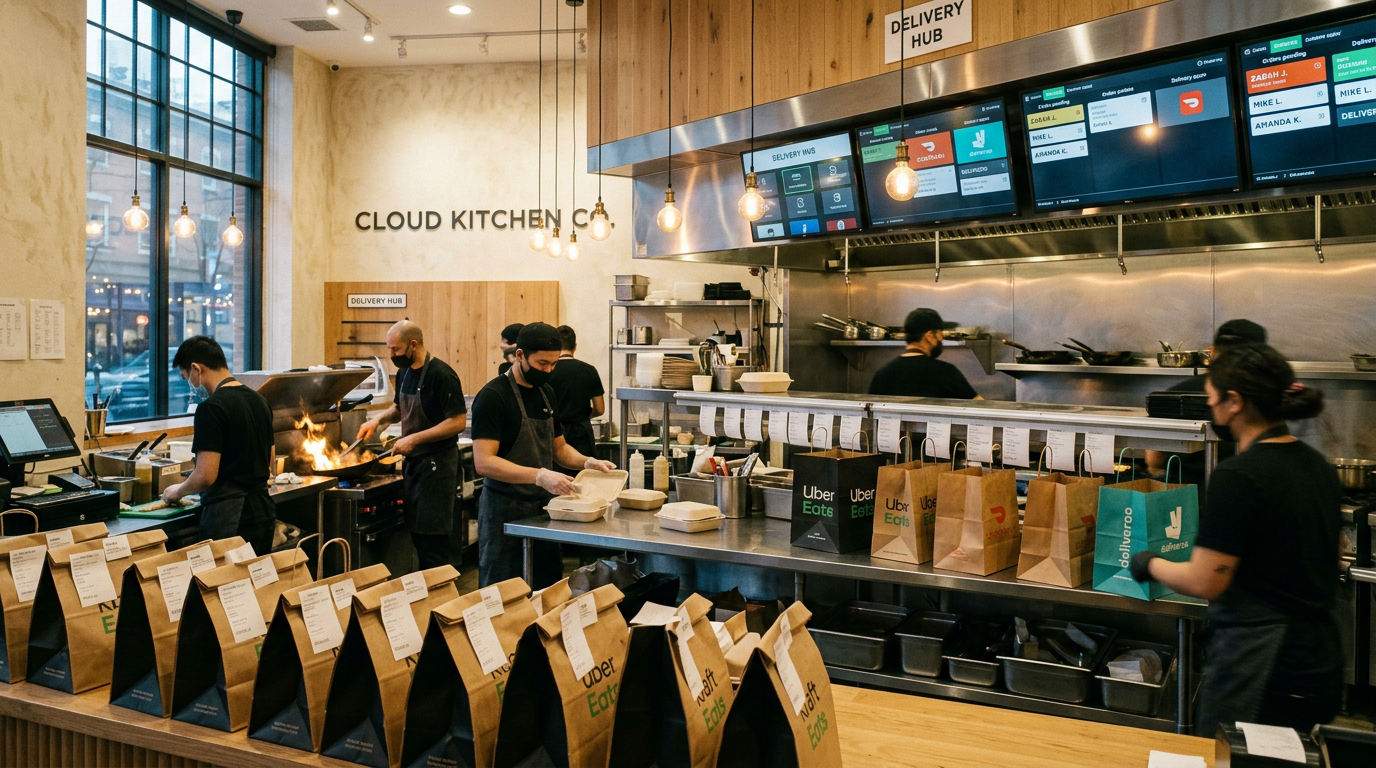
The operational flow of a ghost kitchen is elegantly simple compared to traditional restaurant models. When a customer places an order through DoorDash, Uber Eats, Grubhub, or another delivery platform, the order appears on a dedicated tablet or POS system in the kitchen. Kitchen staff prepares the food according to standardized recipes, packages it in delivery-appropriate containers, and places it in a designated pickup area. A delivery driver arrives, picks up the order, and transports it to the customer.
This model eliminates several traditional restaurant functions entirely: there is no host/hostess, no servers, no bartender, no front-of-house manager, and no dining room maintenance. The kitchen team focuses exclusively on food production, which often results in better consistency and faster execution than traditional restaurants where staff must divide attention between dine-in and takeout orders.
The Ghost Kitchen Business Case in 2026
The financial case for ghost kitchens has never been stronger, driven by sustained consumer demand for delivery, technological improvements in order management, and the proven economics of delivery-only operations.
Market Size and Growth Trajectory
The global ghost kitchen market currently stands at approximately $11.9 billion and is projected to reach $36 billion by 2035, representing a compound annual growth rate (CAGR) of 12-15%. In the United States alone, the delivery food market generates over $100 billion in annual revenue, with ghost kitchens capturing an increasingly significant share. This growth is fueled by changing consumer habits—particularly among millennials and Gen Z consumers who order delivery an average of 2-3 times per week—and the continued expansion of delivery platform infrastructure.
The 2020-2023 period accelerated adoption dramatically as pandemic restrictions forced restaurants to pivot to delivery-only models. Many operators discovered that ghost kitchen economics could be superior to traditional restaurant operations, even after restrictions lifted. The result is a mature market in 2026 with established technology stacks, proven operational frameworks, and informed consumers who expect seamless delivery experiences.
Startup Cost Comparison
The capital requirements for launching a ghost kitchen represent a fraction of traditional restaurant startup costs:
| Cost Category | Ghost Kitchen | Traditional Restaurant |
|————–|—————|————————|
| Real Estate (deposit + initial) | $2,000-$10,000 | $50,000-$250,000 |
| Equipment | $15,000-$35,000 | $150,000-$400,000 |
| Licenses and Permits | $500-$3,000 | $5,000-$20,000 |
| Initial Inventory | $2,000-$5,000 | $15,000-$50,000 |
| Technology (POS, tablets) | $1,500-$5,000 | $5,000-$15,000 |
| Branding and Marketing | $1,000-$5,000 | $10,000-$50,000 |
| Working Capital | $3,000-$10,000 | $25,000-$100,000 |
| Total Estimated Startup | $20,000-$60,000 | $500,000-$1,000,000+ |
This dramatic difference in startup costs makes ghost kitchens accessible to first-time operators who might not have access to the capital required for traditional restaurant ventures. It also enables existing restaurant owners to test new concepts or cuisines without risking their primary business.
Space and Staffing Efficiency
The physical footprint required for a ghost kitchen—typically 200 to 500 square feet—is roughly 10% of what a traditional full-service restaurant requires (average 2,100 square feet for limited-service restaurants). This efficiency translates directly to lower real estate costs, reduced utility expenses, and smaller maintenance requirements.
Staffing follows a similar pattern. A ghost kitchen typically operates with 3-5 team members during peak hours: a kitchen manager/lead, 2-3 line cooks, and perhaps a prep cook or food runner. Compare this to a traditional quick-service restaurant that might employ 15-25 people across front and back of house, or a full-service restaurant that could require 30+ employees. The reduced labor burden simplifies management, reduces payroll costs, and eliminates the complexity of front-of-house service training.
Profit Margins and Revenue Potential
Ghost kitchens typically achieve net profit margins of 5-15%, which compares favorably to the 2-8% margins common among traditional restaurants. The higher margins result from several factors: reduced labor costs, lower real estate expenses, elimination of dining room overhead, and—critically—the ability to run multiple virtual brands from a single kitchen space to maximize revenue per square foot.
Monthly revenue potential varies significantly based on concept, location, and operational execution, but successful ghost kitchens typically generate between $15,000 and $50,000 in monthly revenue. High-performing operations in prime delivery zones with optimized menus and multiple brands can exceed $75,000 monthly, though these figures represent the upper tier of performance.
The breakeven timeline for a ghost kitchen—approximately 6 months—is dramatically shorter than the 3-5 year breakeven period typical for traditional restaurants. This faster path to profitability reduces investor risk and enables operators to reinvest in growth more quickly.
How to Start a Ghost Kitchen — Step by Step
Launching a successful ghost kitchen requires systematic execution across ten key areas. Here’s your complete roadmap:
Step 1: Market Research and Concept Development
Before investing a single dollar, conduct thorough market research to validate your concept. Analyze the delivery landscape in your target area: Which cuisines are overrepresented? Where are the gaps? What are average order values? What delivery platforms are dominant?
Study your potential competitors on DoorDash, Uber Eats, and Grubhub. Look at their pricing, menu size, customer reviews, and delivery radius. Identify your differentiation—what will make customers choose you over established competitors? This could be a unique cuisine, superior quality, better value, faster delivery, or better packaging.
Consider your target customer demographic. Are you targeting busy professionals seeking quick lunch solutions? Families ordering weeknight dinners? Late-night snackers? Each demographic has different preferences for cuisine, pricing, and service speed.
Step 2: Business Plan and Financial Projections
A solid business plan is essential whether you’re self-funding or seeking investment. Your plan should include:
Concept summary: What cuisine will you serve? What’s your brand identity? Who is your target customer?
Market analysis: What is the size of your addressable market? Who are your competitors? What are your competitive advantages?
Operations plan: How will you source ingredients? What will your kitchen schedule look like? How will you manage quality control?
Marketing plan: How will you acquire customers? What channels will you use? What’s your customer acquisition cost target?
Financial projections: Include startup costs, monthly operating expenses, revenue projections, and cash flow forecasts. Model multiple scenarios (conservative, expected, optimistic) to understand your range of outcomes.
For financial projections, assume commission fees of 15-30% to delivery platforms, food costs of 25-35% of revenue, labor costs of 20-30% of revenue, and rent of $1,500-$4,000 monthly for ghost kitchen space. Your net margin target should be 8-15% after accounting for all expenses.
Step 3: Choose Your Kitchen Model
Ghost kitchens can operate under several models, each with different cost structures and operational implications:
Shared kitchen (commissary): You rent space in a commercial kitchen that houses multiple ghost kitchen operators. This model minimizes your real estate commitment and provides shared infrastructure ( Hood, refrigeration, storage). Costs typically range from $1,500-$4,000 monthly for dedicated counter space. The trade-off is limited control over scheduling and potential wait times during peak hours.
Dedicated ghost kitchen space: You lease and outfit your own commercial kitchen space. This provides full control over operations and scheduling but requires higher capital investment and longer commitment. Suitable for operators with proven concepts and growth plans.
Restaurant backend: If you or a partner own an existing restaurant, you can operate a ghost kitchen concept in the existing kitchen during off-peak hours. This maximizes utilization of existing infrastructure but requires coordination with the primary operation.
For most first-time operators, a shared kitchen arrangement provides the best balance of low commitment and operational flexibility. As your business proves viable, you can transition to a dedicated space.
Step 4: Secure Permits and Licenses
Compliance with local regulations is non-negotiable. The specific requirements vary by jurisdiction, but you’ll typically need:
Business license: Register your business entity (LLC, corporation, etc.) with your state and obtain local business licenses. Cost: $50-$500 depending on location.
Food handler’s permit: At least one person on your team must hold a food handler’s permit, which requires passing a food safety exam. Some jurisdictions require this for all food handlers. Cost: $10-$50 per person.
Health department permit: You’ll need to pass health inspections and obtain a permit to operate a food establishment. This requires a kitchen that meets health department standards for commercial food preparation. Cost: $100-$1,000 annually.
Sales tax permit: Register to collect and remit sales tax on food sales. Most states require this, and requirements vary significantly.
Employer identification number (EIN): Required if you have employees, and useful for banking even if operating solo.
Schedule time with your local health department early in the process—they can advise on kitchen requirements and help you avoid costly mistakes.
Step 5: Equipment and Kitchen Setup
Your equipment needs depend on your menu concept, but most ghost kitchens require:
Cooking equipment: Commercial range or induction cooktops ($2,000-$8,000), convection oven ($1,500-$5,000), microwave ($200-$800), fryer if needed ($800-$2,500).
Refrigeration: Reach-in refrigerator ($3,000-$8,000), undercounter refrigerator ($800-$2,500), freezer ($1,500-$4,000).
Prep equipment: Stainless steel prep tables ($500-$2,000 each), cutting boards, commercial-grade knives, pots, pans, and utensils.
Packaging station: Dedicated area for packaging orders with appropriate containers, bags, and labeling supplies.
POS and technology: Tablet mounts for delivery platform tablets, receipt printer, thermal label printer ($200-$500), POS software subscription ($50-$200 monthly).
Safety equipment: Fire extinguisher, first aid kit, commercial-grade cleaning supplies, temperature monitoring equipment.
For a lean startup, you can source quality used equipment through restaurant supply auctions and commercial kitchen liquidators, potentially saving 30-50% compared to new equipment costs.
Step 6: Technology Stack
The right technology transforms ghost kitchen operations from chaotic to systematic. Your core technology stack should include:
POS system: A cloud-based POS designed for delivery operations (Toast Go, Square for Restaurants, or specialized ghost kitchen POS like Otter). Cost: $0-$200 monthly plus hardware.
Order aggregation: Services like Otter, PrepMate, or Deliverect aggregate orders from multiple delivery platforms into a single dashboard, eliminating the need to monitor multiple tablets. Cost: $50-$200 monthly.
Delivery platform integration: Set up accounts with DoorDash, Uber Eats, Grubhub, and any regional platforms relevant to your market. Understand each platform’s commission structure, promotional options, and operational requirements.
Inventory management: Digital inventory tracking prevents stockouts and reduces food waste. Many POS systems include basic inventory management; dedicated apps like BlueCart or MarketMan offer more advanced features.
Recipe management: Use digital recipe cards to ensure consistency across all orders. This is particularly valuable as you scale and add team members. AI-powered recipe tools like those available at AI Chef Pro can help you standardize recipes, calculate food costs, and optimize menus for delivery.
Step 7: Menu Development for Delivery
Menu development for ghost kitchens requires a different approach than traditional restaurant menus. Every item must travel well, hold up during delivery transit, and be efficiently produced.
Prioritize travel-friendly items: Dishes that maintain quality during 20-40 minute delivery windows. Avoid items that get soggy, separate, or lose texture. Sauces should be packaged separately when possible.
Limit SKU count: A focused menu of 15-25 items is easier to execute consistently than an extensive menu. Fewer items mean faster prep times, reduced waste, and easier quality control.
Design for efficiency: Build your menu around overlapping ingredients and prep workflows. A ghost kitchen with three virtual brands might share base proteins, sauces, and prep work across all menus, dramatically improving efficiency.
Optimize for packaging: Every menu item must have a packaging solution that maintains quality and presents well upon arrival. Test your packaging with actual delivery runs before launching.
Price strategically: After accounting for 15-30% platform commissions, 25-35% food costs, and other expenses, ensure your menu pricing supports target margins. Use menu engineering to highlight high-margin items.
AI-powered menu development tools can help you analyze food costs, optimize recipe formulations, and identify opportunities to improve profitability. Explore options at AI Chef Pro for recipe costing and menu optimization features.
Step 8: Delivery Platform Strategy
Your relationship with delivery platforms is critical—they’re simultaneously your primary sales channel and your largest variable expense.
Platform selection: Start with the dominant platforms in your market (DoorDash and Uber Eats typically have the largest user bases). Grubhub maintains strong positions in some markets. Consider regional platforms if they have meaningful presence. You don’t need to be on every platform—focus on where your target customers order.
Commission structures: Commission rates typically range from 15-30% depending on whether you use their marketing services and fulfillment options. Understand exactly what you’re paying for at each tier.
Menu optimization for platforms: Each platform has different requirements and display formats. Optimize your menu photos, descriptions, and pricing for each platform. Some platforms offer promotional placement for operators who participate in their advertising programs
This second part of our comprehensive guide dives deep into the technology stack that powers successful ghost kitchens, the economics of running multiple virtual brands, the real numbers behind profitability, and the critical mistakes that trip up inexperienced operators.
Ghost Kitchen Technology Stack
The technological infrastructure of a ghost kitchen differs fundamentally from traditional restaurants. Without dine-in customers, your digital systems become the entire customer experience. Investing in the right technology stack isn’t optional—it’s the foundation of your operation.
Order Aggregation Platforms
Managing orders from multiple delivery apps simultaneously on separate tablets creates chaos. Order aggregation platforms consolidate incoming orders from DoorDash, Uber Eats, Grubhub, and other platforms into a single interface.
Ordermark (now part of Nextbite) pioneered this space and remains a strong choice for operators running multiple virtual brands. Their platform integrates with most major delivery services and provides unified reporting across all channels.
Deliverect has emerged as a powerful alternative, particularly for ghost kitchens seeking robust analytics. Their dashboard shows real-time performance across platforms, helping you identify which apps drive the most orders and at what cost. Deliverect integrates with POS systems and provides automated routing to kitchen display systems.
Cuboh offers similar aggregation capabilities with a focus on restaurant operations. Their platform handles order consolidation, menu management across platforms, and analytics reporting.
When evaluating aggregation platforms, consider:
- Number of delivery platform integrations
- Real-time synchronization capabilities
- Reporting and analytics depth
- POS compatibility
- Commission structures (some charge additional fees on top of delivery platform commissions)
POS Systems for Ghost Kitchens
Your point-of-sale system manages orders, tracks inventory, processes payments, and generates the financial data that determines profitability. Ghost kitchen-specific POS requirements differ from traditional restaurants.
Toast for Restaurants has developed specialized features for delivery-focused operations. Their Ghost Kitchen edition includes order routing, prep station management, and integrated delivery dispatch. Toast provides comprehensive reporting that helps operators understand food costs, labor efficiency, and delivery platform performance. The platform integrates directly with major aggregation tools and offers competitive processing rates.
Square for Restaurants offers a more streamlined option suitable for smaller operations or those just starting. Their platform handles order management, inventory tracking, and basic analytics with an intuitive interface. Square’s strength lies in its seamless integration with Square’s broader payment ecosystem and relatively straightforward setup.
Olo takes a different approach, positioning itself as an “order management platform” rather than a traditional POS. Olo excels at managing digital ordering across multiple channels—delivery apps, website ordering, and loyalty programs—from a single dashboard. Many major restaurant chains use Olo for their off-premises operations.
When selecting a POS system for your ghost kitchen, prioritize:
- Delivery platform integration capabilities
- Real-time inventory management
- Comprehensive reporting and analytics
- Kitchen display system (KDS) compatibility
- Scalability as you add brands or locations
Kitchen Display Systems
A Kitchen Display System (KDS) replaces paper tickets with digital screens that show orders, modifications, and timing information. In a ghost kitchen, where speed and accuracy determine customer satisfaction and reviews, a KDS is essential.
Modern KDS solutions integrate directly with your POS and order aggregation platforms, displaying orders automatically as they come in. Look for systems that offer:
- Color-coded urgency indicators
- Modification and special request highlighting
- Station routing (sending tickets to appropriate prep stations)
- Performance metrics (average ticket time, late orders)
- Offline capability (orders continue displaying if internet drops)
Touchscreen KDS stations from companies like Astound or Qube start around $500-$800 per station, with software subscriptions adding $50-$150 monthly. For a ghost kitchen running multiple brands, two to three stations typically suffice—one for order entry/routing and one or two for food preparation.
AI-Powered Demand Forecasting
Artificial intelligence has moved from buzzword to practical operational tool in ghost kitchens. Demand forecasting AI analyzes historical sales data, weather patterns, local events, and seasonal trends to predict order volume.
Prima offers predictive analytics specifically for restaurant operations, helping ghost kitchens optimize inventory purchasing and staff scheduling. Their AI analyzes your sales data alongside external factors to forecast demand with increasing accuracy over time.
BlueCart provides similar forecasting capabilities integrated with their supply ordering platform, helping operators align purchasing decisions with predicted demand.
The value of demand forecasting extends beyond inventory management:
- Labor scheduling: Staff based on predicted volume rather than guesswork
- Inventory purchasing: Reduce food waste by ordering closer to actual need
- Prep planning: Start production runs when demand warrants
- Marketing timing: Schedule promotions during predicted low periods
For ghost kitchens running multiple brands, demand forecasting becomes even more valuable—you can predict which brands will be busiest and adjust prep priorities accordingly.
Customer Data and Analytics
Every order generates data that, properly analyzed, improves profitability. Delivery platforms guard their customer data closely, but your POS and aggregation platforms provide valuable insights.
Key metrics every ghost kitchen operator should track:
- Average order value: Total revenue divided by order count
- Order frequency: How often repeat customers order
- Platform performance: Orders, revenue, and ratings by delivery app
- Peak hours: When volume concentrates throughout the day
- Item popularity: Which menu items drive revenue
- Customer acquisition cost: Marketing spend divided by new customers acquired
- Net promoter score: Customer satisfaction indicator
Loyalty programs built into your direct ordering channel provide the richest customer data. When customers order directly through your website or app, you own that relationship. Direct ordering typically carries 0% commission versus 15-30% from third-party platforms—making the data and repeat purchase incentives even more valuable.
AI Chef Pro: Menu Optimization and Recipe Management
Managing multiple virtual brands requires consistent recipe execution, ongoing menu optimization, and careful food cost control. AI Chef Pro (aichef.pro/en) provides an integrated suite of tools designed specifically for ghost kitchen operations.
Their platform offers:
- Menu engineering: AI analysis of menu item profitability and popularity to optimize your offerings
- Recipe management: Centralized recipe storage with standardized portions and costing
- Food cost optimization: Real-time tracking and alerts when ingredient costs shift
- Menu scaling: Tools to adapt recipes as you add brands or locations
For ghost kitchens running multiple virtual brands from a single kitchen, AI Chef Pro’s ability to manage cross-brand ingredient overlap becomes particularly valuable—maximizing purchasing efficiency while maintaining distinct brand identities.
Their free tier provides essential recipe management for operators testing the model, with paid plans starting at EUR 25 monthly for full optimization capabilities.
Running Multiple Brands from One Kitchen
The ghost kitchen model’s most compelling advantage is the ability to run multiple restaurant concepts from a single kitchen facility. This virtual brand strategy multiplies revenue without proportional cost increases.
The Virtual Brand Model Explained
A virtual brand is a restaurant concept that exists only digitally—on delivery apps and through direct ordering channels—without a physical storefront or dine-in presence. Multiple virtual brands can operate simultaneously from one commercial kitchen, each with its own:
- Brand identity and visual design
- Menu and pricing
- Customer base and delivery radius
- Positioning and marketing
The shared infrastructure includes:
- Kitchen equipment and facility
- Staff (with cross-training)
- Purchasing and inventory management
- Management and administrative functions
- Licenses and permits
This economics of scope—where adding brands increases total revenue while costs rise more slowly—creates the profit potential that makes ghost kitchens attractive to operators.
How to Create Complementary Brand Concepts
The most successful multi-brand ghost kitchens run concepts that share operational efficiencies while appealing to distinct customer bases.
Complementary cuisine types allow shared ingredients and prep processes. A burger brand, a wing brand, and a salad brand might share:
- Protein preparation (chicken for wings and burgers, beef for burgers and salads)
- Vegetable prep across all brands
- Cooking equipment (grills, fryers)
- Assembly procedures
This ingredient and equipment overlap reduces food costs, minimizes training complexity, and allows flexible staff allocation based on demand.
Non-competing meal occasions matter too. A breakfast-focused brand and a late-night comfort food brand target different dayparts, smoothing labor requirements and maximizing equipment utilization across more hours.
Distinct brand positioning prevents customer confusion while capturing different market segments. Consider:
- Price positioning: A premium burger brand alongside a value-focused brand
- Cuisine style: An Italian pasta brand alongside a Thai cuisine brand
- Dietary focus: A plant-based brand alongside a traditional protein-focused brand
- Geographic appeal: A brand with local/regional identity alongside a broader concept
Managing Operations Across Brands
Running multiple brands from one kitchen introduces operational complexity that requires careful management.
Shared staff with brand-specific training: Your kitchen team must understand each brand’s recipes, plating standards, and quality expectations. Cross-training is essential—staff should be able to produce any brand’s menu items competently.
Dedicated brand stations: Even in a shared kitchen, consider designating areas or stations for specific brands to prevent cross-contamination of ingredients and maintain distinct preparation standards. Color-coded containers and station organization help.
Unified prep schedules: Coordinate prep times across brands. If two brands need the same protein prepared differently, batch prep can often accommodate both requirements.
Clear brand standards documentation: Each brand needs detailed recipes, photos of correct presentation, and quality standards. These documents ensure consistency regardless of which team member prepares the order.
Unified technology: Your POS and KDS should handle multiple brands seamlessly, routing orders to appropriate stations and tracking brand-specific performance.
Platform-Specific Brand Optimization
Different delivery platforms attract different customer demographics and emphasize different features. Your brand strategy should account for platform-specific dynamics.
| Platform | Best For | Considerations |
|———-|———-|—————-|
| DoorDash | Broad reach, suburban markets | Higher commission rates, strong advertising options |
| Uber Eats | Urban areas, late-night orders | Integrated with rideshare, tech-savvy customers |
| Grubhub | Corporate ordering, lunch delivery | Strong in specific metro markets |
| Postmates | Convenience-focused customers | Merging with Uber Eats in many markets |
| Direct ordering | Highest margins, customer ownership | Requires marketing investment |
Consider creating platform-specific variations of your brands. A burger brand might emphasize different menu items or promotions on DoorDash versus its direct ordering channel. Platform analytics reveal which items perform best where.
Revenue Multiplication: A Practical Example
Consider a ghost kitchen running three virtual brands from a single 800-square-foot (74 m²) commercial kitchen:
Brand A (Burgers): Average order $22, 30 orders daily
Brand B (Wings): Average order $26, 20 orders daily
Brand C (Salads): Average order $18, 15 orders daily
Combined daily revenue: $1,460
Monthly revenue (30 days): $43,800
The same kitchen, staff, and equipment that produced $15,000 monthly running a single brand now generates nearly three times the revenue. Fixed costs—rent, utilities, insurance, licenses—remain constant. Labor increases modestly with volume but not proportionally to revenue.
This multiplication effect is the core economic advantage of the virtual brand model.

Running Multiple Virtual Brands?
AI Chef Pro helps you develop unique menus for each brand, optimize food costs across concepts, and scale recipes effortlessly. 55+ AI tools from €25/month.
Ghost Kitchen Profitability — Real Numbers
Understanding the financial mechanics of ghost kitchens separates successful operators from those who close within their first year. Here are the real numbers.
Revenue Model Breakdown
Using conservative assumptions for an established ghost kitchen operation:
Daily metrics:
- Average orders per day: 50
- Average order value: $25
- Daily revenue: $1,250
Monthly revenue:
- 30-day month: $37,500
- 26 operating days (accounting for closures): $32,500
- Realistic monthly range: $30,000-$50,000 for a single-brand operation
Multi-brand operations compound these numbers:
- Single brand: $30,000-$45,000/month
- Two brands: $50,000-$75,000/month
- Three brands: $75,000-$120,000/month
These figures assume established operations with optimized menus and functioning delivery partnerships. New ghost kitchens should expect 3-6 months to reach these volumes.
Detailed Cost Structure
Ghost kitchens have distinct cost structures compared to traditional restaurants. Here’s a realistic breakdown for a profitable operation:
Food costs (28-32% of revenue): $10,500 monthly
- Ingredient costs vary by cuisine type
- Ghost kitchens typically achieve lower food costs than traditional restaurants due to reduced menu variety per brand
- Target: 30% or below for healthy margins
Labor costs (28-32% of revenue): $10,500 monthly
- Includes chefs, prep staff, and delivery coordination
- Ghost kitchens require fewer staff than equivalent-revenue traditional restaurants (no front-of-house)
- Target: 30% or below
Delivery platform commissions (15-30% of revenue): $6,000 average
- Varies significantly by platform and contract
- DoorDash and Uber Eats typically 15-30% depending on marketing participation
- Grubhub often 15-20%
- Direct ordering: 0%
- Strategic priority: Increase direct ordering share to reduce this cost
Rent and utilities (8-12% of revenue): $3,500 monthly
- Commercial kitchen space: $2,000-$4,000/month depending on market
- Utilities: $400-$800/month
- No customer-facing retail space needed
Packaging (4-6% of revenue): $1,800 monthly
- Quality delivery packaging is essential for food quality and brand perception
- Costs $1.50-$2.50 per order
- Consider packaging as marketing—customers share photos of well-presented food
Technology and software ($300-800/month): $500 monthly
- POS system: $100-$300/month
- Order aggregation: $100-$300/month
- KDS: $100-$200/month
- Analytics and other tools: $100-$200/month
Insurance and licenses ($400-800/month): $600 monthly
- General liability insurance
- Food handling permits
- Business licenses
Marketing ($3-5% of revenue): $1,500 monthly
- Platform advertising
- Social media management
- Direct customer acquisition
Net Margins: What You Can Actually Expect
After all expenses, ghost kitchen net margins typically range from 5-15%:
Conservative scenario (5-8% margin):
- $37,500 revenue × 5% = $1,875 monthly profit
- $37,500 revenue × 8% = $3,000 monthly profit
Optimized scenario (10-15% margin):
- $37,500 revenue × 10% = $3,750 monthly profit
- $37,500 revenue × 15% = $5,625 monthly profit
These margins reflect established operations. New ghost kitchens should expect lower margins—or losses—during the first 3-6 months while building volume and optimizing operations.
How to Increase Margins
Increase direct ordering percentage: Every order through your website or app instead of a delivery platform saves 15-30% in commissions. A shift from 20% direct ordering to 40% can improve overall margins by 3-5 percentage points.
Build loyalty programs: Repeat customers cost less to acquire and order more frequently. A simple loyalty program offering rewards after 5 or 10 orders increases customer lifetime value.
Optimize menu engineering: Use data to identify high-margin items and promote them strategically. Remove low-margin, low-volume items that complicate prep without contributing revenue.
Reduce food waste: Better forecasting, standardized portions, and inventory management reduce waste—a 2% improvement in food cost translates directly to margin improvement.
Cross-train staff effectively: Flexible staff who can work any station reduces overtime and allows optimal scheduling based on actual demand.
Break-Even Timeline
Most ghost kitchens reach break-even within 3-6 months of opening, assuming:
- Adequate initial capital ($30,000-$75,000 for equipment, inventory, marketing, and operating expenses)
- Realistic volume ramp-up expectations
- Competent operational management
Factors affecting break-even timeline:
- Market competition: Saturated markets take longer to establish
- Brand differentiation: Unique concepts reach profitability faster than me-too operations
- Marketing investment: Higher initial marketing spend accelerates volume
- Operational efficiency: Well-trained teams reach profitability faster
Scaling Economics: Adding Brands vs. Adding Locations
Once a single-brand ghost kitchen is profitable, growth options emerge:
Adding virtual brands costs approximately $5,000-$15,000 per new brand for:
- Menu development and testing
- Brand identity and photography
- Platform setup and listing
- Initial marketing
Adding physical locations costs approximately $50,000-$150,000 for:
- Additional kitchen build-out
- Equipment
- Staff onboarding
- Permits and licenses
The virtual brand path offers faster scaling with lower capital requirements. Many operators add 2-3 brands to their first location before considering expansion to a second physical site.
Common Ghost Kitchen Mistakes to Avoid
Learning from others’ failures is cheaper than making your own mistakes. Here are the most common ghost kitchen pitfalls that operators encounter.
Underestimating Delivery Platform Commissions
Platform commissions of 15-30% can seem manageable on paper, but they fundamentally alter unit economics. An operation with 30% food costs, 30% labor, and 25% platform commissions has only 15% remaining for all other expenses—leaving minimal margin
Related Reading
- Smart Kitchen Technology for Commercial Kitchens: 2026 Guide
- AI Menu Pricing Strategy: Data-Driven Pricing for Restaurants
- AI Cooking Assistant for Professional Chefs
- AI Food Cost Calculator: Reduce Costs Instantly
- Restaurant Profit Margin Calculator
- Best AI Tools for Chefs in 2026
Discover more from AI Chef Pro Blog
Subscribe to get the latest posts sent to your email.