Food waste in restaurants represents one of the most significant operational inefficiencies in the hospitality industry. Across the United States alone, restaurants generate between 22 and 33 billion pounds of food waste annually—an staggering figure that translates to billions of dollars in lost revenue, increased disposal costs, and unnecessary environmental impact. For the average restaurant, this waste amounts to 4-10% of all food purchased, money that could be redirected toward ingredient quality, staff wages, or business growth.
The good news? Artificial intelligence offers practical, data-driven solutions that can reduce restaurant food waste by 30% or more. Whether you operate a fine dining establishment, a fast-casual chain, or a neighborhood bistro, AI-powered tools can help you forecast demand more accurately, manage inventory in real-time, and make smarter decisions about purchasing, prep, and menu design.
This comprehensive guide explores the true cost of food waste in restaurants and presents 12 actionable AI-powered strategies you can implement today to slash waste, improve profitability, and align your operation with growing consumer expectations for sustainability.
Cut Food Waste by 30% with AI-Powered Tools
AI Chef Pro offers 55+ specialized tools for demand forecasting, inventory management, and waste analytics. Start free.
The True Cost of Restaurant Food Waste
Understanding the full impact of food waste requires looking beyond the obvious expense of discarded ingredients. The true cost of restaurant food waste encompasses direct financial losses, hidden operational expenses, and far-reaching consequences that affect your bottom line, your team, and your reputation.
Direct Cost: Wasted Ingredients
The most visible form of food waste is the money spent on ingredients that never reach the customer. When a restaurant wastes 4-10% of purchased food, that percentage translates directly to lost revenue. For a restaurant with $500,000 in annual food purchases, a 7% waste rate means $35,000 in pure loss—money that could fund new equipment, marketing campaigns, or simply increase profit margins.
This waste occurs throughout the operation: over-ordered produce that spoils before use, over-prepared menu items that sit too long and must be discarded, and portion sizes that exceed customer appetite levels. Each of these represents money leaving your business without generating any return.
Labor Cost: Time Spent Prepping Food That Gets Thrown Away
Every hour your kitchen staff spends preparing ingredients that will ultimately be wasted represents inefficient labor allocation. When prep cooks spend 30 minutes trimming vegetables that will be thrown away, or line cooks prepare sauces in quantities that exceed demand, you’re paying for labor that produces no value.
Beyond the immediate labor cost, there’s the opportunity cost: time spent on wasted prep could be redirected toward improving food quality, training staff on new techniques, or enhancing plate presentation. AI helps you prep only what you need, ensuring that every labor hour contributes to dishes that reach the table.
Disposal Costs: Waste Hauling Fees
Food waste doesn’t disappear when you throw it away—it costs money to remove. Most restaurants pay for waste hauling services, and waste volume directly impacts these costs. In many municipalities, disposal fees have increased substantially as communities implement food waste diversion programs or landfilled waste taxes.
Some restaurants pay $150-300 per month for waste hauling, with costs rising alongside waste volume. Reducing your waste output not only saves on ingredient costs but also lowers your disposal expenses—a double benefit that compounds over time.
Environmental Impact: 8-10% of Global Greenhouse Gas Emissions
The environmental cost of food waste extends far beyond your restaurant’s walls. According to the Food and Agriculture Organization of the United Nations, food waste accounts for 8-10% of global greenhouse gas emissions. When food decomposes in landfills, it produces methane—a greenhouse gas 25 times more potent than carbon dioxide over a 100-year period.
For restaurant owners who care about their environmental footprint, reducing food waste represents one of the most impactful actions they can take. It’s an environmental responsibility that aligns perfectly with business economics: every pound of food you don’t waste saves money while also reducing your operation’s carbon footprint.
Reputational Cost: Sustainability Matters to 73% of Diners
Modern consumers increasingly factor sustainability into their dining decisions. Research indicates that 73% of diners say they would choose a restaurant that demonstrates commitment to reducing food waste over one that doesn’t. This preference is particularly strong among younger demographics—Millennials and Gen Z consumers, who represent a growing share of restaurant spending.
A restaurant that actively fights food waste can leverage this commitment in marketing, attracting environmentally-conscious customers who want to support businesses aligned with their values. Conversely, restaurants known for excessive waste may face reputational damage, particularly as food waste becomes a more prominent topic in media and public discourse.
12 AI-Powered Strategies to Reduce Food Waste
The following strategies represent the most effective AI-powered approaches to reducing restaurant food waste. Each strategy addresses a specific pain point in the food production and service cycle, and together, they form a comprehensive system for waste reduction.
1. AI Demand Forecasting: Predict Covers and Menu Mix
One of the most powerful applications of artificial intelligence in restaurant operations is demand forecasting. Traditional forecasting methods rely on manager intuition, simple historical averages, or basic spreadsheet tracking—approaches that struggle to account for the many variables affecting daily demand.
AI-powered forecasting systems analyze multiple data sources simultaneously: historical sales data, weather patterns, local events, seasonal trends, day of week, time of year, and even social media activity about your restaurant or local area. Machine learning algorithms identify patterns humans might miss and continuously refine predictions as new data becomes available.
How it works in practice:
- A restaurant using AI forecasting learns that rainy Tuesdays in November see 23% fewer covers than average
- The system predicts that a local music festival on Saturday will increase demand by 45%
- Based on these predictions, the system recommends prep quantities for each menu item
The impact: Restaurants implementing AI demand forecasting typically reduce overproduction waste by 20-30%. When you prep closer to actual demand, you throw away far less finished food at the end of service.
2. Smart Inventory Management: Real-Time Tracking and Auto-Ordering
Effective inventory management is the foundation of waste reduction, yet many restaurants still rely on manual counts, paper records, or basic spreadsheet systems that update infrequently. By the time you discover you’re low on an ingredient, you may have already over-ordered another, leading to spoilage.
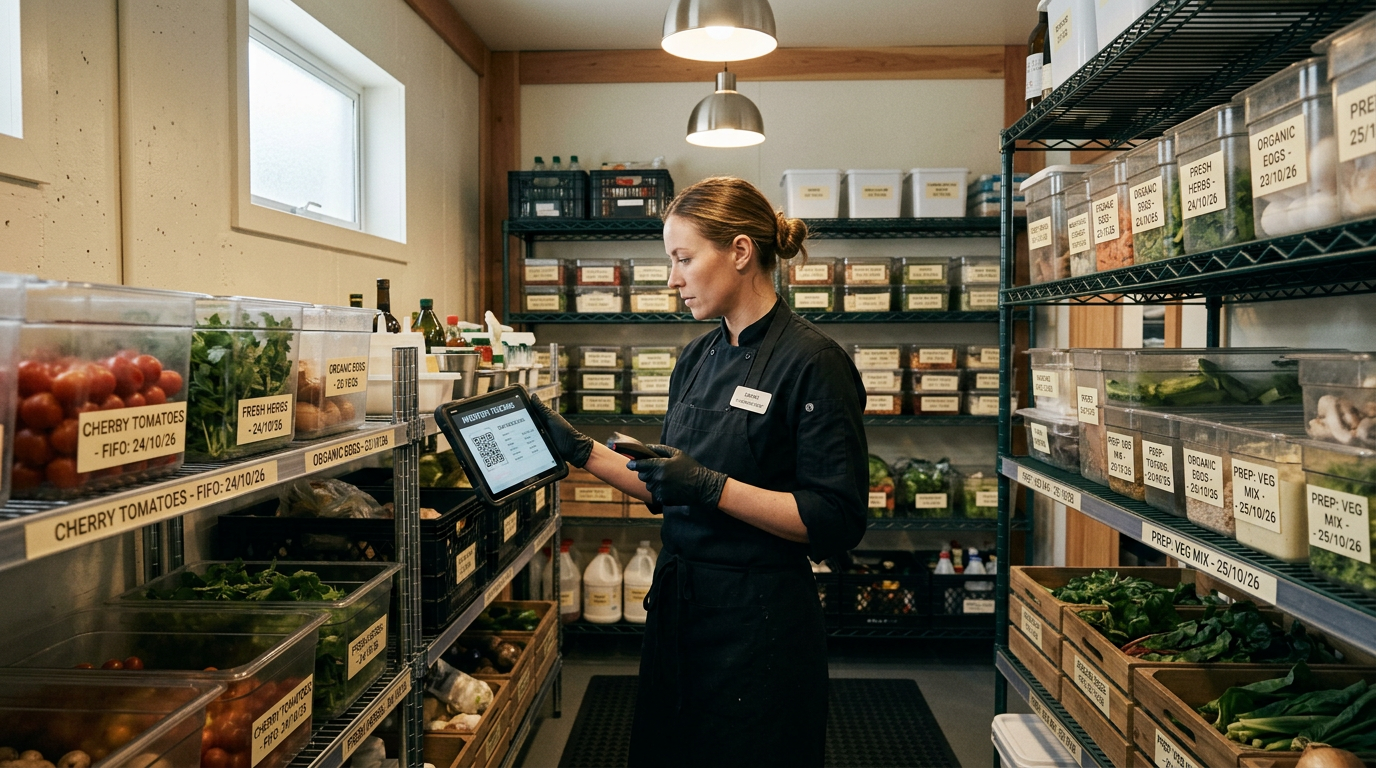
Smart inventory management systems use AI combined with IoT (Internet of Things) sensors to track inventory levels in real-time. Smart shelves with weight sensors automatically log when products are removed, while barcode or RFID scanning provides instant visibility into stock levels.
Key features include:
- Automated par level calculations: AI analyzes usage patterns to recommend optimal reorder points
- Expiration tracking: Systems track purchase dates and alert you when items approach use-by dates
- Auto-ordering: Some systems can automatically generate purchase orders when inventory falls below par levels
- Usage analytics: Identify which ingredients consistently have excess waste and why
The result? You always have the right ingredients on hand without the excess that leads to spoilage. Restaurants using smart inventory management typically see 15-25% reductions in waste from expired or forgotten ingredients.
3. AI-Powered Prep Lists: Prep Exactly What You Need
Even with accurate demand forecasting, many restaurants still rely on traditional prep lists based on historical percentages or chef intuition. These approaches often result in over-prepping, particularly for items with short shelf lives after preparation.
AI-powered prep lists go beyond simple forecasting by considering:
- Current inventory of prepped items (that soup you made yesterday still in the walk-in)
- Real-time sales during service (adjusting prep for lunch vs. dinner rush)
- Remaining shelf life of prepped items (prioritizing older preparations)
- Upcoming reservations or events
Practical example: Your AI system knows you have 8 pounds of prepped roasted vegetables remaining from yesterday, that tomorrow’s lunch forecast shows lighter demand, and that these vegetables lose optimal quality after 48 hours. The system recommends featuring the vegetables in a special on tonight’s menu rather than preparing fresh—reducing waste while potentially increasing perceived value with a “house-made” special.
4. Dynamic Menu Adjustment: Feature Items Approaching Shelf Life
Dynamic menu engineering allows restaurants to actively manage their menu based on current inventory conditions. AI systems can identify ingredients approaching their use-by window and recommend or automatically adjust menu offerings to prioritize these items.
This goes beyond simple daily specials. Advanced systems can:
- Adjust menu descriptions to highlight dishes featuring older ingredients
- Temporarily increase prominence of items using ingredients at risk
- Suggest price promotions for items needing movement
- Modify online ordering interfaces to feature at-risk items
For example, if your fish purveyor delivered fresh halibut yesterday and you have more than expected, the AI can recommend featuring a halibut special prominently on your menu, potentially at a slight premium given its quality. Conversely, if halibut inventory is aging, the system might suggest a discounted special to move product before quality degrades.
5. Waste Tracking and Analytics: Winnow, Leanpath
Knowledge is power, and understanding exactly where your food waste occurs is essential to reducing it. Waste tracking systems like Winnow and Leanpath use technology to capture, categorize, and analyze your waste data.
Winnow uses smart cameras mounted above waste bins to automatically identify and quantify what gets thrown away. The system classifies waste by category (spoilage, prep waste, plate waste, over-production) and provides detailed analytics about waste patterns.
Leanpath takes a manual tracking approach, with staff using touchscreens to log waste items as they’re discarded. While requiring more human input, this system provides detailed qualitative information about why items were wasted.
The analytical power comes from:
- Identifying which menu items generate the most waste
- Understanding the biggest waste categories (spoilage vs. prep vs. plate)
- Tracking waste over time to measure improvement
- Benchmarking against industry standards
- Pinpointing specific processes or items needing attention
Without this data, you’re guessing about waste causes. With detailed analytics, you can make informed decisions about where to focus your improvement efforts.
6. recipe scaling with AI: Link to [AI Recipe Scaling Guide]
Recipe scaling represents a critical intersection of portion control, prep planning, and waste reduction. When recipes aren’t properly scaled for actual demand, restaurants either over-produce (creating waste) or under-produce (losing sales).
AI-powered recipe scaling tools analyze your sales data, current inventory, and forecasted demand to recommend batch sizes and scaling factors for each recipe. These systems account for:
- Minimum batch sizes for equipment efficiency
- Shelf life of prepared items
- Portion consistency requirements
- Ingredient overlap between menu items
Modern AI scaling tools like those available through AI Chef Pro can automatically calculate optimal batch sizes, reducing the guesswork that leads to over-prepping. By preparing only what you need, scaled precisely to expected demand, you eliminate the waste that comes from producing too much.
Implementation tip: Start by identifying your highest-waste recipes—items frequently discarded at end of service—and implement AI scaling for these first. The impact will be immediate and measurable.
7. Smart Portion Control
Portion control affects both food cost and waste. When portions are too large, customers leave food on their plates—which becomes waste. When portions are inconsistent, you either lose money on oversized portions or frustrate customers with stingy ones.
AI-enhanced portion control uses computer vision and machine learning to ensure consistency:
- Vision systems on plating stations verify that portions match target weights
- Scooping aids with built-in scales provide real-time feedback to staff
- Menu engineering considers typical appetite when designing portion sizes
The customer connection: Portion size directly impacts perceived value. The right portion leaves customers satisfied without feeling overstuffed or cheated. AI helps you find that optimal balance, reducing plate waste while maintaining (or improving) customer satisfaction.
Plate waste benchmarks: Industry data suggests 5-10% of prepared food becomes plate waste. In fine dining, where portions tend to be more generous, this percentage can be higher. Intelligent portion sizing directly reduces this waste stream.
8. Cross-Utilization Menu Design: Use Trim in Stocks, Sauces
Menu design significantly impacts waste potential. A menu where each dish requires unique ingredients creates more waste than one designed with cross-utilization in mind.
AI-assisted menu design analyzes your ingredient list and identifies opportunities to use trim and byproduct across multiple dishes:
- Beef trim becomes ground beef for burgers, steak tips, or bolognese
- Vegetable trim goes into stocks, soups, or purees
- Fish bones and trimmings transform into fumet or fish stock
- Stale bread becomes bread crumbs, croutons, or bread pudding
Computational menu design: Advanced AI systems can suggest menu modifications that maximize cross-utilization. Input your current recipes and desired proteins, and the system identifies opportunities to create overlap you might have missed.
The financial impact: Cross-utilization doesn’t just reduce waste—it effectively reduces your food cost per dish. When trim that would become waste instead becomes an ingredient in another dish, you extract more value from every pound purchased.
9. AI-Optimized Ordering Schedules
When you order matters as much as how much you order. Even with perfect inventory tracking, if your delivery schedule doesn’t align with your actual usage patterns, you’ll either run out of items or receive more than you can use before the next delivery.
AI-optimized ordering considers:
- Lead time from order to delivery
- Current inventory levels
- Upcoming demand forecasts
- Shelf life constraints
- Storage capacity limitations
The optimization advantage: Rather than ordering the same amount each week, AI recommends order quantities and timing that account for expected variations. During slow weeks, orders decrease. Before expected busy periods, orders increase—but only to levels that can realistically be used.
This approach prevents the common problem of receiving a large order just before a slow period, when ingredients will sit in storage and potentially expire before use.
10. Temperature Monitoring IoT: Prevent Spoilage
Spoilage represents pure loss—ingredients that never reach customers because they degraded in quality. While some spoilage is inevitable, much of it results from inadequate temperature control in storage units or during transport.
IoT temperature monitoring systems provide continuous oversight:
- Smart sensors in walk-ins, reach-ins, and dry storage monitor temperature 24/7
- Alert systems notify managers immediately when temperatures drift outside safe ranges
- Historical data identifies patterns (walk-in struggling on hot days, freezer door left open)
- Compliance documentation simplifies health department inspections
The spoilage prevention angle: A walk-in that drifts to 45°F (7°C) for several hours can turn thousands of dollars of product unsafe. Temperature monitoring catches these issues before product must be discarded, providing immediate return on investment.
Recommended sensors: Place sensors in multiple locations within each storage unit, as temperatures aren’t uniform throughout. Pay special attention to door areas and areas near cooling units, which often experience the most temperature variation.
11. Food Cost Alerts: Link to [AI food cost calculator]
Food cost management and waste reduction are deeply connected. When food costs rise unexpectedly, it often indicates waste problems—ingredients being discarded, over-ordering, or inefficient portioning.
AI-powered food cost monitoring provides:
- Real-time food cost tracking against targets
- Automatic alerts when costs exceed acceptable thresholds
- Root cause analysis identifying which ingredients or menu items are driving cost increases
- Trend analysis spotting problems before they become serious
Link to: AI Food Cost Calculator – Reduce Costs Guide
Proactive management: Rather than discovering waste problems during monthly inventory, AI alerts you as issues develop. If ground beef costs jumped 15% this week, the system investigates: Did you receive less product than invoiced? Was more ground beef discarded than usual? Is portion sizes trending larger?
This immediate visibility allows rapid correction before waste becomes a significant line-item problem.
12. Staff Training with AI Insights
Your team is essential to waste reduction—but only if they have the information and tools to act effectively. AI provides insights that can transform staff training and engagement:
- Waste dashboards make the problem visible to kitchen staff
- Leaderboards create friendly competition between stations or shifts
- Targeted training addresses specific waste problems identified by data
- Feedback loops show staff the impact of their improvements
The engagement factor: When line cooks see that their station consistently wastes more than others, they often take initiative to improve. When prep staff understand how their over-prepping affects the bottom line, they become more careful with scaling.
Gamification opportunities: Some restaurants have found success with waste reduction competitions—challenging teams to achieve specific waste reduction targets with prizes for meeting goals. AI provides the objective metrics needed for fair competition.
Track, Measure, and Eliminate Food Waste
From demand forecasting to smart inventory management — AI Chef Pro connects your kitchen data to actionable waste reduction insights.
Measuring Your Food Waste Reduction
You can’t manage what you don’t measure. Implementing AI food waste reduction tools is only half the equation—you need robust metrics to track progress, identify gaps, and demonstrate ROI to stakeholders. This section provides the formulas, benchmarks, and tracking frameworks you need to turn waste reduction into measurable success.
Calculating Your Waste Percentage
The foundational metric for any restaurant food waste reduction initiative is your waste percentage. Calculate it using either weight-based or cost-based formulas:
- Weight-based formula: Total food waste weight (lbs) ÷ Total food purchased (lbs) × 100 = Waste %
- Cost-based formula: Food cost of waste ($) ÷ Total food cost ($) × 100 = Waste %
The cost-based formula is typically more accessible since most restaurants track food purchases in financial terms. For example, if you spent $50,000 on food in a month and $2,500 of that ended up as waste, your waste percentage is 5%—right in the middle of the casual dining benchmark.
Pro tip: Track prep waste separately from plate waste. Prep waste (trimmings, spoilage) indicates kitchen efficiency, while plate waste (customer returns) signals portion sizing or quality issues. AI tools like Winnow and Leanpath automatically categorize waste by type, giving you actionable insights.
Target Benchmarks by Restaurant Type
Not all restaurants should aim for the same waste percentage. Industry benchmarks vary significantly based on service style, menu complexity, and customer expectations:
| Restaurant Type | Target Waste % | Notes |
|---|---|---|
| Quick Service (QSR) | 2-4% | Streamlined menus and high volume enable lower waste. Top performers achieve under 2%. |
| Casual Dining | 4-6% | Moderate menu variety. Focus on prep efficiency and portion control. |
| Fine Dining | 5-8% | Higher waste is expected due to culinary standards (garnish, trim). Prioritize cross-utilization. |
These benchmarks represent achievable targets for restaurants actively managing restaurant food waste. If you’re starting above these ranges—say, 10-15%—you have significant savings opportunity. A 5% reduction in food costs translates to $2,500 monthly savings on a $50K food budget, or $30,000 annually.
Tracking Frequency Recommendations
Consistent tracking frequency is critical for identifying trends and measuring AI tool effectiveness:
- Daily: Log all waste during initial audit phase (weeks 1-4). Use AI waste tracking tools to automate data entry.
- Weekly: Analyze waste patterns by category (prep, plate, spoilage). Identify top 3 waste items.
- Monthly: Calculate overall waste percentage, compare to benchmarks, report to leadership.
- Quarterly: Review AI analytics dashboards, adjust forecasting models, set new targets.
Restaurants using AI-powered waste tracking report 70% faster data collection compared to manual logging. This efficiency allows staff to focus on prevention rather than paperwork.
Calculating ROI for Waste Reduction Programs
Before investing in AI food waste reduction tools, calculate expected ROI using this formula:
- Annual savings: Total food purchases × waste % reduction × 100 = $ saved
- Program cost: Software subscriptions + training + implementation = $ investment
- ROI %: (Annual savings – Program cost) ÷ Program cost × 100 = ROI
Example: A casual dining restaurant spending $600K annually on food reduces waste from 8% to 4% using AI tools. Annual savings = $600,000 × 4% = $24,000. Program cost (AI tools + training) = $8,000. ROI = ($24,000 – $8,000) ÷ $8,000 × 100 = 200%.
Most AI waste reduction programs achieve 150-300% ROI within the first year, making them among the highest-ROI investments in restaurant operations.

Implementation Timeline
Successfully reducing restaurant food waste requires a phased approach. Rushing to implement advanced AI forecasting before establishing baseline metrics leads to poor results. Follow this 6-month roadmap for sustainable transformation.
Phase 1: Baseline Measurement and Waste Audit (Weeks 1-4)
Before implementing any AI tools, you need accurate baseline data. This phase establishes your current waste profile and identifies priority areas:
- Week 1: Conduct comprehensive waste audit. Weigh and categorize all waste over 7 days. Document top 5 waste items by category.
- Week 2: Calculate baseline waste percentage using cost-based formula. Identify waste hotspots (overproduction, spoilage, prep inefficiency).
- Week 3: Select AI waste tracking platform (Winnow, Leanpath, or AI Chef Pro tools). Train staff on logging procedures.
- Week 4: Establish baseline metrics in AI dashboard. Set initial targets (10-15% reduction in first quarter).
Phase 1 deliverables: documented waste audit, baseline waste percentage, staff training completion, AI dashboard configured.
Phase 2: Quick Wins Implementation (Months 2-3)
With baseline data established, implement high-impact, low-complexity solutions that generate immediate savings:
- Month 2: Deploy smart inventory tracking and AI-generated prep lists. Implement temperature IoT monitoring for walk-ins and reach-ins. Start portion control training for line cooks.
- Month 3: Optimize ordering based on inventory data. Launch cross-utilization program for prep trimmings. Review first month’s waste data in AI dashboard.
Phase 2 typically delivers 15-20% waste reduction through improved processes alone, before advanced AI forecasting even activates.
Phase 3: Advanced AI Integration (Months 4-6)
With processes optimized and data quality established, implement advanced AI food waste reduction capabilities:
- Month 4: Integrate demand forecasting AI. Connect to POS data for real-time sales tracking. Begin dynamic menu optimization based on waste analytics.
- Month 5: Implement AI-driven ordering automation. Deploy predictive spoilage alerts. Launch automated food cost alerts.
- Month 6: Review comprehensive analytics. Calculate final ROI. Set Year 2 targets and expansion plans.
By month 6, most restaurants achieve 25-35% waste reduction—a transformative result that pays for the entire AI implementation many times over.
Frequently Asked Questions
Ready to Transform Your Kitchen’s Waste Performance?
Join thousands of operators using AI to reduce food waste, lower costs, and boost profitability. Free tier available — 10 uses/month.
How much food waste does the average restaurant produce?
The average restaurant in the US produces 25,000 to 75,000 pounds of food waste annually, depending on size and concept. This translates to 4-10% of food purchased, with higher percentages for fine dining and lower percentages for QSR. The EPA estimates that 30-40% of food in the US is wasted at the retail and consumer levels, with restaurants contributing significantly to this figure.
What is a good food waste percentage for a restaurant?
Target waste percentages vary by restaurant type: 2-4% for quick service, 4-6% for casual dining, and 5-8% for fine dining. Top-performing restaurants achieve below these benchmarks through rigorous AI-driven waste management. The key is consistent measurement and continuous improvement rather than hitting an arbitrary target.
How can AI reduce restaurant food waste?
AI reduces restaurant food waste through multiple mechanisms: demand forecasting predicts customer volume to prevent overproduction; smart inventory tracking monitors stock levels and predicts spoilage; prep lists optimize ingredient usage based on upcoming sales; and waste tracking AI categorizes and analyzes waste patterns. AI makes waste reduction scalable by processing vast amounts of data that humans cannot analyze manually.
What is the ROI of food waste reduction programs?
Most restaurant food waste reduction programs achieve 150-300% ROI within the first year. A restaurant spending $50,000 monthly on food that reduces waste from 8% to 4% saves $24,000 annually—far exceeding the $5,000-$10,000 cost of implementing AI waste reduction tools. Additional benefits include improved sustainability, regulatory compliance, and enhanced staff engagement.
Which AI tools help reduce restaurant food waste?
Leading AI tools for restaurant food waste reduction include Winnow and Leanpath (specialized waste tracking), AI Chef Pro (comprehensive suite of 55+ tools for demand forecasting, inventory, and analytics), and IoT temperature monitoring systems. The best results come from integrating multiple tools—AI Chef Pro offers this integrated approach with a free tier of 10 uses per month.
How do you track food waste in a restaurant?
Track food waste by implementing a systematic approach: first, conduct a baseline waste audit weighing all waste over 7 days; second, categorize waste by type (prep, plate, spoilage); third, calculate cost-based waste percentage monthly; fourth, use AI waste tracking tools like Winnow or AI Chef Pro to automate logging and analysis; fifth, review weekly reports to identify trends and implement corrective actions.
Conclusion
Restaurant food waste is a solvable problem. The strategies outlined in this article—demand forecasting, smart inventory, AI prep lists, dynamic menus, and systematic waste tracking—transform waste reduction from an aspiration into a measurable science. AI makes what was once impossible: processing thousands of data points to predict customer demand, optimize ordering, and prevent waste before it happens.
The numbers don’t lie. A 30% reduction in restaurant food waste is achievable within 6 months using the phased approach outlined here. On a $600K annual food budget, that translates to $18,000-$24,000 in annual savings—money that goes directly to your bottom line.
But the benefits extend beyond finances. Every pound of food waste you prevent reduces environmental impact, supports community feeding programs, and demonstrates to customers that your restaurant takes sustainability seriously. In an era where consumers increasingly choose restaurants aligned with their values, waste reduction is a competitive advantage.
AI Chef Pro offers the most comprehensive suite of AI tools specifically designed for restaurants. With over 55 tools covering demand forecasting, inventory management, prep optimization, and waste analytics, you have everything needed to achieve and exceed your waste reduction targets.
Ready to transform your restaurant’s waste performance? Start with AI Chef Pro’s free tier—10 uses per month to test the tools and see results. Visit https://aichef.pro/en to explore the full suite and begin your waste reduction journey today.
Related Reading
- AI Food Cost Calculator: How to Reduce Restaurant Costs
- Recipe Cost Calculator: How to Price Every Dish for Maximum Profit
- Restaurant Profit Margins Explained: Benchmarks by Type and Size
- AI Recipe Scaling: How to Scale Any Recipe Perfectly
- AI Menu Pricing Strategy: Data-Driven Pricing for Restaurants
- Smart Kitchen Technology for Commercial Kitchens: The Complete Guide
Discover more from AI Chef Pro Blog
Subscribe to get the latest posts sent to your email.