The automated restaurant is no longer a glimpse into a dystopian future—it’s happening right now in kitchens and dining rooms across the globe. The robotic restaurant market is projected to reach $4.8 billion by 2030, representing one of the most significant technological shifts in the foodservice industry over the past decade. From Flippy, the robotic arm that flawlessly flips burgers at Carl’s Jr., to elegant robot servers like BellaBot delivering plates to tables in major restaurant chains, automation has moved beyond science fiction and into the operational reality of modern hospitality.
This transformation is being driven by an undeniable force: the persistent labor shortage that has left 73% of restaurant operators actively investing in technology solutions. The question is no longer whether robotics will play a role in restaurant operations, but rather which types of robots make sense for specific applications and how operators can evaluate the real return on investment.
This comprehensive guide examines the current state of restaurant automation in 2026, provides detailed analysis of available technologies across different operational categories, evaluates the business case for robotic implementation, and offers a realistic assessment of where automation excels and where it falls short. Whether you’re a fine dining operator considering a single robot server or a quick-service franchise evaluating full kitchen automation, this guide covers what works, what doesn’t, and how to determine if robotics are right for your operation.
While Robots Handle the Repetitive, AI Handles the Strategy
AI Chef Pro gives your human team 55+ AI tools for menu engineering, recipe scaling, food cost analysis, and demand forecasting. Start free.
The State of Restaurant Robotics in 2026
The restaurant robotics landscape in 2026 represents a maturation of technologies that were merely novelties five years ago. What was once a collection of expensive proof-of-concept demonstrations has evolved into a diverse ecosystem of reliable, commercially available solutions deployed across thousands of establishments worldwide. The industry has moved from asking “can robots work in restaurants?” to “which robots work best for which applications?”
Market adoption varies significantly by segment and robot category. Quick-service restaurants (QSR) have embraced cooking robots at the highest rate, particularly for high-volume repetitive tasks like burger flipping and fry cooking. Fast-casual and casual dining establishments have shown growing interest in serving robots and automated preparation equipment. Fine dining, while often portrayed as resistant to automation, has begun adopting specific solutions for back-of-house tasks that don’t impact the guest experience.
Understanding the distinct categories of restaurant robots is essential for making informed investment decisions. Each category addresses different operational challenges and delivers different value propositions.
Cooking Robots
Cooking robots represent the most visible category of restaurant automation, featured prominently in media coverage and industry conferences. These machines are designed to replicate specific cooking tasks traditionally performed by human cooks, with varying degrees of autonomy and capability. The current generation of cooking robots excels at repetitive, standardized tasks where consistency and throughput are paramount.
Modern cooking robots range from single-function machines handling one specific task to comprehensive systems capable of preparing entire menu categories. The key differentiator is their ability to maintain consistent quality while operating continuously without breaks, sick days, or turnover-related training costs.
Serving Robots
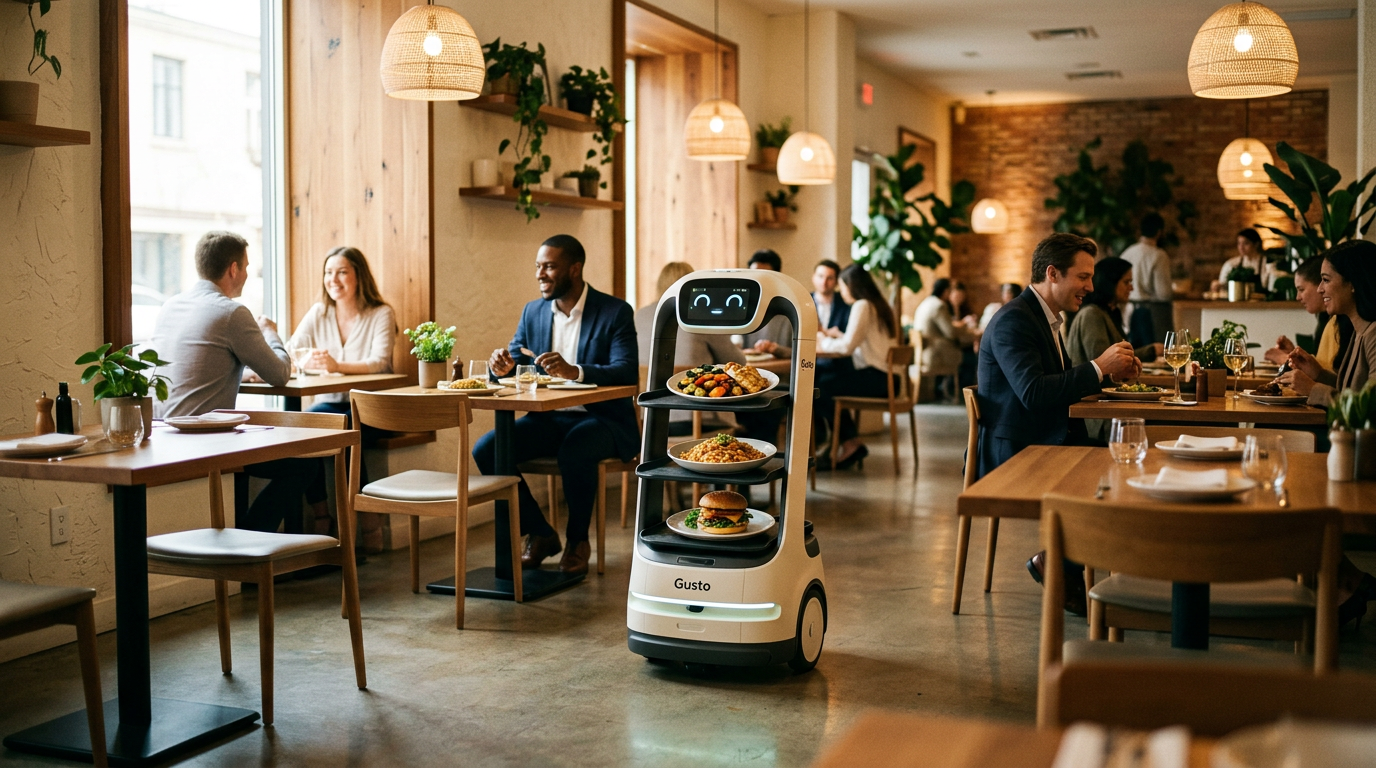
Robot servers have emerged as one of the most rapidly adopted categories in restaurant automation. These autonomous mobile robots navigate dining rooms, delivering food from the kitchen to tables while requiring human servers to handle the final interaction. The technology has advanced significantly, with modern serving robots featuring sophisticated navigation systems, obstacle avoidance, and the ability to integrate with restaurant point-of-sale systems.
The value proposition for serving robots focuses less on replacing human workers and more on augmenting their capabilities. By handling the physically demanding and time-consuming task of transporting food and dishes, robot servers allow human staff to focus on customer interaction, upselling, and table management—tasks that deliver greater value to both the restaurant and the employee.
Prep Robots
Automated preparation equipment addresses the labor-intensive prep work that traditionally consumes significant kitchen staff time. These machines handle tasks like vegetable chopping, salad assembly, ingredient portioning, and component preparation. The category has seen particular growth in establishments offering standardized menu items where portion consistency directly impacts food costs.
Prep robots are often the most economically accessible category of restaurant automation, with many solutions priced significantly below cooking or serving robots while delivering substantial labor savings in high-volume environments.
Dishwashing Robots
Automated dishwashing systems represent a specialized but increasingly important category as operators struggle to fill dishwashing positions that have historically experienced the highest turnover rates in restaurant operations. Modern automated dishwashing solutions range from conveyor-based commercial systems to fully robotic dish-handling solutions that load, wash, and unload dishes without human intervention.
Robot Chefs: Cooking Automation
The concept of a robot chef that can replicate the nuanced cooking of a trained human chef remains largely aspirational. However, the current generation of cooking robots excels at specific, well-defined cooking tasks where standardization delivers measurable benefits. Understanding the capabilities and limitations of each technology is crucial for realistic expectations and successful implementation.
Flippy (Miso Robotics)
Flippy, developed by Miso Robotics, has become the most widely recognized cooking robot in the restaurant industry. The robotic arm system is specifically designed for fry station operations, handling tasks including cooking timing, flipping, and basket removal. Originally deployed at Caliburger locations, Flippy has expanded to numerous partner restaurants and stadium food service operations.
The system uses computer vision and machine learning to identify food items, monitor cooking progress, and adjust timing accordingly. Flippy’s primary value proposition is consistency—it never forgets to flip, never misjudges cooking time due to distraction, and maintains exact specifications across thousands of cooking cycles.
Capabilities: Flippy handles fry cooking and related tasks with minimal human oversight. The system integrates with existing fryer equipment and can operate continuously during peak periods. It monitors oil temperature, adjusts cooking times for different items, and alerts operators when baskets are ready for removal.
Limitations: Flippy is a single-function machine optimized specifically for fry cooking. It cannot handle other cooking tasks, meaning operators still require human cooks for the broader menu. The system requires regular maintenance and calibration to maintain accuracy.
ROI Data: Miso Robotics reports that Flippy can reduce fry station labor costs by up to 70% while increasing throughput by up to 30%. The typical installation costs between $30,000 and $50,000 for hardware, with monthly software subscription fees ranging from $1,500 to $3,000 depending on service level.
Spyce
Spyce, a Boston-based company, developed a unique concept: a fully automated kitchen specifically designed for grain bowls and healthy fast-casual fare. The Spyce system uses a combination of robotic arms, automated cooking vessels, and precision ingredient dispensing to prepare complete meals without human cooks.
The system represents a more comprehensive approach to cooking automation, capable of handling multiple recipe types and ingredient combinations within its menu scope. Spyce’s concept demonstrated that automated cooking could produce varied, customizable meals at speeds exceeding traditional kitchen operations.
Capabilities: Spyce systems can prepare hundreds of bowl combinations, automatically cooking grains, proteins, and vegetables to specification while executing precise portioning and plating. The system maintains ingredient quality through automated storage and handling.
Limitations: The system’s menu scope is necessarily constrained to items that can be executed within its mechanical capabilities. Complex dishes requiring multiple cooking techniques or artistic presentation remain beyond current automated cooking technology.
Pazzi
Pazzi, a French robotics company, focused on automated pizza preparation—arguably one of the most demanding cooking automation challenges due to the specialized techniques required for dough handling. The Pazzi system automates the entire pizza-making process from dough ball to finished pizza.
The technology addresses the significant labor challenges in pizza operations, where skilled dough handlers and pizza makers command premium wages. Pazzi’s approach demonstrates how robotics can address specific skilled-labor shortages in cuisine-specific operations.
Capabilities: Pazzi handles dough stretching, sauce application, topping distribution, and baking coordination. The system can produce consistent pizzas at rates exceeding most human-operated setups while maintaining exact ingredient specifications.
Limitations: Like all specialized cooking robots, Pazzi’s application is limited to pizza. The system requires significant space and infrastructure investment, making it most suitable for high-volume pizza operations.
CookRight (CaliBurger)
CookRight, developed in partnership between Miso Robotics and CaliBurger, represents an evolution beyond physical robot arms into AI-powered monitoring systems. CookRight uses computer vision and machine learning to monitor grill operations, tracking burger cooking progress and alerting human cooks when intervention is needed.
This approach represents an important distinction in the restaurant automation landscape: not all valuable robotics require physical machines. AI-powered monitoring systems can deliver significant operational benefits by augmenting human capabilities rather than replacing them.
Capabilities: CookRight monitors multiple burger cooking operations simultaneously, tracking doneness, identifying when flipping is needed, and alerting staff to remove items at optimal times. The system learns from each cooking cycle, improving accuracy over time.
Limitations: CookRight assists rather than replaces human cooks. The system requires human operators to execute its recommendations and cannot function independently.
Cost and ROI Summary for Robot Chefs
The investment required for cooking automation varies widely based on technology sophistication and application scope. Entry-level cooking robots and AI monitoring systems can cost as little as $10,000 to $30,000, while comprehensive cooking systems like Spyce or Pazzi can exceed $150,000 for full installation.
Return on investment calculations must account for multiple factors: direct labor reduction, increased throughput during peak periods, consistency improvements that reduce waste, and reduced workers’ compensation exposure for repetitive strain injuries. Most cooking robot implementations achieve payback within 18 to 30 months, with higher-volume operations typically realizing faster returns.
Robot Servers and Delivery
The deployment of robot servers in restaurants has accelerated dramatically, with major chains and independent operators alike implementing autonomous delivery robots. These machines have proven particularly effective in addressing the physically demanding aspects of food service work, reducing server fatigue and enabling staff to focus on customer interaction.
BellaBot
Developed by Pudu Robotics, BellaBot has become one of the most widely deployed serving robots in the restaurant industry. The robot features a sleek, modern design with an expressive LED face that displays emotions, helping create a friendly interaction with customers rather than the cold, mechanical experience some might expect.
BellaBot navigates restaurant environments using advanced simultaneous localization and mapping (SLAM) technology, avoiding obstacles while efficiently moving between kitchen and dining areas. The robot can carry multiple dishes simultaneously and is designed to integrate smoothly with existing restaurant workflows.
Use Cases: BellaBot excels at food running—transporting completed orders from the kitchen window to designated tables. It can also handle bussing duties, collecting dishes and transporting them to dishwashing areas, and can be equipped for drink delivery applications.
Capabilities: The robot features a 66-pound carrying capacity, multiple trays for order separation, voice interaction capabilities, and intelligent obstacle avoidance. BellaBot can operate for 12 to 24 hours on a single charge, depending on usage intensity.
Limitations: BellaBot requires a relatively obstacle-free path between kitchen and dining areas. Extremely crowded dining rooms, narrow spaces, and multi-level establishments may present navigation challenges. The robot cannot interact with customers beyond basic delivery confirmation.
Impact Data: Operators implementing BellaBot report approximately 30% improvement in food running efficiency, with servers able to manage more tables simultaneously. More significantly, servers report reduced fatigue and physical strain, with fewer requests for transfer from floor duties to less demanding positions.
Servi (Bear Robotics)
Bear Robotics developed Servi specifically for restaurant applications, with features optimized for the unique challenges of dining room delivery. The robot incorporates a tall, narrow design that allows it to navigate between closely spaced tables while carrying substantial loads.
Servi has been deployed extensively in both chain and independent restaurants, with notable implementations at major casual dining brands seeking to address ongoing server staffing challenges.
Use Cases: Primary applications include food delivery from kitchen to table, bussing of finished dishes, and supplementary drink service support. The robot’s three-tier design allows separation of items by course or destination.
Capabilities: Servi features a 66-pound capacity distributed across three shelves, autonomous navigation with dynamic obstacle avoidance, and integration with restaurant calling systems for order pickup notifications.
Cost: Pricing for Servi typically ranges from $15,000 to $25,000 per unit, with monthly service subscriptions available for ongoing support and software updates.
Pudu Robotics Extended Line
Beyond BellaBot, Pudu Robotics offers a range of delivery robots designed for different restaurant applications. The company’s portfolio includes specialized solutions for larger venues, bussing applications, and high-volume environments.
The diversity of options reflects the maturation of the robot server category, with manufacturers developing specialized solutions for different operational contexts rather than one-size-fits-all approaches.
Important Clarification: Augmentation, Not Replacement
A critical distinction must be made regarding robot servers: they are designed to augment human servers, not replace them. This is a fundamental reality of current restaurant automation technology that operators must understand for realistic implementation planning.
Robot servers cannot take orders, respond to guest complaints, provide menu recommendations, process payments, or handle the countless unexpected situations that arise in restaurant service. They excel at the transportation task—moving items from point A to point B—which happens to be one of the most time-consuming aspects of server duties.
The most successful implementations use robots to enhance server productivity rather than reduce server headcount. A single server working with a robot server can effectively manage more tables, provide better service to each table, and maintain higher energy levels throughout a shift. This approach typically generates better financial returns than pure headcount reduction while also improving employee satisfaction and retention.
Automated Prep and Dishwashing
Behind the more visible cooking and serving robots lies a substantial category of automation focused on preparation and dishwashing operations. These systems address some of the most challenging staffing issues in restaurants while delivering consistent quality improvements that directly impact food costs.
Chowbotics (Salad Robots)
Chowbotics, now part of Signature Science, developed the Sally robot—a fully automated salad preparation system that allows customers or staff to create custom salads from dozens of ingredient options. The machine precisely measures and combines ingredients, ensuring consistent portions and eliminating waste from ingredient spoilage.
The Sally robot addresses multiple operational challenges simultaneously: it reduces the need for dedicated salad preparation staff, ensures exact portion control that improves food cost consistency, and can operate in locations without full kitchen facilities—enabling salad service in convenience stores, airports, and corporate cafeterias.
Capabilities: The system can store up to 22 different ingredients, automatically dispensing precise portions into a bowl. It handles the entire assembly process, from base greens through proteins, toppings, and dressings, with each selection made via touchscreen interface.
Limitations: Menu scope is necessarily limited to items the machine can assemble. Complex or artistic presentations are not possible. The system requires regular restocking and maintenance.
Automated Vegetable Cutting
Several manufacturers have developed automated vegetable cutting systems that address the labor-intensive prep work required for knife skills positions. These machines can slice, dice, julienne, and shred various vegetables at volumes that would require multiple human prep cooks.
For operations with high vegetable utilization—salad bars, fast-casual concepts, vegetarian-focused restaurants—automated cutting systems can significantly reduce prep labor while maintaining consistent cut sizes that improve cooking uniformity and presentation.
Robotic Dishwashers
The dishroom represents one of the most challenging areas for restaurant staffing, with consistently high turnover and physically demanding work conditions. Automated dishwashing systems range from advanced conveyor systems to fully robotic solutions that can load, wash, unload, and stack dishes without human intervention.
The most advanced systems use robotic arms equipped with computer vision to identify dish types, grasp them appropriately, place them in rack systems, and coordinate with commercial dishwasher equipment. These systems can operate continuously during service periods, eliminating the bottleneck that often develops during peak meal periods.
Capabilities: Modern systems handle most common dishware types, coordinate with dishwasher equipment, and can maintain throughput exceeding what human dishwashers can sustain over extended periods.
Limitations: Initial investment is substantial, typically ranging from $50,000 to $200,000 depending on automation level. The systems require compatible dishware and may struggle with unusual items or heavily soiled
Not Ready for Robots? Start with AI Software Instead
Restaurant AI doesn’t require hardware investment. AI Chef Pro delivers menu engineering, food cost tracking, and demand forecasting from your browser.
The Business Case for Restaurant Robots — ROI Analysis
Beyond the novelty factor, restaurant operators are increasingly evaluating robotics through a strictly financial lens. The initial capital investment can be substantial, but for the right operation, the return on investment (ROI) tells a compelling story. Understanding the numbers behind robotic implementation is essential before making any purchasing decisions.
Labor costs represent the largest single expense for most restaurant operations, often consuming 30-40% of revenue. Robot chefs and servers address this cost center directly, offering predictable performance without the variables of attendance, turnover, or scheduling constraints. However, the financial case varies significantly by robot type, operation volume, and local labor markets.
Robot Investment and ROI Comparison
| Robot Type | Cost Range | Annual Labor Saved | Payback Period |
|---|---|---|---|
| Fry Station (Flippy) | $30K-75K | $40K-60K | 8-18 months |
| Robot Server (BellaBot) | $15K-25K | $15K-25K | 12-18 months |
| Pizza Robot | $50K-150K | $50K-80K | 12-24 months |
| Robotic Dishwasher | $50K-200K | $35K-55K | 18-36 months |
| Salad/Bowl Assembly | $25K-80K | $30K-50K | 10-20 months |
Where Robots Make Financial Sense
Based on current deployment data, robotics investment proves most attractive under specific operational conditions:
- High-volume quick-service and fast-casual operations — Locations processing 500+ orders daily see the fastest payback periods, as automation directly multiplies throughput capacity
- Repetitive, standardized tasks — Frying, pizza assembly, salad building, and consistent dish patterns offer ideal automation opportunities where human variation introduces quality inconsistency
- Labor-scarce markets — Regions with minimum wages above $15/hour or genuine staffing shortages make automation economically compelling regardless of capital costs
- Extended operating hours — Locations running 18-24 hour shifts maximize robot utilization, spreading fixed costs across more revenue-generating hours
Where Robots Don’t Make Sense
Despite the promising numbers, certain restaurant concepts should approach robotics cautiously:
- Fine dining with creative plating — The artistry and presentation precision required in upscale concepts remains beyond current robotic capabilities
- Small operations with low volume — A neighborhood café processing 80 daily covers cannot justify $30K+ investments with limited labor savings
- Menus requiring frequent changes — Seasonal rotations, daily specials, and rotating concepts create programming overhead that erodes automation benefits
- Limited capital reserves — Operations without financial cushion for unexpected repairs or integration costs face elevated risk
The decision to implement robotics should begin with honest assessment of your operation’s volume stability, task standardization, and labor economics. Those metrics will determine whether the numbers work in your specific context.
Challenges and Limitations
While the potential of restaurant robotics is substantial, operators must navigate significant challenges before implementation. Understanding these limitations prevents costly missteps and sets realistic expectations for robotic integration.
Maintenance and Operational Costs
Robot maintenance represents an ongoing expense often underestimated during initial planning. Annual maintenance contracts range from $3,000 to $8,000 depending on robot complexity and coverage level. These systems require specialized technicians—rare in rural markets—creating potential downtime vulnerabilities. Additionally, replacement parts, software updates, and calibration services add cumulative costs over a robot’s 5-10 year operational lifespan.
Menu Flexibility Constraints
Current generation robot chefs excel at consistency but struggle with variability. Programming a fry station for five menu items differs dramatically from adapting to daily specials, seasonal ingredients, or customer modifications. When menu changes require new programming, operators face either significant downtime during reprogramming or the cost of external technical support—sometimes exceeding $500 per menu update.
Customer Perception: The Novelty Factor
Customer responses to robotic service remain mixed, creating both opportunities and risks. Initial curiosity drives traffic—many restaurants report sales bumps from robot novelty—but sustained customer acceptance depends on food quality and service reliability. Some diners express discomfort with robot servers, while others appreciate the efficiency. The key insight: novelty attracts, but consistency retains.
Environmental and Integration Challenges
Restaurant environments present harsh conditions for precision robotics. Grease accumulation affects sensors, high temperatures near cooking equipment strain mechanical components, and moisture from dishwashing areas creates electrical hazards. These factors demand more robust (and expensive) equipment specifications than comparable industrial applications.
Integration with existing POS systems, inventory management, and kitchen display systems adds complexity and cost. Many operators report 3-6 months of adjustment periods before robotic systems achieve intended efficiency levels.
Capital Requirements and Regulatory Considerations
The upfront capital required for meaningful robotic implementation remains prohibitive for many independent operators. While financing options exist, the debt service adds to operational overhead during already-tight profit margin periods.
Regulatory frameworks continue evolving across jurisdictions. Some cities require special permits for autonomous servers, while health department regulations regarding robot food contact surfaces remain inconsistent. Operators must navigate these requirements before deployment.
The Human + Robot Kitchen: The Augmented Future
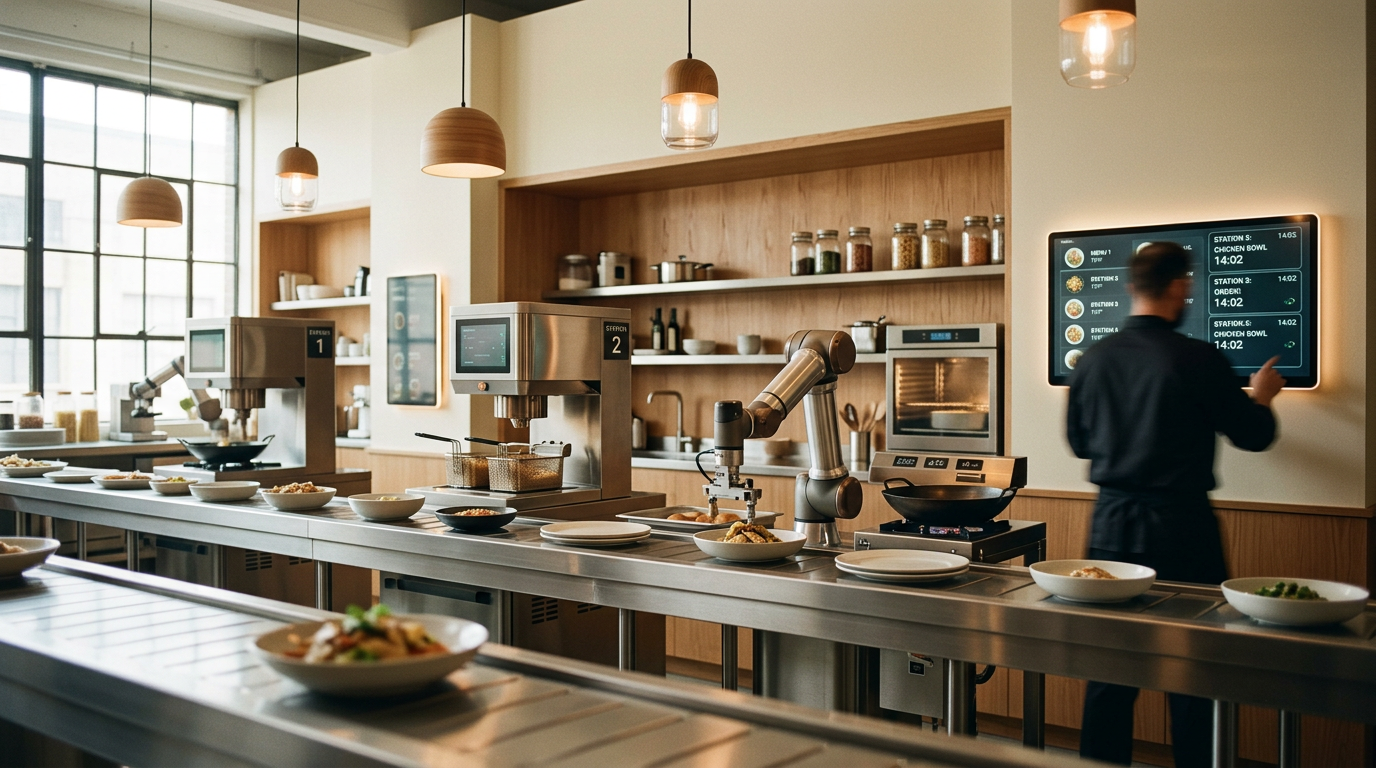
The most successful restaurants of the coming decade won’t choose between human creativity and robotic efficiency—they’ll master the art of augmentation. The future kitchen isn’t about replacing one with the other; it’s about deploying each where they deliver maximum value.
What Robots Do Best
Robotic systems excel at defined, repetitive tasks that require consistent precision:
- Temperature-controlled frying at exact timing intervals
- Assembly-line bowl and salad construction
- Plate bussing and dish transport
- Ingredient portioning and prep consistency
- High-volume pizza production
These tasks demand reliability over creativity—exactly what automation delivers. Robots don’t call in sick, don’t require scheduling, and don’t produce inconsistent results due to fatigue or distraction.
What Humans Do Best
Despite robotics advances, distinctly human capabilities remain irreplaceable:
- Creative menu development — Crafting dishes that tell stories, evoke emotions, and differentiate your brand
- Problem-solving in real-time — Adapting when supplies arrive late, equipment fails, or a guest has unusual dietary needs
- Guest interaction and relationship building — The personal touch that transforms a meal into an experience and generates loyal customers
- Team leadership and culture — Mentoring staff, maintaining morale, and embodying your restaurant’s values
- Quality inspection and creative plating — The artistic judgment that elevates presentation
AI as the Bridge: Empowering the Human Side
This is where artificial intelligence becomes transformative—not as a replacement for human judgment, but as an amplifier of human capability. AI Chef Pro represents this philosophy directly, offering over 55 specialized tools designed specifically for culinary professionals and restaurant operators.
These tools address the human side of the equation with capabilities including:
- Advanced menu engineering to maximize profitability
- Recipe development and optimization
- Precise food cost management and control
- Demand forecasting for inventory and staffing
- Flavor profiling and pairing recommendations
- Supplier analysis and negotiation support
While robots handle the consistent execution of established recipes, AI tools empower your culinary team to create those recipes, optimize their profitability, and continuously improve based on data-driven insights.
AI Chef Pro offers a free tier with 10 uses per month, allowing restaurant professionals to explore these capabilities without commitment. For operators ready to embrace the augmented kitchen model, this combination of robotic execution and AI-powered creativity represents the most practical path forward.
Frequently Asked Questions
The Future Kitchen: Human Creativity + AI Intelligence
Let robots handle the repetitive. Let AI handle the data. Let your team handle the creativity. AI Chef Pro — 55+ tools, free tier available.
How much do restaurant robots cost?
Restaurant robot costs range from $15,000 to $200,000 depending on type and capability. Serving robots like BellaBot typically cost $15,000-$25,000. Cooking robots such as Flippy or pizza automation systems range from $30,000-$150,000. Robotic dishwashing systems represent the higher end at $50,000-$200,000. These figures represent purchase prices; financing options can spread costs over time but add interest expenses.
Can robots fully replace restaurant workers?
No—current robotics technology augments rather than replaces restaurant workers. Robots excel at repetitive, standardized tasks like frying, assembly, and bussing, but cannot replicate human creativity, problem-solving, or genuine guest interaction. The most successful implementations use robots to handle tedious tasks while freeing human staff to focus on guest experience, creative cooking, and relationship building. Additionally, robotics require human oversight, maintenance, and programming—creating new rather than eliminated roles.
Which restaurants currently use robots?
Major chains leading robot adoption include Chipotle (testing Flippy for fry operations), Sweetgreen (automated bowl assembly), and various Pizza Hut and Domino’s locations (pizza robots). Robot servers from BellaBot and Pudu appear in numerous chains including Hometown Buffet, JD.com’s restaurants, and several hotel chains. However, widespread adoption remains concentrated in quick-service and fast-casual segments. Fine dining and independent restaurants represent less than 15% of current deployments.
What tasks can restaurant robots perform?
Current restaurant robots handle diverse functions across the operation: cooking robots perform frying, grilling, pizza assembly, and salad/bowl construction. Serving robots deliver food to tables and handle bussing. Dishwashing robots automate the cleaning and sanitization process. Ingredient preparation robots handle chopping, slicing, and portioning. Some advanced systems manage inventory tracking and quality monitoring. The specific capability depends on the robot type and programming, with newer models offering increasing task flexibility.
What is the ROI of restaurant robotics?
Typical payback periods range from 12-24 months depending on robot type, operation volume, and labor costs. Annual labor savings range from $15,000 (basic serving robots) to $80,000 (advanced cooking systems). Beyond labor, robots provide consistency improvements, throughput gains, and reduced waste—all contributing to ROI. However, maintenance costs ($3,000-$8,000 annually), programming updates, and integration expenses must factor into complete ROI calculations. High-volume quick-service operations typically see faster returns than lower-volume concepts.
Are customers comfortable with robotic restaurants?
Customer comfort levels show significant variation. Research indicates approximately 61% of consumers express curiosity about robotic restaurant service, with younger demographics more receptive. The novelty factor drives initial traffic spikes when robots debut, but long-term acceptance depends entirely on food quality and service consistency. Some customers appreciate efficiency and reduced human contact, while others prefer traditional service interaction. Fine dining guests generally expect human service, while quick-service customers often prefer speed over social interaction. Success requires matching robot deployment to your specific customer demographic preferences.
Conclusion: Navigating the Robotic Restaurant Revolution
Restaurant robotics has moved definitively from science fiction to business reality. The technology exists, the ROI math works for the right operations, and major chains are deploying systems at scale. Yet this technology remains a targeted solution rather than a universal answer—the robotic restaurant of popular imagination isn’t replacing all human-staffed establishments anytime soon.
What we’re witnessing is instead a gradual, task-by-task transformation of the restaurant industry. Robots handle what machines do best: consistent, repetitive, high-volume tasks that don’t require creativity or judgment. Humans focus on what they do best: crafting memorable experiences, solving unexpected problems, building relationships that create loyal customers.
For operators evaluating this technology, the practical path forward involves honest assessment of your specific operation. High-volume quick-service locations with standardized menus and challenging labor markets will continue leading adoption. Fine dining and independent concepts should view robotics as a tool for specific tasks rather than wholesale transformation.
The most successful restaurants of the next decade will be those that strategically deploy automation where it delivers clear value while investing in the human capabilities that truly differentiate their brand. This means optimizing both sides of the equation—the consistent execution robots provide AND the creative excellence that builds customer loyalty.
That’s exactly why AI Chef Pro exists. While robots handle execution, our suite of 55+ AI-powered tools empowers your culinary team to maximize creativity, optimize profitability, and make data-driven decisions. From menu engineering to food cost management to demand forecasting, these tools amplify the human capabilities that matter most.
Ready to optimize your restaurant’s human side? Explore AI Chef Pro’s complete toolkit at https://a
Related Reading
- Restaurant Technology 2026: The Definitive Guide
- Smart Kitchen Technology for Commercial Kitchens
- Ghost Kitchen Technology Stack
- AI Cooking Assistant for Professional Chefs
- How to Launch a Virtual Kitchen with AI
- Restaurant Food Waste: 12 AI Strategies
Discover more from AI Chef Pro Blog
Subscribe to get the latest posts sent to your email.