
Autonomous food delivery robots are rolling out across US cities and campuses, fundamentally changing how restaurants reach their customers. The market is projected to reach $1.5 billion by 2028, with companies like Starship Technologies already completing over 7 million deliveries. This rapid growth represents a paradigm shift in last mile delivery robot technology, offering restaurants an alternative to traditional third-party delivery apps that charge hefty commissions.
For restaurant operators facing slim margins and increasing competition, food delivery robots present an intriguing opportunity to reduce costs, improve efficiency, and differentiate their brand. However, understanding the technology, evaluating the major players, and determining whether this solution fits your specific operation requires careful analysis.
This comprehensive guide covers everything you need to know about autonomous delivery robots—including how they work, the leading companies in the space, cost comparisons, and practical steps to implement robot delivery in your restaurant.
Optimize Your Delivery Menu with AI
AI Chef Pro helps you engineer menus for delivery, forecast demand, and track food costs across all channels. 55+ tools, free tier available.

How Food Delivery Robots Work
The technology behind autonomous delivery robots represents a sophisticated blend of robotics, artificial intelligence, and navigation systems. Understanding how these machines operate is essential for restaurant operators considering this delivery method.
Autonomous Navigation Systems
Modern delivery robots rely on a multi-layered approach to navigate safely through urban environments. The primary technologies include:
- GPS (Global Positioning System): Provides global location tracking, allowing robots to calculate routes and monitor their position in real-time.
- LiDAR (Light Detection and Ranging): Uses laser pulses to create detailed 3D maps of the surrounding environment, detecting obstacles, pedestrians, and infrastructure.
- Camera Systems: High-resolution cameras provide visual recognition capabilities, enabling robots to identify traffic signals, crosswalks, and potential hazards.
- Ultrasonic Sensors: Supplement other sensors for close-range obstacle detection, particularly useful when navigating tight spaces.
- Machine Learning Algorithms: Process sensor data in real-time to make navigation decisions, learn from past experiences, and adapt to changing conditions.
These systems work together to enable fully autonomous navigation, though most companies also maintain remote monitoring centers where human operators can take control if necessary.
Sidewalk vs. Road Robots
There are two primary categories of delivery robots, each designed for different environments and use cases:
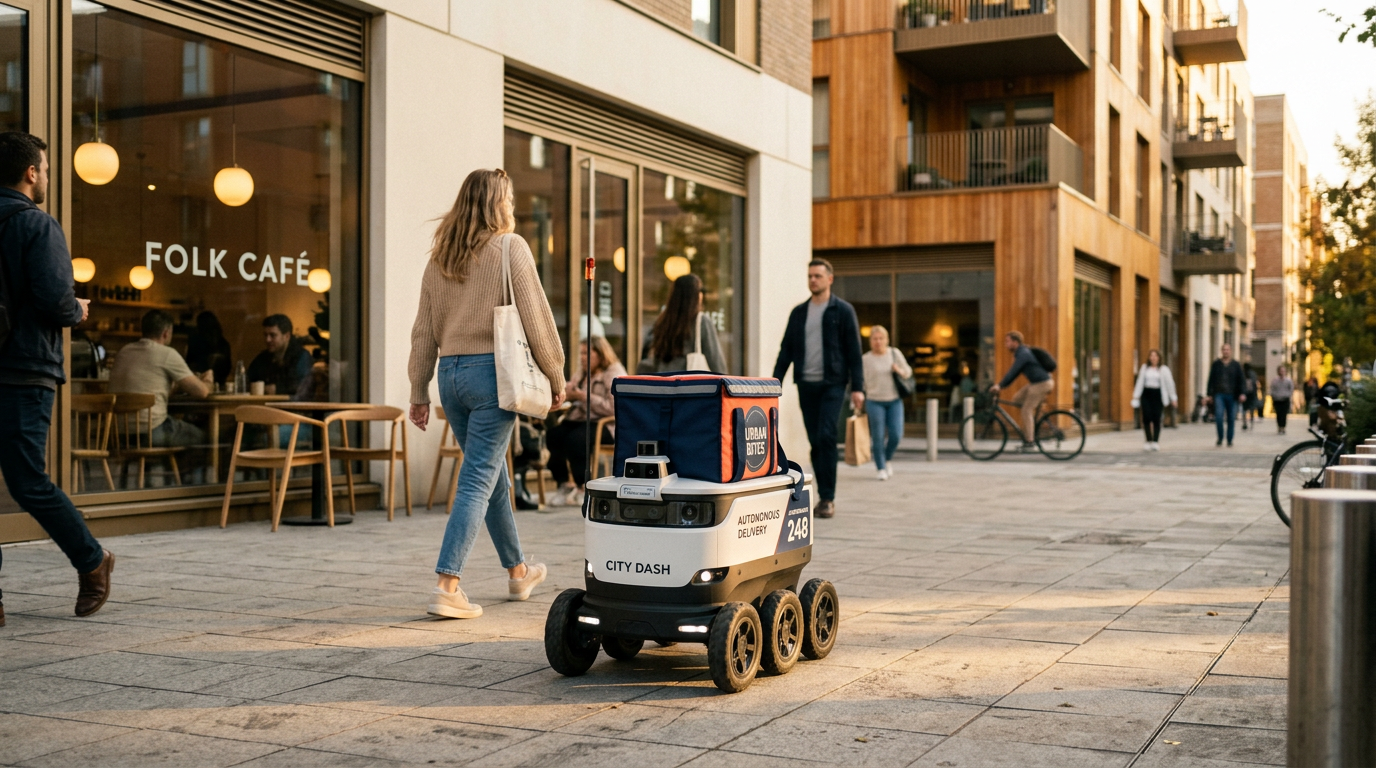
Sidewalk Delivery Robots are smaller, lighter machines designed to travel on pedestrian pathways. These robots typically weigh 20-80 pounds and travel at speeds of 4-6 mph. They navigate sidewalks, crosswalks, and pedestrian areas, making them ideal for campus environments and dense urban neighborhoods. Companies like Starship Technologies, Kiwibot, and Serve Robotics primarily operate sidewalk robots.
Road Robots are larger vehicles designed to travel on streets alongside regular traffic. These autonomous vehicles can reach higher speeds (up to 25-35 mph) and carry heavier payloads (up to 100+ pounds). Nuro is the leading company in this category, with vehicles designed for grocery and food delivery on roads. These robots require more robust regulatory approval but can serve a wider delivery radius.
Last Mile Delivery Concept
The term “last mile” refers to the final leg of the delivery process—from a distribution point or restaurant to the customer’s location. This segment is often the most expensive and time-consuming part of delivery, particularly in dense urban areas where traffic, parking, and congestion create significant delays.
Last mile delivery robots excel in this final segment because they can bypass traffic congestion, park directly at customer locations, and operate continuously without the constraints of human drivers. For restaurants, this means more predictable delivery times and potentially fresher food reaching customers.
Technical Specifications
Understanding the capabilities and limitations of delivery robots helps restaurant operators determine if this technology fits their needs:
- Delivery Radius: Most sidewalk delivery robots operate within a 1-3 mile radius from the restaurant. This limitation makes them most suitable for restaurants in dense urban areas or near university campuses.
- Speed: Sidewalk robots typically travel at 4-6 mph, which translates to 10-15 minutes for a one-mile delivery under normal conditions.
- Payload Capacity: Most robots can carry 20-50 pounds of food, equivalent to approximately 2-4 typical food delivery orders. This capacity is suitable for individual orders or small group deliveries.
- Weather Capabilities: Modern robots can operate in light to moderate rain and snow, though extreme weather conditions may limit their effectiveness. Most companies have developed weather-resistant designs and operational protocols for various conditions.
- Battery Life: Most robots can operate for 8-16 hours on a single charge, with automatic return to charging stations when battery levels are low.
Major Food Delivery Robot Companies
The autonomous delivery robot market has matured significantly, with several established players competing for restaurant partnerships. Here’s a detailed look at the leading companies:
Starship Technologies
Starship Technologies is widely recognized as the pioneer and leader in robot food delivery. Founded by two Skype co-founders in 2014, the company has completed over 7 million deliveries and operates in more than 25 U.S. cities.
Key Statistics:
- 7 million+ deliveries completed
- Presence in 25+ U.S. cities
- Strong focus on university campuses
- Over 2,000 robots in operation
Pricing Model: Starship charges a flat delivery fee of $1.99 per order, significantly lower than traditional third-party delivery commissions that can reach 15-30%.
Restaurant Partnerships: Starship partners with major brands including Chipotle, Domino’s, and various campus dining services. The company has established strong relationships with university food services, making it the go-to choice for campus-adjacent restaurants.
Serve Robotics
Serve Robotics, a spin-off from Uber, has quickly established itself as a major player in urban food delivery robots. The company operates in Los Angeles and Dallas, with plans for rapid expansion.
Key Statistics:
- Level 4 autonomous capability
- Uber Eats partnership integration
- Operations in LA and Dallas
- 200+ robots deployed
Pricing Model: Serve operates on a per-delivery fee structure similar to Starship, with pricing varying by location and partnership terms.
Restaurant Partnerships: The Uber Eats partnership gives Serve Robotics immediate access to thousands of restaurants on the Uber Eats platform. This integration makes it easy for restaurants already using Uber Eats to add robot delivery as an option.
Kiwibot
Kiwibot has carved out a niche in university campus delivery, completing over 200,000 deliveries across multiple U.S. campuses. The company focuses on providing affordable, sustainable delivery options for campus communities.
Key Statistics:
- 200,000+ deliveries completed
- Primary focus on university campuses
- Operations in multiple U.S. cities
- Emphasis on sustainability
Pricing Model: Kiwibot charges approximately $3.99 per delivery, with some campus partnerships offering reduced or waived fees.
Restaurant Partnerships: Kiwibot partners with campus dining services and local restaurants near university locations. The company has established relationships with major food service providers including Aramark and Sodexo.
Nuro
Nuro takes a different approach from other companies by focusing on larger road-going vehicles rather than sidewalk robots. The company’s autonomous vehicles are designed for higher-volume deliveries over greater distances.
Key Statistics:
- Larger road-based delivery vehicles
- Partnerships with major retailers
- Higher payload capacity (up to 100+ lbs)
- Extended delivery radius
Pricing Model: Nuro operates on business-to-business contracts with partners rather than a per-order fee model for restaurants.
Restaurant Partnerships: Nuro has established partnerships with Kroger for grocery delivery and Domino’s for pizza delivery. The company’s focus on larger vehicles makes it suitable for bulk orders and grocery delivery rather than typical restaurant takeout.
Coco
Coco operates a fleet of teleoperated robots in Los Angeles and Austin, combining autonomous technology with human oversight for enhanced reliability.
Key Statistics:
- Teleoperated technology with human monitoring
- Operations in LA and Austin
- Restaurant-focused service
- Real-time human oversight
Pricing Model: Coco charges per-delivery fees competitive with other robot delivery services.
Restaurant Partnerships: Coco focuses specifically on restaurant delivery partnerships, working with various quick-service and fast-casual restaurants in its service areas.
Cartken
Cartken offers a white-label autonomous delivery platform that businesses can customize for their specific needs. This approach allows restaurants and delivery companies to brand their own robot fleets.
Key Statistics:
- White-label platform for businesses
- Customizable for specific needs
- Integration capabilities
- B2B focus
Pricing Model: Cartken operates on B2B licensing and partnership arrangements rather than direct consumer delivery fees.
Restaurant Partnerships: Cartken works with businesses seeking to launch their own branded robot delivery services, making it ideal for restaurant groups or delivery companies wanting proprietary robot delivery capabilities.
Benefits for Restaurants
Implementing food delivery robots offers several compelling advantages for restaurant operators looking to optimize their delivery operations:
Lower Delivery Costs
Perhaps the most significant benefit is the potential for dramatic cost savings. Traditional third-party delivery apps charge commissions ranging from 15% to 30% per order. In contrast, robot delivery services typically charge flat fees of $1.99-$3.99 per delivery, representing savings of $3-8 or more per order compared to traditional delivery methods.
For high-volume restaurants processing hundreds of delivery orders weekly, these savings can translate to thousands of dollars in monthly profit improvement.
Consistent Delivery Times
Autonomous delivery robots offer more predictable delivery times compared to human drivers. Robots follow optimized routes, don’t face traffic delays to the same degree, and don’t require time for parking or navigation uncertainties. Most robot deliveries within the 1-3 mile radius are completed in 15-30 minutes, providing customers with reliable ETAs.
Novelty Factor
The novelty of receiving food delivered by a robot can drive customer interest and repeat orders. For restaurants in robot-served areas, this technology differentiation can attract curious customers and generate social media exposure as customers share their robot delivery experiences.
No Tipping Required
Unlike human delivery drivers, robot deliveries don’t require tipping. While this might seem like a minor point, it simplifies the customer experience and ensures the restaurant captures the full order value without additional compensation expectations.
24/7 Availability Potential
Autonomous robots can operate around the clock without requiring shift changes, breaks, or overtime pay. For restaurants looking to extend their delivery hours, particularly late-night service, robot delivery offers a scalable solution.
Reduced Delivery Errors
Robot delivery systems integrate directly with restaurant ordering platforms, reducing the potential for miscommunication, wrong addresses, or order mix-ups. The automated nature of the system minimizes human error throughout the delivery process.
Brand Differentiation
Offering robot food delivery positions your restaurant as innovative and tech-forward. This differentiation can attract younger, tech-savvy customers and position your brand as a leader in adopting new technologies.
Challenges and Limitations
While the benefits are compelling, restaurant operators should also understand the limitations and challenges associated with autonomous delivery robots:
Limited Range
The 1-3 mile delivery radius significantly limits the customer base that can be served via robot. Restaurants in suburban areas or with geographically dispersed customers may find robot delivery impractical. This technology works best for restaurants in dense urban areas or near university campuses.
Weather Sensitivity
While modern robots can handle light rain and moderate weather conditions, extreme weather—including heavy rain, snow, high winds, and extreme temperatures—can disrupt operations. Restaurants in regions with harsh winters or frequent severe weather should consider seasonal limitations.
Theft and Vandalism Concerns
Although incidents are rare given the robots’ security features, theft and vandalism remain concerns. Most robots include alarms, GPS tracking, and remote monitoring capabilities. Companies typically assume liability for losses, but restaurant operators should understand the specific terms of their partnerships.
Regulatory Landscape
Sidewalk delivery robot regulations vary significantly by city and state. Some municipalities have embraced the technology with minimal restrictions, while others have imposed strict requirements or outright bans. Restaurant operators should verify that robot delivery is permitted in their area before investing in this option.
Infrastructure Requirements
Successful robot delivery may require infrastructure investments or accommodations, including designated loading zones, accessible pathways, and proper lighting. In some cases, restaurants may need to work with property managers or local authorities to ensure their location is robot-friendly.
Customer Adoption Curve
While robot delivery generates novelty, some customers may be hesitant to embrace the technology or may not know how to interact with robots for pickup. Customer education and clear instructions may be required to ensure smooth deliveries.
Food Temperature Maintenance
Maintaining food temperature during delivery presents challenges, particularly for longer routes or in extreme weather conditions. Restaurants must optimize their packaging for robot delivery, using insulated bags and containers designed to maintain temperature during the 15-30 minute delivery window.
Delivery Robots Cut Costs — AI Cuts Them Further
Combine robot delivery with AI-powered demand forecasting and menu optimization. AI Chef Pro helps you maximize every delivery channel.
Cost Analysis for Restaurants
Understanding the financial implications of different delivery methods is essential for making informed decisions. Here’s a comprehensive comparison:
| Delivery Method | Per-Order Cost | Commission | Avg Delivery Time | Range |
|---|---|---|---|---|
| Third-Party App | $3-5 + 15-30% commission | Yes (15-30%) | 30-45 minutes | 5+ miles |
| In-House Driver | $5-8 per delivery | No | 20-35 minutes | 3-5 miles |
| Delivery Robot | $1.99-3.99 flat fee | No/Low | 15-30 minutes | 1-3 miles |
ROI Calculation for High-Density Areas
For restaurants in high-density urban areas or near university campuses, the return on investment for robot delivery can be substantial. Consider this example:
Imagine a quick-service restaurant processing 200 delivery orders per day at an average order value of $25:
- Third-Party App (25% commission): $1,250 daily commission + $600 in driver fees = $1,850 daily delivery costs
- Robot Delivery ($2.50 avg): $500 daily robot fees = $500 daily delivery costs
- Daily Savings: $1,350
- Monthly Savings: Approximately $40,500
- Annual Savings: Approximately $486,000
These calculations demonstrate why restaurants in suitable locations should seriously consider robot delivery as a cost optimization strategy.
# Food Delivery Robots: Technology, Companies, and What Restaurants Need to Know
Part 2: Implementation, Future Trends, and FAQ

How to Get Started with Delivery Robots
Implementing delivery robots in your restaurant operation requires careful planning and execution. Follow this step-by-step guide to ensure a successful launch.
Step 1: Evaluate Your Market
Before committing to robot delivery, assess whether your location is suited for this technology. Consider these factors:
- Population density — Robot delivery thrives in urban environments with walkable neighborhoods and concentrated customer bases
- Campus proximity — Universities and college towns represent ideal markets, with over 100 campuses currently offering robot delivery services
- Local regulations — Some cities require permits or have specific rules governing autonomous robots on sidewalks and streets
- Customer demographics — Tech-savvy younger consumers (Millennials and Gen Z) are more likely to embrace robotic delivery as a novelty and convenience
If your restaurant is located in a suburban area with low walkability or faces strict local regulations, robot delivery may not be the right fit—at least not yet.
Step 2: Choose a Robot Delivery Partner
Select a partner that operates in your area and aligns with your operational needs. Here’s a quick comparison:
- Starship Technologies — Largest fleet, most established, operating in 25+ US cities and 100+ campuses globally
- Serve Robotics — Backed by Uber Eats, strong presence in Los Angeles and other major metros
- Kiwibot — Focus on college campuses, expanding urban footprint
- Coco — West Coast presence, rapid expansion in Southern California
- Cartken — Smaller footprint but strong technology, operational in select markets
Contact each provider to confirm service availability in your zip code and request a pilot program overview.
Step 3: Optimize Your Menu for Robot Delivery
Not all menu items travel equally well in a robot compartment. To maximize customer satisfaction:
- Use appropriate packaging — Invest in insulated containers that maintain temperature during the 15-30 minute delivery window
- Select travel-friendly items — Fried foods, pizzas, burgers, and bowls generally perform well. Avoid items that wilt, sog, or require immediate plating
- Consider portion sizes — Most robots have limited cargo space (typically 20-30 liters). Ensure your portions fit comfortably in the compartments
- Adjust pricing — Factor in per-delivery costs when setting menu prices for robot orders
For restaurants looking to optimize their entire menu for delivery—whether robotic or traditional—AI Chef Pro (aichef.pro/en) offers 55+ AI-powered tools including menu engineering, demand forecasting, and packaging recommendations. Their free tier includes 10 uses per month, perfect for operators exploring delivery optimization.
Step 4: Set Up Operations
Smooth operational integration is critical for success:
- Designate a loading zone — Create a clear, accessible area near your pickup counter where staff can load robots efficiently
- Train your team — Ensure front-of-house staff understand the loading process, order verification, and robot handling basics
- Integrate order tracking — Connect your POS with the robot provider’s system for seamless order transmission and real-time tracking
- Establish prep timing — Coordinate with your kitchen to have orders ready when the robot arrives, minimizing wait times
Step 5: Market the Novelty
Robot delivery is still a novelty that generates buzz. Leverage this advantage:
- Social media content — Document robot arrivals, unboxings, and customer reactions. Short videos perform exceptionally well
- In-store signage — Announce the new delivery option with eye-catching displays at the entrance and pickup area
- First-delivery promotions — Offer discounts or free items for the first few robot orders to generate initial volume and reviews
- Partner with the robot company — Many providers offer joint marketing support for new restaurant partners
Step 6: Track and Optimize
Monitor key performance indicators to ensure profitability:
- Delivery times — Track average delivery duration and compare to traditional delivery
- Customer satisfaction — Gather feedback specifically on robot delivery experience
- Cost per delivery — Calculate your actual cost including food, packaging, and per-delivery fees
- Order volume impact — Measure whether robot delivery attracts new customers or shifts existing orders
Use this data to adjust your menu, pricing, or operational processes for maximum efficiency.
The Future of Food Delivery Robots
The robot delivery industry is evolving rapidly. Here’s what restaurants should watch for in the coming years:
Airborne Expansion: Drone Delivery
While ground-based robots dominate today, drone delivery is emerging as the next frontier. Companies like Wing (Alphabet), Amazon Prime Air, and Zipline are testing food delivery via aerial drones. Drones can cover longer distances faster, potentially serving suburban areas that ground robots cannot efficiently reach. Expect regulatory frameworks to develop over the next 3-5 years as drone delivery scales.
Larger Autonomous Vehicles
Beyond sidewalk robots, companies like Nuro are developing larger autonomous vehicles designed for road use. These vehicles can handle bigger orders, catering-size deliveries, and multi-stop routes. For restaurants with catering operations or larger order volumes, these vehicles could prove transformative.
ghost kitchen Integration
Robot delivery pairs naturally with ghost kitchen models. As ghost kitchens proliferate to meet demand for delivery-only concepts, robots offer a cost-effective last-mile solution. Expect to see more delivery-only restaurant brands specifically designing menus and operations around robotic logistics.
Regulatory Expansion
Currently, about 25+ US cities have active robot delivery programs. As safety records continue to prove strong (millions of deliveries with minimal incidents), more municipalities will likely approve robot delivery. The 2024-2025 period may see significant geographic expansion.
24/7 Capabilities
Most current operations run during daytime hours. However, robots equipped with improved lighting and sensing technology could enable late-night and overnight delivery—perfect for 24-hour restaurants, late-night fast food, and convenience store deliveries.
Multi-Restaurant Hub Models
Future models may feature centralized hubs where robots pick up orders from multiple restaurants in a concentrated area, then deliver to a neighborhood. This could reduce per-restaurant infrastructure requirements and enable smaller operations to access robot delivery.
Frequently Asked Questions
Ready to Automate Your Delivery Operations?
From menu engineering to demand forecasting — AI Chef Pro gives you the intelligence to succeed with any delivery channel. Start free.
How much do food delivery robots cost restaurants?
Most robot delivery providers use a per-delivery fee model rather than requiring restaurants to purchase hardware. Fees typically range from $1.99 to $3.99 per delivery, depending on the provider and contract terms. This is significantly cheaper than the 15-30% commission fees charged by traditional third-party delivery apps like DoorDash or Uber Eats. Restaurants generally don’t need to invest in any equipment—the robot company owns and maintains the robots.
Are delivery robots safe?
Yes, delivery robots are designed with safety as a primary concern. Most operate at maximum speeds of 4-6 mph—walking pace—allowing them to navigate pedestrian areas safely. They feature multiple sensors, cameras, and obstacle detection systems. Additionally, human operators remotely monitor fleets and can intervene if needed. Starship alone has completed over 7 million deliveries with an excellent safety record. Therobots are also lightweight (under 50 pounds) and designed to yield to pedestrians.
Where are food delivery robots available?
Robot delivery is available in over 25 US cities and 100+ university campuses. Major markets include Los Angeles, Dallas, Austin, Washington DC, Miami, Denver, and various college towns across the country. Coverage is expanding rapidly as companies scale their operations. To check availability in your area, visit the individual provider websites or contact them directly.
Can delivery robots handle hot food?
Yes—robot compartments are insulated and designed to maintain food temperature during delivery. Most robots can keep hot food hot and cold food cold for 15-30 minutes, which covers the typical delivery radius of under 2 miles. For best results, use quality insulated packaging and prioritize orders with shorter delivery distances. The technology works particularly well for fast-casual orders like burgers, pizza, and bowls that travel well.
Do delivery robots replace delivery drivers?
Robot delivery complements rather than replaces human drivers. Robots excel at short-distance, neighborhood deliveries—typically under 2 miles. For longer distances, complex deliveries (apartments, office buildings), or larger orders, human drivers remain essential. Many restaurants use a hybrid approach: robots for nearby orders and traditional delivery for customers further away. This optimizes both cost and coverage.
What types of restaurants benefit most from delivery robots?
Restaurants that benefit most include: high-volume quick-service and fast-casual establishments in dense urban areas; locations near college campuses or office complexes with large, tech-savvy customer bases; ghost kitchens looking to reduce delivery costs; and any restaurant currently paying high commission fees (15-30%) to third-party apps. The ideal scenario is high order volume, concentrated delivery radius, and customers willing to try new technology.
Conclusion
Food delivery robots have moved beyond hype to become a proven, cost-effective logistics solution for the right restaurant operations. With millions of successful deliveries, clear safety records, and per-delivery costs significantly lower than traditional third-party apps, the technology offers tangible benefits for qualifying restaurants.
The key is honest self-assessment: does your location, customer base, and menu align with what robot delivery requires? If you’re operating in a dense urban area, near a campus, or paying excessive commission fees to delivery aggregators, robot delivery deserves serious consideration.
As the technology continues to expand—with drone delivery, larger autonomous vehicles, and 24/7 capabilities on the horizon—early adopters will gain valuable operational experience and market positioning.
For restaurants ready to optimize their delivery operations, AI Chef Pro (aichef.pro/en) provides the tools you need to succeed. From menu engineering for delivery optimization to demand forecasting and packaging recommendations, their suite of 55+ AI-powered tools helps operators make data-driven decisions. The free tier of 10 uses per month lets you explore the platform risk-free.
The future of restaurant delivery is automated, efficient, and increasingly robotic. The question isn’t whether robots will play a major role—it’s whether your restaurant will be ready to meet that future.
Related Reading
- Robotic Restaurants: How Robot Chefs and Servers Are Reshaping the Industry
- Restaurant Technology 2026: The Definitive Guide
- Ghost Kitchen Guide 2026
- Ghost Kitchen Technology Stack
- How to Launch a Virtual Kitchen with AI
- Smart Kitchen Technology for Commercial Kitchens
Discover more from AI Chef Pro Blog
Subscribe to get the latest posts sent to your email.