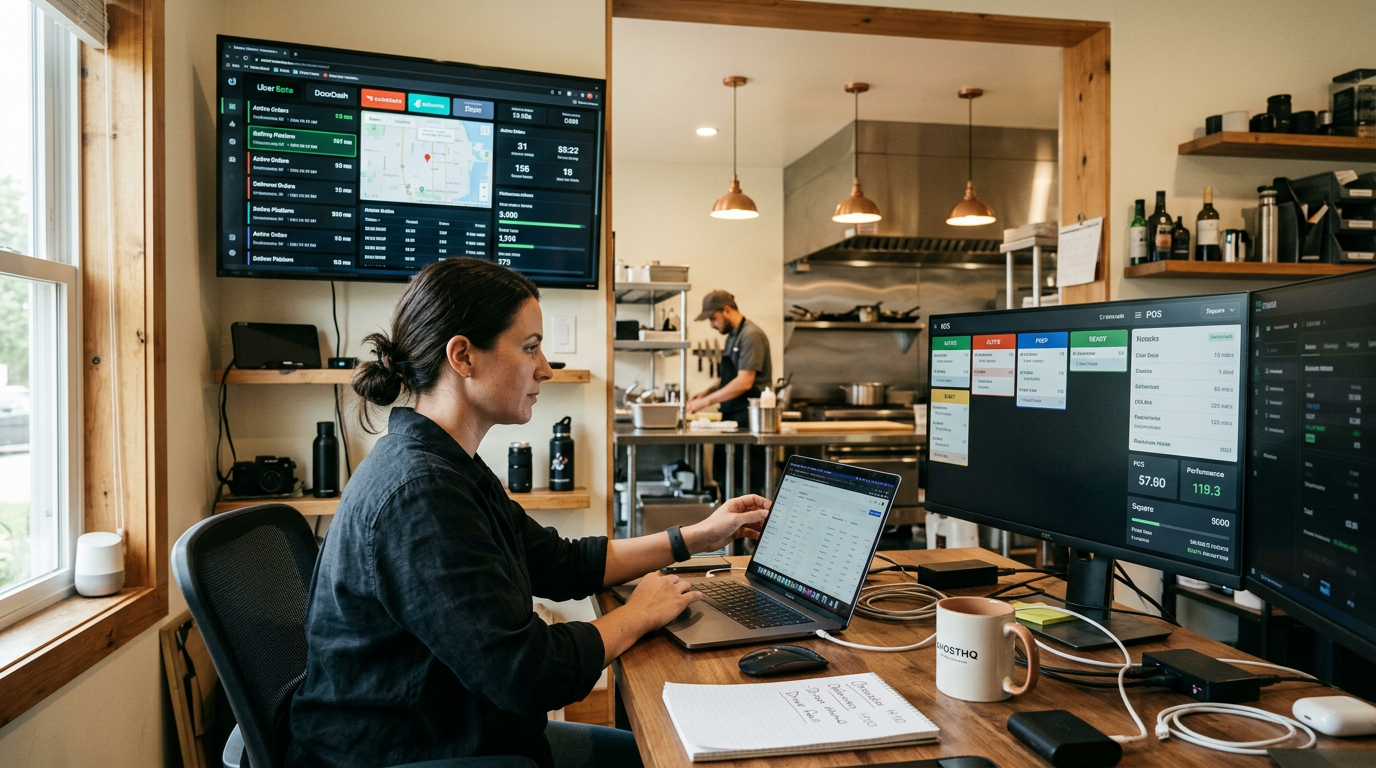

In the rapidly evolving landscape of the foodservice industry, ghost kitchen technology has emerged as the critical differentiator between profitable operations and those that struggle to survive. The modern ghost kitchen—defined as a delivery-focused culinary facility without dine-in service—operates at the intersection of culinary excellence and technological innovation. Yet many operators still approach their tech infrastructure as an afterthought, treating software as a convenient add-on rather than the operational backbone that enables scalability, profitability, and consistent quality.
This mindset represents a fundamental misunderstanding of how successful ghost kitchens function. Technology is not a supplementary layer in the ghost kitchen model; it is the very foundation upon which the entire operation rests. Without the right technology stack, the promises of reduced overhead, expanded reach, and improved margins that attract entrepreneurs to the ghost kitchen model quickly evaporate under the weight of operational chaos, order errors, and unsustainable commission structures.
The ghost kitchen technology stack comprises multiple integrated layers, each addressing specific operational challenges—from receiving orders across multiple delivery platforms to managing inventory in real-time, from coordinating kitchen production to analyzing profitability across menu items. When these layers work in concert, they create a seamless operational flow that transforms what could be a logistical nightmare into a streamlined, data-driven enterprise capable of scaling efficiently.
This comprehensive guide examines the seven essential layers of a ghost kitchen technology stack in 2026, providing detailed analysis of the leading platforms, integration considerations, pricing structures, and strategic recommendations for building an infrastructure that supports sustainable growth. Whether you’re launching your first virtual brand or managing a multi-brand ghost kitchen operation, understanding and implementing the right technology stack will determine your ability to compete in an increasingly sophisticated market.
Complete Your Tech Stack with AI
AI Chef Pro adds the AI layer your ghost kitchen needs — 55+ tools for menu optimization, recipe scaling, food cost analysis, and demand forecasting. Free tier available.
The 7 Layers of a Ghost Kitchen Tech Stack
The architecture of a successful ghost kitchen technology stack resembles a pyramid of interdependent systems, each layer building upon the foundation established by those below it. At the base lies order management and aggregation—the critical first point of contact between customer demand and kitchen operations. Rising through the stack, we encounter point-of-sale systems that process transactions and manage menu data, kitchen display systems that orchestrate production workflows, inventory management tools that ensure ingredient availability, delivery platform integrations that connect to customers, analytics platforms that provide visibility into operational performance, and finally, artificial intelligence and automation capabilities that optimize every aspect of the operation.
The diagram below illustrates how these seven layers interconnect to form a complete ghost kitchen technology ecosystem:
┌─────────────────────────┐
│ LAYER 7: AI & │
│ AUTOMATION │
└───────────┬─────────────┘
│
┌───────────────────────┼───────────────────────┐
│ │ │
▼ ▼ ▼
┌───────────────┐ ┌─────────────────┐ ┌───────────────────┐
│ LAYER 6: │ │ LAYER 5: │ │ LAYER 4: │
│ ANALYTICS & │◄──►│ DELIVERY │◄──►│ INVENTORY & │
│ BUSINESS │ │ PLATFORM │ │ SUPPLY CHAIN │
│ INTELLIGENCE │ │ STRATEGY │ │ │
└───────┬───────┘ └────────┬────────┘ └─────────┬─────────┘
│ │ │
└─────────────────────┼───────────────────────┘
│
┌─────────┴─────────┐
│ LAYER 3: KITCHEN │
│ DISPLAY SYSTEMS │
└─────────┬─────────┘
│
┌─────────┴─────────┐
│ LAYER 2: POS │
│ SYSTEMS │
└─────────┬─────────┘
│
┌─────────┴─────────┐
│ LAYER 1: ORDER │
│ MANAGEMENT & │
│ AGGREGATION │
└───────────────────┘
Understanding this layered architecture is essential because the technology decisions made at each level cascade throughout the entire operation. A poor choice at the order aggregation layer, for example, creates downstream challenges in kitchen production, inventory accuracy, and analytics visibility. Conversely, investing wisely in foundational systems creates compound benefits as you add more sophisticated capabilities.
Layer 1: Order Management and Aggregation
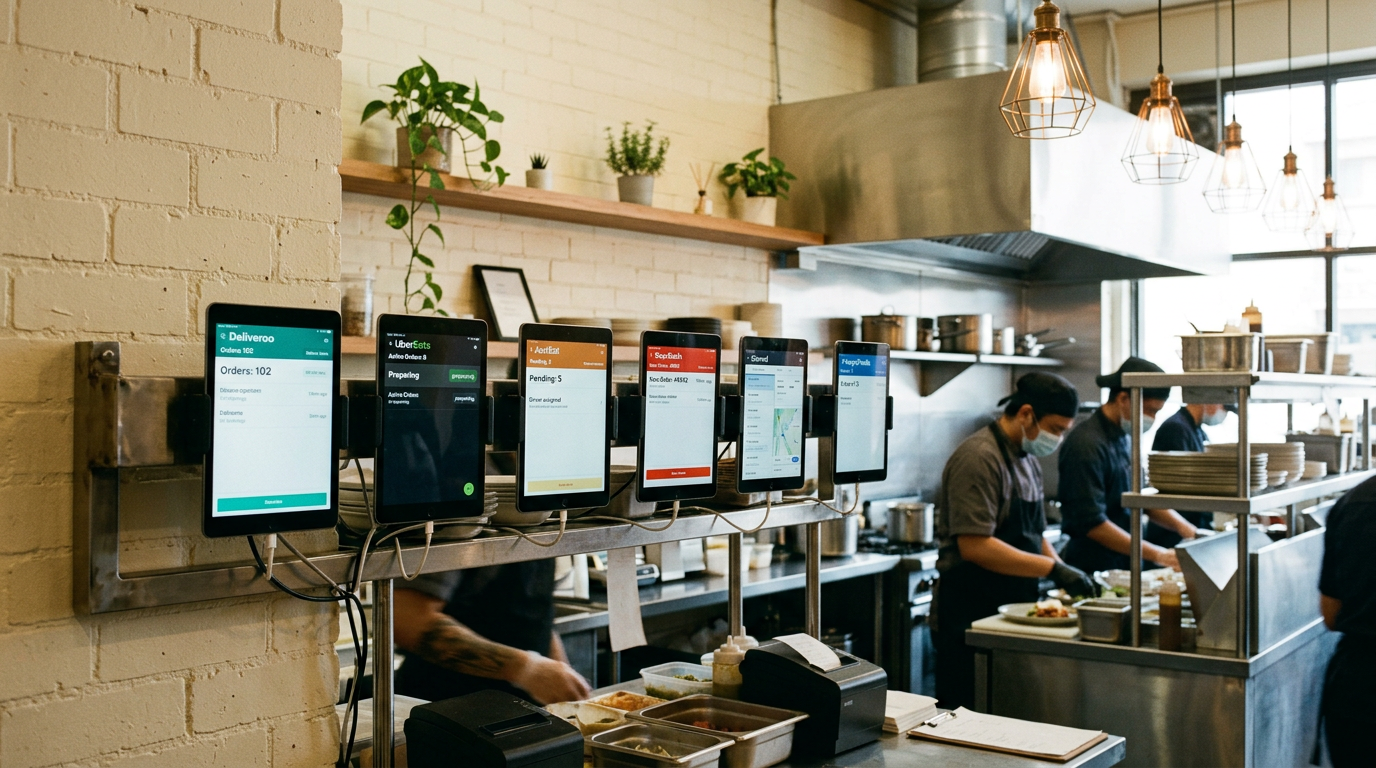
The first and perhaps most critical layer in any ghost kitchen technology stack is order management and aggregation. In the fragmented delivery marketplace of 2026, ghost kitchens typically partner with multiple third-party delivery platforms—DoorDash, Uber Eats, Grubhub, and regional players—to maximize their reach and order volume. Without order aggregation technology, kitchen staff would need to monitor and respond to orders on separate tablets for each platform, creating operational chaos, increasing error rates, and fundamentally limiting the kitchen’s ability to scale.
Order aggregation platforms consolidate incoming orders from all connected delivery channels onto a single screen, creating a unified order queue that kitchen staff can manage efficiently. This consolidation delivers immediate operational benefits: reduced ticket errors from manual order entry, faster ticket processing times, and simplified workflow for kitchen staff who no longer need to check multiple devices.
Leading Order Aggregation Platforms
The market for order management and aggregation has matured significantly, with several platforms emerging as leaders in the ghost kitchen technology space:
Deliverect has established itself as a dominant player in the order aggregation space, particularly for operations seeking robust integration capabilities. The platform connects with over 100 delivery platforms globally and offers real-time menu synchronization across all channels—a critical capability that prevents the menu discrepancies that frustrate customers and generate negative reviews. Deliverect’s dashboard provides comprehensive order visibility and analytics, though its pricing tends toward the higher end of the market, making it particularly suitable for mid-to-large ghost kitchen operations with sufficient order volume to justify the investment.
Ordermark, now part of the Nextbite ecosystem following their merger, has historically been one of the most recognized names in order aggregation for ghost kitchens. The platform specializes in consolidating orders from major delivery platforms and directing them to kitchen display systems or point-of-sale terminals. Ordermark’s strength lies in its simplicity and reliability—operators consistently praise its stability and ease of use, though some note that advanced features require additional investment beyond the base platform.
Cuboh differentiates itself through its focus on the restaurant operator experience, offering a unified tablet solution that aggregates orders while providing additional operational tools. Beyond basic order aggregation, Cuboh offers features like customer data aggregation, review management across platforms, and analytics dashboards. The platform has gained traction among multi-brand ghost kitchen operators who need to manage several virtual concepts from a single interface.
Otter represents a newer entrant that has quickly gained popularity due to its competitive pricing and feature-rich offering. Otter provides order aggregation, menu management, and analytics capabilities in a unified platform, with particular strength in its real-time synchronization features. The platform has been aggressive on pricing, making it attractive for ghost kitchens in early growth stages or those operating on tighter margins.
Pricing and Selection Considerations
Order aggregation pricing typically ranges from $50 to $300 per month depending on the platform, feature set, and order volume. Most platforms offer tiered pricing structures where monthly fees increase as order volumes grow or as additional features become available. Some platforms charge per-order fees in addition to monthly subscription costs, which ghost kitchen operators should carefully evaluate based on their expected order volume.
When selecting an order aggregation platform, ghost kitchen operators should prioritize several key factors: integration compatibility with their chosen POS and kitchen display systems, reliability and uptime guarantees, quality of customer support, and the platform’s roadmap for new feature development. The delivery platform landscape continues to evolve, with new players entering and existing platforms changing their terms, so selecting an aggregation platform with strong relationships across multiple delivery channels provides important strategic flexibility.
Layer 2: POS Systems for Ghost Kitchens
The point-of-sale system serves as the operational hub of any ghost kitchen, managing menu data, processing transactions, and serving as the central data repository that connects to other systems in the technology stack. For ghost kitchens specifically, the POS system must be cloud-native, API-driven, and designed with delivery-first operations in mind—requirements that eliminate many traditional restaurant POS systems that were designed primarily for dine-in service.
Cloud-native POS architecture provides critical advantages for ghost kitchen operations. Data stored in the cloud is accessible from any location with internet connectivity, enabling multi-location management and providing redundancy against hardware failures. API-driven systems allow seamless integration with order aggregation platforms, delivery providers, and analytics tools—connectivity that forms the foundation of an efficient technology stack.
Leading POS Platforms for Ghost Kitchens
Toast has emerged as a leading POS solution for ghost kitchens, offering a comprehensive feature set specifically designed for delivery and takeout operations. Toast’s platform includes robust menu management, integrated ordering through third-party delivery aggregators, kitchen display system functionality, and comprehensive analytics. The platform’s open API enables deep integration with a wide range of third-party tools, making it an excellent foundation for building a complete technology stack. Toast offers competitive pricing at approximately $60-200 per month depending on the feature set and hardware requirements, with additional transaction-based fees.
Square for Restaurants provides a compelling option for ghost kitchens seeking an entry point into professional POS technology. Square’s platform offers solid core POS functionality with straightforward integration to the broader Square ecosystem, which includes payment processing, customer relationship management, and marketing tools. The platform’s pricing structure is transparent and competitive, though some ghost kitchen operators find that advanced features available in competitors’ platforms require workarounds or additional third-party tools.
Lightspeed offers a robust POS solution with particular strength in inventory management integration—a capability that becomes increasingly important as ghost kitchen operations scale. The platform’s cloud-based architecture supports multi-location management, and its API enables integration with the broader technology ecosystem. Lightspeed’s pricing positions it in the mid-to-premium range, making it most suitable for operations that will fully utilize its comprehensive feature set.
Clover provides a flexible POS solution with a strong ecosystem of third-party integrations, making it adaptable to various ghost kitchen configurations. The platform offers both hardware and software solutions, with pricing varying based on the specific configuration chosen. Clover’s strength lies in its customizability, though this flexibility can also create complexity during initial setup and configuration.
Integration Requirements
The POS system’s integration capabilities with order aggregation platforms represent perhaps its most critical specification for ghost kitchen operations. Without seamless integration, orders must be manually entered into the POS after being received through aggregation platforms—a process that introduces errors, creates delays, and fundamentally undermines the operational efficiency that technology should provide. Ghost kitchen operators should verify that any POS under consideration offers native or API-based integration with their preferred order aggregation platform before making a final selection.
Layer 3: Kitchen Display Systems
The Kitchen Display System transforms the abstract concept of incoming orders into organized, actionable work instructions for kitchen staff. In a ghost kitchen environment where the visual presentation and customer interaction of traditional restaurant service doesn’t exist, the KDS becomes the primary interface through which kitchen teams understand what to cook, when to cook it, and in what order to prioritize preparation.
Digital kitchen display systems have demonstrated remarkable impact on operational efficiency. Research and operator testimonials consistently indicate that properly implemented KDS solutions can reduce ticket errors by up to 80%—a dramatic improvement that directly impacts customer satisfaction, reduces waste from remade orders, and improves throughput during peak periods.
KDS Platform Options
Fresh KDS has established itself as a leading independent kitchen display system, offering a cloud-based platform that integrates with most major POS and order aggregation systems. Fresh KDS provides customizable display layouts, priority routing capabilities that automatically sequence orders based on preparation time and delivery deadlines, and comprehensive analytics on kitchen performance. The platform’s pricing is competitive, making it accessible to ghost kitchens at various growth stages.
Toast KDS offers integrated kitchen display functionality for operators using the Toast POS platform. This tight integration provides advantages in terms of setup simplicity and data consistency, though it limits the KDS to operations already committed to Toast’s broader ecosystem. For Toast users, the integrated KDS provides a seamless experience that connects order entry directly to kitchen production without the complexity of managing separate systems.
Square KDS similarly provides integrated kitchen display functionality for Square POS users, offering a streamlined solution for operations within the Square ecosystem. The platform includes essential KDS features including order organization, timing tools, and basic analytics, though operators seeking more advanced functionality may need to supplement with third-party solutions.
When evaluating KDS options, ghost kitchen operators should prioritize systems that offer flexible display configurations (essential for multi-brand operations running different concepts from the same kitchen), robust integration with their chosen order aggregation and POS platforms, and features that support workflow optimization such as course firing, item routing, and prep station assignment.
Layer 4: Inventory and Supply Chain Management
Effective inventory management represents one of the most significant opportunities for ghost kitchen operators to improve profitability—yet it remains an area where many operations underinvest until problems become critical. In a delivery-focused model where every order represents a discrete transaction, accurate inventory tracking enables real-time ingredient availability checking, automatic deduction of inventory as orders are prepared, and data-driven purchasing decisions that minimize both stockouts and waste.
The most sophisticated inventory management platforms now incorporate artificial intelligence for demand forecasting, helping ghost kitchen operators maintain optimal par levels based on historical sales patterns, seasonal variations, and emerging trends. Research indicates that AI-powered demand forecasting can reduce food waste by 15-30%—savings that directly improve gross margins in an operation where food costs typically represent 25-35% of revenue.
Inventory Management Platforms
MarketMan provides comprehensive inventory management designed specifically for the foodservice industry. The platform offers real-time inventory tracking, automated purchasing workflows, vendor management, and detailed cost analysis. MarketMan’s strength lies in its ability to track inventory at the recipe level, automatically calculating ingredient usage based on orders and providing accurate food cost calculations. The platform integrates with major POS systems and offers robust reporting capabilities for financial analysis.
BlueCart offers a modern inventory management approach, combining purchasing, invoicing, and inventory tracking in a unified platform. The platform’s strength in supplier management makes it particularly valuable for ghost kitchens operating multiple brands with diverse ingredient requirements. BlueCart’s mobile-first design accommodates the mobile nature of much inventory work, though some operators note that the learning curve for full feature utilization requires dedicated training time.
Lightspeed Inventory provides integrated inventory management for operations using the Lightspeed POS platform. The system offers multi-location inventory tracking, automated reorder points, and comprehensive reporting on inventory performance. For operations already invested in the Lightspeed ecosystem, the integrated inventory management eliminates the need for separate systems and provides seamless data flow between sales, inventory, and purchasing functions.
Implementation Best Practices
Successful inventory management in ghost kitchen operations requires more than technology implementation—it demands operational discipline and process design. Ghost kitchen operators should establish clear inventory counting routines (daily for high-usage items, weekly for lower-usage items), create par level formulas based on historical usage and lead times, and implement receiving procedures that ensure accurate inventory records from the moment ingredients enter the facility. The technology platform enables these processes, but the operational commitment determines their effectiveness.
Layer 5: Delivery Platform Strategy
The delivery platform landscape represents both the primary revenue channel for ghost kitchens and one of their largest operational expenses. Understanding commission structures, platform dynamics, and strategic approaches to multi-platform presence is essential for maximizing profitability while building sustainable order volume.
Third-party delivery platforms typically charge commission rates ranging from 15% to 30% of order value, with rates varying by platform, market, and operator negotiation. These commissions represent a significant cost center that directly impacts gross margins, making platform strategy a critical consideration for ghost kitchen profitability.
Platform Commission Comparison
Each major delivery platform offers different commission structures and service levels:
DoorDash typically offers commission rates ranging from 15% to 30%, with higher rates providing increased visibility in search results and access to promotional programs. DoorDash’s large customer base and strong brand recognition make it an essential channel for most ghost kitchens, though operators should carefully evaluate the economics of various commission tiers.
Uber Eats similarly offers tiered commission structures with rates in the 15-30% range. The platform’s integration with Uber’s broader transportation network provides access to a large, loyal user base, though some operators report lower average order values compared to other platforms.
Grubhub, while smaller than DoorDash and Uber Eats in many markets, maintains a loyal customer base particularly in urban areas. Commission rates generally fall within the standard range, though the platform’s less aggressive promotional approach may result in lower order volume for some operators.
Building Direct Ordering Channels
The strategic response to high commission rates involves developing direct ordering channels that reduce or eliminate third-party fees while building direct customer relationships. Direct ordering can take several forms: dedicated mobile apps, websites with ordering functionality, and loyalty programs that incentivize direct ordering through exclusive offers or enhanced rewards.
Building a direct ordering channel requires investment in customer acquisition and retention, but the economics can be compelling. A ghost kitchen that converts 30% of its orders from third-party platforms to direct ordering at zero commission effectively increases gross margin by 9-15 percentage points on those orders—a substantial improvement that compounds significantly at scale.
Loyalty programs represent a particularly effective tool for driving direct orders. By offering points, discounts, or exclusive menu items only available through direct channels, ghost kitchens can create meaningful incentives for customers to order directly. The key is ensuring that the direct ordering experience matches or exceeds the convenience of third-party platforms, with easy reordering, accurate menu information, and reliable delivery or pickup options.
Losing Money on Delivery Commissions?
AI Chef Pro helps ghost kitchen operators optimize menu pricing, reduce food costs, and maximize profit per order. 55+ AI tools from €25/month.
Layer 6: Analytics and Business Intelligence
Data-driven decision making separates professional ghost kitchen operations from amateur attempts. Analytics and business intelligence capabilities provide visibility into every aspect of the operation—from menu item profitability to delivery performance, from peak hour patterns to customer lifetime value—enabling operators to make informed decisions rather than relying on intuition or incomplete information.
Analytics Capabilities
Comprehensive ghost kitchen analytics should address several key areas:
Operational metrics provide visibility into daily performance, including order volume, average ticket size, preparation times, and delivery performance. These metrics enable real-time operational adjustments and help identify emerging issues before they impact customer satisfaction.
Financial analytics track cost per order, food cost percentages, labor productivity, and overall profitability by brand, menu item, or time period. Understanding the true profitability of each menu item enables data-driven menu engineering decisions that optimize the balance between customer appeal and margin contribution.
Customer analytics provide insight into ordering patterns, frequency, average order values, and customer acquisition costs. This information supports targeted marketing efforts and helps identify opportunities to increase customer lifetime value.
Platform Analytics Options
Toast Analytics provides comprehensive reporting for operations using the Toast POS platform. The system offers pre-built reports on key performance indicators, with customization options for operators seeking deeper analysis. Integration with Toast’s broader platform provides seamless data flow from ordering through payment and reporting.
Square Dashboard offers analytics capabilities for Square POS users, with particular strength in sales and customer analytics. The platform’s visual reporting approach makes it accessible to operators without deep analytical backgrounds, though some advanced features require additional investment.
Custom BI Solutions using tools like Tableau, Power BI, or Google Data Studio can provide sophisticated analytical capabilities for operations with the resources to develop custom dashboards and reports. These solutions require additional development investment but offer unlimited customization potential for operators with specific analytical requirements.
Layer 7: AI and Automation
The frontier of ghost kitchen technology lies in artificial intelligence and automation capabilities that optimize operations across the entire technology stack. From menu optimization to recipe scaling, from food cost analysis to kitchen robotics, AI-powered tools are transforming how ghost kitchens operate and compete.
AI-Powered Optimization
AI Menu Optimization represents one of the most impactful applications of artificial intelligence in ghost kitchen operations. By analyzing sales data, customer feedback, ingredient costs, and operational constraints, AI-powered tools can recommend menu changes that improve profitability, reduce complexity, and enhance customer satisfaction. These systems can identify underperforming items, suggest price optimizations, and even recommend new menu items based on emerging trends and customer preferences.
Recipe Scaling capabilities enabled by AI allow ghost kitchens to efficiently manage recipe modifications for varying batch sizes. Whether preparing for a surge in orders or scaling down during slower periods, AI-powered recipe scaling ensures consistent quality and accurate ingredient quantities regardless of production volume. This technology proves particularly valuable for multi-brand operations that must maintain consistent quality across diverse menus.
Food Cost Analysis powered by AI provides real-time visibility into ingredient costs and their impact on menu profitability. Advanced systems can track price fluctuations from suppliers, calculate the cost impact of menu substitutions, and alert operators to cost variances that require attention. By maintaining tight control over food costs, ghost kitchens can protect margins even as ingredient prices fluctuate.
Kitchen Robotics and Automation
Beyond software-based AI, physical automation technologies are beginning to influence ghost kitchen operations. Kitchen robotics for food preparation—while still in relatively early stages of adoption—offer potential for addressing labor challenges and improving consistency. Automated cooking equipment, robotic food assembly systems, and intelligent food holding solutions represent investments that some forward-thinking ghost kitchen operators are exploring as part of their technology roadmap.
Building Your Stack: Budget Guide
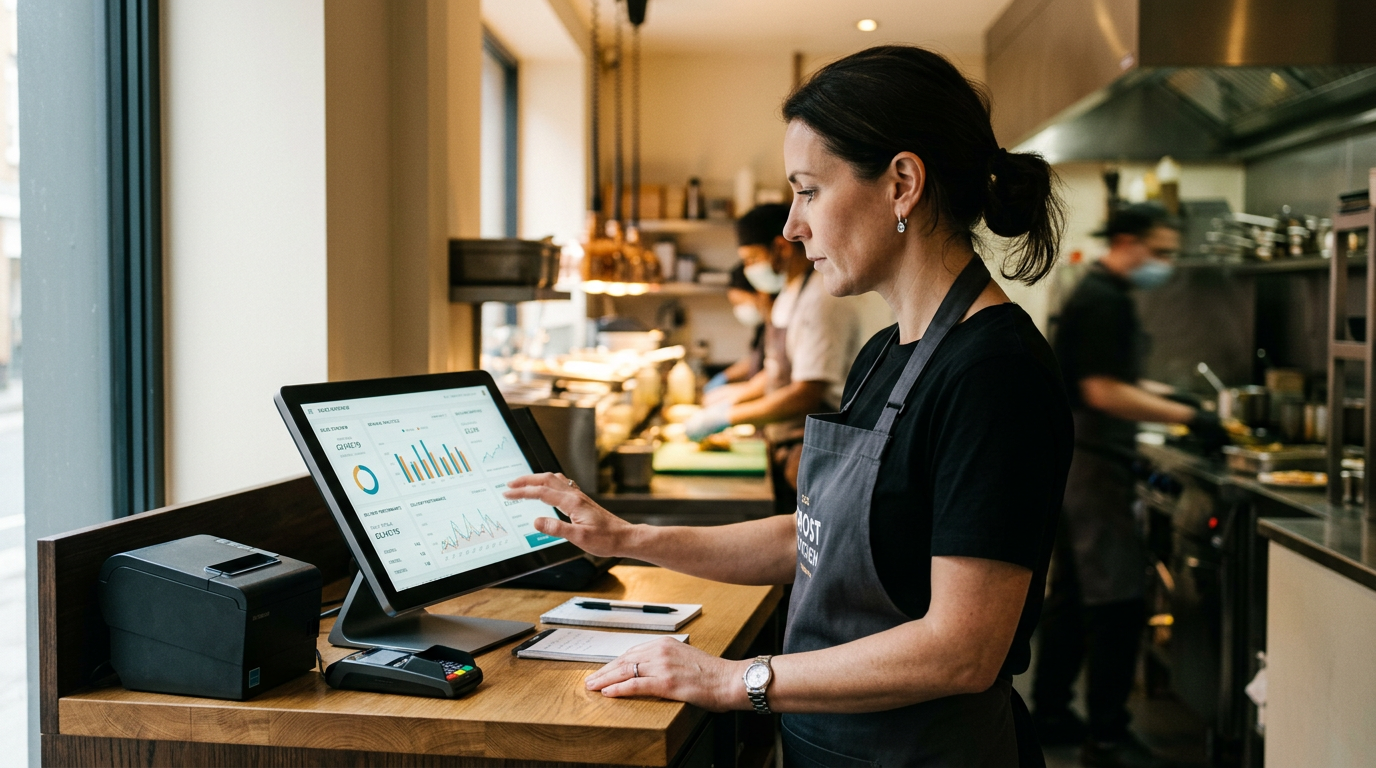
Ghost kitchen technology investments should align with operational scale and growth stage. The following budget guide provides framework for building an appropriate technology stack at each development phase:
Starter Stack (Under $500/month)
For new ghost kitchen operations or those testing market concepts, a starter stack focuses on essential capabilities without significant investment in advanced features:
- Order Aggregation: $50-100/month—Platforms like Otter or Cuboh provide essential order consolidation
- POS System: $60-150/month—Square for Restaurants or basic Toast configuration
- KDS: Often included with POS or available through Fresh KDS entry tier
- Basic Analytics: Included with POS and aggregation platforms
- Total Estimated Monthly Investment: $200-400
This starter stack provides the fundamental infrastructure needed to accept and process orders efficiently while maintaining visibility into basic operational metrics.
Growth Stack ($500-1,500/month)
As ghost kitchen operations scale, the technology stack should expand to include more sophisticated capabilities:
- Order Aggregation: $100-200/month—Full-featured platform with advanced integrations
- POS System: $100-200/month—Comprehensive POS with full feature utilization
- KDS: $50-150/month—Dedicated KDS platform with advanced routing
- Inventory Management: $100-200/month—Full inventory tracking and purchasing
- Analytics Enhancement: $50-100/month—Enhanced analytics or custom reporting
- Total Estimated Monthly Investment: $500-1,500
The growth stack enables operational optimization through comprehensive data visibility and efficient production workflows.
Enterprise Stack ($1,500+/month)
Multi-brand ghost kitchen operations at scale require enterprise-grade technology with advanced capabilities:
- Order Aggregation: $200-300/month—Enterprise-level platform with premium support
- POS System: $200-300/month—Multi-location capable POS with advanced features
- KDS: $150-300/month—Advanced KDS with full customization
- Inventory Management: $200-400/month—Comprehensive platform with AI forecasting
- Analytics/BI: $100-300/month—Custom dashboards and advanced reporting
- AI and Automation: $200-500/month—AI optimization tools and emerging technologies
- Total Estimated Monthly Investment: $1,500-4,000+
Enterprise stacks provide the comprehensive infrastructure needed to manage complex, multi-brand operations with sophisticated optimization capabilities.
Frequently Asked Questions
What is the most important technology layer for a ghost kitchen?
While all seven layers of the ghost kitchen technology stack are important, order management and aggregation (Layer 1) typically serves as the most critical foundation. Without effective order consolidation, kitchen operations become chaotic, error rates increase, and the ability to scale is fundamentally limited. However, the “most important” layer can vary based on operational context—ghost kitchens struggling with food costs would benefit most from inventory management, while those facing labor challenges might prioritize automation tools.
How much does ghost kitchen technology cost per month?
Ghost kitchen technology costs range significantly based on operational scale and feature requirements. Starter stacks suitable for new operations typically cost $200-400 per month. Growth-stage operations should budget $500-1,500 monthly for comprehensive capabilities. Enterprise multi-brand operations typically invest $1,500-4,000 or more monthly in technology infrastructure. These estimates include core systems (POS, order aggregation, KDS, inventory) but exclude payment processing fees, delivery platform commissions, and one-time implementation costs.
Can ghost kitchens operate without third-party delivery platforms?
While technically possible to operate exclusively through direct ordering channels, most ghost kitchens benefit from third-party delivery platform presence for customer acquisition and volume. The decision involves a trade-off between commission costs (15-30% per order) and the customer acquisition value that platforms provide. Many successful ghost kitchens pursue a hybrid strategy: maintaining presence on third-party platforms for discovery while actively building direct ordering channels to reduce long-term commission dependency.
How do I integrate multiple technology platforms in my ghost kitchen?
Integration between ghost kitchen technology platforms typically occurs through API connections and native integrations offered by the platforms themselves. When building a technology stack, operators should prioritize platforms with established integration partnerships—most major order aggregation platforms, POS systems, and KDS providers have documented integrations with common partners. Implementation may require technical assistance from the platforms or integration specialists, particularly for custom workflows or legacy system connections.
What ROI can ghost kitchens expect from technology investment?
Technology investment ROI in ghost kitchens manifests through multiple channels: reduced order errors (typically 50-80% reduction with proper KDS implementation), decreased food waste (15-30% reduction with AI-powered inventory management), improved labor efficiency, and better decision-making through data visibility. Most operators see payback within 6-18 months depending on operation scale and existing technology maturity. The most significant ROI often comes from optimizing the delivery platform mix and building direct ordering channels to reduce commission expenses.
The AI Layer Your Ghost Kitchen Is Missing
From recipe development to menu engineering, AI Chef Pro gives delivery-only operators the intelligence edge. Start free today.
Conclusion: Building Your Competitive Advantage Through Technology
The ghost kitchen model has evolved from a novel experiment into a permanent fixture of the foodservice industry. As the market matures and competition intensifies, technology infrastructure increasingly determines which operations thrive and which struggle to maintain profitability. The seven-layer technology stack described in this guide provides a framework for building the operational foundation necessary for sustainable success.
Every layer of the technology stack contributes to operational efficiency and profitability: order aggregation eliminates chaos and reduces errors; POS systems provide the transactional hub; kitchen display systems optimize production workflows; inventory management protects margins through waste reduction; delivery platform strategy balances reach with economics; analytics enable informed decision-making; and AI and automation represent the frontier of competitive advantage.
The key to successful technology implementation lies not in acquiring the most sophisticated tools, but in selecting and integrating the right tools for your specific operational context. A new ghost kitchen launching a single brand does not need enterprise-level inventory forecasting—nor can it justify the investment. Conversely, a multi-brand operation running from a shared kitchen infrastructure cannot operate effectively with starter-tier systems that lack the capacity for complex menu and order management.
As you evaluate your technology needs, consider AI Chef Pro (aichef.pro) as a resource for optimizing your ghost kitchen operations through artificial intelligence. Our suite of AI-powered tools includes capabilities for menu optimization, recipe scaling, and food cost analysis that integrate with your existing technology stack to enhance efficiency and profitability. Explore our resources on AI recipe scaling and food cost optimization to discover how artificial intelligence can transform your ghost kitchen operations.
The ghost kitchen technology landscape will continue to evolve rapidly, with artificial intelligence and automation capabilities expanding significantly in the coming years. Operations that build flexible, integrated technology stacks today position themselves to adopt emerging innovations as they mature. The technology backbone you establish now will determine your ability to compete effectively in 2026 and beyond.
Invest wisely in your technology stack, integrate systems thoughtfully, and commit to data-driven operational excellence. The ghost kitchens that treat technology as a strategic asset rather than an operational expense will define the future of this dynamic industry segment.
Related Reading
- Ghost Kitchen Guide 2026: How to Start and Scale
- 7 Cloud Kitchen Business Models Compared
- Dark Kitchen vs Ghost Kitchen vs Cloud Kitchen
- Smart Kitchen Technology for Commercial Kitchens
- AI Menu Pricing Strategy
- AI Food Cost Calculator
Discover more from AI Chef Pro Blog
Subscribe to get the latest posts sent to your email.