

Food safety isn’t optional in today’s restaurant industry—it’s a legal requirement, a business imperative, and a fundamental responsibility to your customers. HACCP (Hazard Analysis Critical Control Points) provides the systematic framework that top-tier restaurants use to prevent foodborne illnesses before they happen. Yet despite its importance, approximately 40% of independent restaurants still operate without a formal HACCP plan, leaving themselves exposed to legal liability, failed health inspections, and potentially devastating reputational damage.
This comprehensive guide provides a complete HACCP plan template designed specifically for restaurants. Whether you’re opening a new establishment or strengthening your existing food safety protocols, this step-by-step approach will help you build a robust HACCP system that protects your customers, your staff, and your business.
Streamline Your Kitchen Operations with AI
AI Chef Pro complements your HACCP system with 55+ AI tools for recipe management, food cost analysis, and demand forecasting. Free tier available.

What Is HACCP?
HACCP stands for Hazard Analysis Critical Control Points, a preventive food safety management system that identifies, evaluates, and controls hazards throughout the food production process. But understanding HACCP requires knowing its fascinating origins and how it evolved into the gold standard for food safety worldwide.
The Origin Story: NASA and the Birth of Modern Food Safety
The HACCP system was developed in the 1960s through a unique collaboration between NASA, the U.S. Army, and the Pillsbury Company. The challenge was formidable: ensure that food consumed by astronauts during space missions was absolutely free from pathogens and contaminants. Traditional end-product testing couldn’t guarantee safety in space, where even a minor foodborne illness could become life-threatening.
Pillsbury engineers created the HACCP framework as a proactive alternative to reactive testing. By identifying potential hazards at each production stage and establishing critical control points, they could prevent problems rather than simply detecting them after occurrence. This approach proved remarkably successful—none of the Apollo astronauts ever experienced a foodborne illness.
FDA Adoption and Regulatory Framework
The success of HACCP in the aerospace context caught the attention of food safety regulators. The FDA began promoting HACCP principles in the 1970s, and in 1995, the agency made HACCP mandatory for seafood processors. This requirement expanded to juice processors in 2001 and, most significantly, to the meat and poultry industry under USDA oversight.
For restaurants, while HACCP is not currently federally mandatory across all operations, the FDA Food Code increasingly incorporates HACCP principles and expects food establishments to demonstrate systematic food safety management. Many state and local health departments now require HACCP-compliant documentation, particularly for establishments serving vulnerable populations, handling specialized processes, or operating at scale.
The Seven Principles of HACCP
The Codex Alimentarius Commission, the international food standards body, established seven core principles that form the foundation of any effective HACCP plan:
- Hazard Analysis: Identify potential biological, chemical, and physical hazards at each production stage
- Determine Critical Control Points (CCPs): Identify points where controls can be applied to prevent or eliminate hazards
- Establish Critical Limits: Set measurable criteria that must be met at each CCP
- Establish Monitoring Procedures: Define how and when CCPs will be monitored
- Establish Corrective Actions: Define procedures for when monitoring indicates a deviation from critical limits
- Establish Verification Procedures: Confirm that the HACCP system is working correctly
- Establish Documentation and Record-Keeping: Maintain records of the HACCP plan and its implementation
HACCP vs. General Food Safety: Understanding the Difference
Many restaurant operators confuse general food safety practices with a formal HACCP plan. While both aim to prevent foodborne illness, they differ fundamentally in approach and comprehensiveness.
General food safety typically involves following regulations, maintaining clean facilities, and training staff on proper handling procedures. These are essential baseline activities, but they’re reactive by nature—you’re following rules rather than systematically analyzing your specific operations.
A HACCP plan, by contrast, is a documented, science-based system tailored to your specific menu, processes, and operations. It requires you to analyze every step of your food flow, identify where hazards could occur, establish measurable control points, and document your monitoring. This systematic approach means you’re not just following generic guidelines—you’re actively preventing the specific hazards that could affect your particular dishes and operations.
Think of it this way: general food safety tells you to keep food at safe temperatures. A HACCP plan requires you to identify exactly where temperature control matters in your kitchen, what those specific temperatures must be, how you’ll monitor them, and exactly what you’ll do when temperatures deviate.
Why Every Restaurant Needs a HACCP Plan
Implementing a formal HACCP plan requires investment of time and resources. Here’s why that investment pays dividends across virtually every aspect of your restaurant operation.
Legal Requirements and Regulatory Compliance
While federal law doesn’t mandate HACCP for all restaurants, the regulatory landscape is evolving rapidly. The FDA Food Code, adopted by most state and local jurisdictions, explicitly references HACCP principles and increasingly expects documented food safety systems. Several states now require HACCP plans for specific operations, and this requirement is likely to expand.
Beyond direct mandates, having a comprehensive HACCP plan demonstrates “due diligence” in food safety—a critical legal concept. If a foodborne illness incident occurs, regulators and courts examine whether you took reasonable steps to prevent it. A documented HACCP plan provides powerful evidence of your commitment to food safety.
Health Inspection Readiness
Health inspectors are trained to evaluate food safety systems, not just individual practices. When they see a well-documented HACCP plan with completed monitoring records, corrective action logs, and verification documentation, they recognize a professionally managed operation. This can translate into better inspection scores, fewer repeat visits, and more favorable treatment when minor issues arise.
Conversely, restaurants without formal HACCP documentation may face closer scrutiny, more frequent inspections, and greater pressure to correct deficiencies immediately. The difference between passing with flying colors and facing temporary closure often comes down to having (or lacking) proper documentation.
Liability Protection
Foodborne illness lawsuits can devastate restaurants financially and reputationally. When customers become ill, plaintiffs’ attorneys examine whether the restaurant followed industry-standard safety protocols. A documented HACCP plan provides your strongest defense—it demonstrates systematic attention to food safety and establishes that any incident occurred despite your implemented controls, not because of negligence.
Insurance carriers increasingly recognize HACCP implementation as a risk management best practice. Some insurers offer premium discounts for restaurants with verified HACCP plans, and having documentation readily available streamlines claims processing if incidents occur.
Customer Trust and Brand Reputation
Today’s diners are more informed about food safety than ever before. News of health code violations spreads rapidly through social media, and a single foodborne illness incident can generate devastating publicity. Customers increasingly expect restaurants to demonstrate professional food safety management.
Having a visible HACCP commitment—displayed in your restaurant, mentioned in your marketing, and reflected in staff training—differentiates your establishment as professionally managed. This builds customer confidence and loyalty, particularly among health-conscious diners and those responsible for group dining decisions.
Staff Accountability and Training
A documented HACCP plan provides clear, written procedures that every team member can follow. Rather than relying on verbal instructions that get forgotten or misinterpreted, you have concrete standards that define exactly what’s expected at each station. This clarity improves consistency, reduces errors, and simplifies training for new employees.
When staff understand not just what to do but why—from the science behind temperature requirements to the specific hazards at each station—they’re more likely to follow procedures consistently. A HACCP plan transforms food safety from an abstract concept into actionable, daily practice.
HACCP Plan Template Step-by-Step
Now let’s build your HACCP plan. This section provides a comprehensive template following the seven principles, with specific guidance for restaurant operations.
Step 1: Assemble Your HACCP Team
Effective HACCP implementation requires cross-functional expertise. Your team should include individuals who understand every aspect of your food operations:
- HACCP Coordinator: Someone with overall responsibility for developing and maintaining the plan—this person should have HACCP training or certification
- Executive Chef or Kitchen Manager: Deep knowledge of food preparation processes, recipes, and kitchen operations
- Sous Chefs and Line Cooks: Frontline perspective on actual kitchen practices and potential problem areas
- Receiving/Dock Staff: Understanding of incoming product quality and handling
- Front-of-House Manager: Knowledge of serving practices, customer interactions, and any menu items prepared in customer view
- Maintenance Personnel: Input on equipment functionality, calibration, and facility conditions
- Supplier Representatives: Potentially valuable for understanding product handling requirements
If your restaurant lacks internal expertise, consider consulting with a food safety specialist or HACCP consultant during plan development. Many restaurants also benefit from third-party audit services to validate their plans.
Step 2: Describe Your Products and Distribution
Your HACCP plan must be specific to your actual operations. Document everything you serve and how it reaches your customers:
- Complete Menu Listing: Every item, including daily specials, children’s menu, and any items prepared off-site
- Ingredient Sourcing: Where each ingredient comes from, including primary suppliers and backup sources
- Distribution Methods: Dine-in, takeout, delivery (in-house and third-party), catering
- Customer Base: General public, families, healthcare facilities, schools, elderly populations—vulnerable populations require extra controls
- Volume and Peak Times: Understanding your busiest periods helps identify where process breakdowns are most likely
- Seasonal Variations: Menu changes, holiday rushes, summer vs. winter operations
This comprehensive product description becomes the foundation for your hazard analysis. You cannot identify risks without fully understanding what you’re producing and how it reaches customers.
Step 3: Identify Intended Use
Different customers face different risks. Your HACCP plan must account for who will consume your food:
- General Population: Standard HACCP controls apply
- Vulnerable Populations: Immunocompromised individuals, elderly, pregnant women, young children require more stringent controls
- Allergen Considerations: Clear identification of menu items containing major allergens (nuts, dairy, shellfish, gluten, eggs, soy, fish, sesame)
- Special Dietary Needs: Medical diets, religious restrictions, preference-based limitations
- Off-Premises Consumption: Takeout and delivery require controls for time and temperature between preparation and consumption
If you serve any vulnerable populations—through healthcare facility catering, school nutrition programs, or even older regular customers—your HACCP plan must reflect the elevated risk and implement additional safeguards.
Step 4: Develop Flow Diagrams
A flow diagram maps your entire food production process from receiving to serving. This visual representation helps you identify every point where hazards could occur.
Create detailed flow diagrams for each menu category or major dish type. The basic flow includes:
- Receiving: Inspection, temperature check, quality verification
- Storage: Dry storage, refrigerated storage, frozen storage
- Thawing: If applicable—commercial thawing methods (running water, refrigerator, microwave)
- Prep: Washing, cutting, marinating, mixing, portioning
- Cooking: Temperatures, times, methods
- Cooling: If preparing in advance—rapid cooling procedures
- Hot Holding: Steam tables, heat lamps, buffet maintenance
- Cold Holding: Refrigerated display, salad bars, cold plating
- Reheating: If serving previously cooked items
- Serving: Plating, garnishing, customer interaction
- Transport: For delivery or catering—temperature maintenance during transit
Walk through each step physically in your kitchen. The diagram should accurately represent your actual process, not an idealized version. Note any areas where flow paths cross (raw to ready-to-eat) or where timing gaps could occur.
Step 5: Conduct Hazard Analysis (Principle 1)
Now examine each step in your flow diagram for potential hazards. HACCP identifies three hazard categories:
Biological Hazards
- Bacteria: Salmonella, E. coli, Listeria, Clostridium perfringens, Staphylococcus aureus, Norovirus—these are the primary biological threats
- Viruses: Hepatitis A, Norovirus—particularly concerning in ready-to-eat items
- Parasites: Giardia, Cryptosporidium—relevant for produce and certain seafood
- Mold/Fungi: Less common but relevant for stored products
Chemical Hazards
- Cleaning Chemicals: Sanitizers, detergents, pest control products
- Food Additives: Preservatives, colorings, flavor enhancers
- Environmental Contaminants: Heavy metals, pesticides, industrial chemicals
- Allergens: Undeclared allergens constitute a chemical/biological hazard requiring control
Physical Hazards
- Foreign Objects: Glass, metal, plastic, bone fragments, insects
- Natural Objects: Pit fragments, shells, seeds
- Equipment Debris: Worn machine parts, broken utensils
For each step in your flow diagram, identify which hazards could occur and assess their likelihood and severity. This analysis drives your Critical Control Point decisions.
Step 6: Determine Critical Control Points (Principle 2)
A Critical Control Point (CCP) is any step where you can apply control to prevent, eliminate, or reduce a hazard to an acceptable level. Not every hazard requires a CCP—only those that are significant and can be controlled at a specific point.
Use the Codex decision tree to systematically identify CCPs:
- Q1: Do preventive control measures exist? If yes, proceed to Q2. If no, proceed to Q3.
- Q2: Is the step designed to eliminate or reduce the hazard to acceptable levels? If yes, it’s a CCP. If no, proceed to Q3.
- Q3: Could contamination with the hazard occur at unacceptable levels or persist? If no, it’s not a CCP. If yes, proceed to Q4.
- Q4: Will a subsequent step eliminate the hazard or reduce it to acceptable levels? If no, it’s a CCP. If yes, it’s not a CCP.
Common restaurant CCPs include receiving (temperature-sensitive products), cooking (pathogen destruction), cooling (preventing spore germination), hot holding (preventing pathogen growth), cold holding (maintaining safe temperatures), and reheating (reaching safe serving temperatures).
Step 7: Establish Critical Limits (Principle 3)
Each CCP requires a specific, measurable critical limit—the exact standard that must be met. Critical limits must be:
- Measurable: You must
Completing Critical Limits
Critical limits are the specific values that must be met at each CCP to ensure food safety. These aren’t suggestions—they’re boundaries that, when crossed, mean the difference between safe food and potential illness outbreaks. Setting appropriate critical limits requires understanding both regulatory requirements and the specific hazards present in your operation.
For cooking processes, critical limits are based on USDA and FDA guidelines for pathogen destruction. For storage, they align with food safety codes that prevent bacterial growth. Your critical limits should be measurable, observable, and enforceable. If you can’t measure it, you can’t control it.
Common Critical Limits in Restaurant Operations
Temperature control dominates most critical limits in foodservice. The “Danger Zone” between 41°F (5°C) and 135°F (57°C) is where pathogens multiply rapidly, so your limits must keep food outside this range. Each menu item may have specific requirements based on its nature—ground meats require higher temperatures than whole muscle cuts due to bacteria being distributed throughout the product.
Time-based controls serve as alternative critical limits when temperature monitoring isn’t practical. The “2-hour/4-hour rule” allows potentially hazardous foods to remain at room temperature for limited periods: 2 hours in the danger zone is acceptable if the food will be served immediately, while 4 hours requires immediate discard. These time limits become critical limits when used as primary controls.
Step 8: Monitoring Procedures
Monitoring transforms your HACCP plan from documentation into active food safety management. Without consistent monitoring, critical limits are meaningless—you’re simply hoping standards are met rather than knowing they are. Effective monitoring procedures answer four questions: Who checks? What do they check? How often? How do they record it?
Who Performs Monitoring
Assign monitoring responsibilities based on proximity to the process. Line cooks monitor cooking temperatures because they’re already at the station. Receiving staff check delivery temperatures because they’re present at unloading. Night managers often handle walk-in cooler checks because they’re present during off-hours. The key principle: the person closest to the CCP performs the monitoring.
Train all monitors on proper technique, including thermometer use, observation methods, and recording procedures. A poorly calibrated thermometer or incorrect probe placement invalidates even the most diligent monitoring effort. Document this training in your records.
Monitoring Frequency Examples
Different CCPs require different monitoring frequencies based on risk level and variability:
- Receiving: Check every delivery, every item. Temperature-abused products cannot be accepted regardless of other factors.
- Hot Holding: Check temperatures every 2 hours during service. Bacteria can multiply rapidly if holding equipment fails.
- Cold Storage: Manual checks every 4 hours if not using continuous monitoring. More frequent checks during peak operation periods.
- Cooking: Check every batch, every item. Different items cook differently—don’t assume consistency.
- Cooling: Check at 2-hour intervals and at completion. The cooling trajectory matters, not just the final temperature.
Documentation Methods
Record monitoring results immediately—memory becomes unreliable within hours. Use standardized logs with columns for date, time, temperature/observation, initials, and corrective actions if needed. Digital systems offer advantages: timestamps can’t be faked, data is readable, and records are easily retrievable during inspections.
Step 9: Corrective Actions
A HACCP plan without corrective actions is incomplete. When monitoring reveals that a critical limit has been exceeded, predetermined procedures must activate immediately. Delayed response allows potentially unsafe food to continue through your operation. Effective corrective actions accomplish three things: identify the problem, prevent unsafe product from reaching guests, and address the root cause to prevent recurrence.
Standard Corrective Action Protocols
Receiving: Reject any delivery item that exceeds temperature limits. Document the rejection, notify the supplier, and do not accept the product. Returning the product protects your operation and signals to suppliers that temperature control matters.
Cold Storage Exceedance: If walk-in temperatures exceed 41°F (5°C), immediately transfer products to backup refrigeration or rolling carts with ice. If the exceedance lasted more than 4 hours above critical limit, discard all potentially hazardous foods. Document the incident, including the cause (door left open, compressor failure) and all products affected.
Cooking Failures: If internal temperature falls below the required critical limit, continue cooking until proper temperature is achieved. If the product has been held at unsafe temperatures before cooking, discard it. Never rely on “cooking it longer” to compensate for prior abuse—the damage may already be done.
Hot Holding Failures: Products below 135°F (57°C) for more than 4 hours must be discarded. If discovered within 2 hours, rapid reheating to 165°F (74°C) within 2 hours may salvage the product—though this represents higher risk and should be documented carefully.
Cooling Failures: If cooling time targets aren’t met at the 2-hour check, immediately employ corrective measures: ice baths, blast chillers, smaller portion sizes, or additional refrigeration. If the 6-hour target isn’t met, discard the product.
Equipment-Related Corrective Actions
When equipment failure causes corrective actions, addressing the root cause matters as much as handling the immediate product. Calibration drift causes many temperature exceedances—schedule regular equipment checks. Thermometer calibration against ice water (32°F/0°C) or boiling water (212°F/100°C at sea level) should occur monthly at minimum. Record all calibrations.
Step 10: Verification
Verification confirms that your HACCP plan actually works. Documentation proves procedures exist—verification proves they’re effective. Without verification, you might follow a plan that fails to prevent illness. Regular verification activities catch problems before they cause harm and build confidence that your food safety systems function correctly.
Verification Activities
Internal Audits: Conduct comprehensive HACCP audits monthly. Review all records for completeness and accuracy. Observe actual practices—are employees following documented procedures? Are monitoring frequencies being met? Audits reveal gaps between plan and practice.
Equipment Calibration: Verify thermometers against reference thermometers quarterly. Professional calibration services provide traceability to national standards. Document all calibration results, including any adjustments made.
Record Review: Designate a responsible party to review all HACCP records weekly. Look for patterns: repeated borderline temperatures, incomplete documentation, frequent corrective actions. Patterns indicate systemic issues requiring plan modification.
Product Testing: Periodic microbiological testing validates that your controls produce safe results. While not required for all operations, testing provides objective evidence of food safety. Partner with certified laboratories for appropriate testing protocols.
Step 11: Record-Keeping
Records transform your HACCP plan from a static document into a living system. They provide evidence of compliance during inspections, enable identification of recurring problems, and protect your business in liability situations. Good records are complete, accurate, legible, and retained appropriately.
Essential HACCP Records
Temperature Logs: Document all CCP monitoring activities—receiving temperatures, storage temperatures, cooking temperatures, holding temperatures, cooling temperatures. Include date, time, specific reading, product identity, and monitor initials.
Corrective Action Forms: Record every instance where critical limits were exceeded or corrective actions were taken. Include the deviation, products affected, actions taken, disposition of product, root cause, and preventive measures implemented.
Training Records: Document HACCP training for all employees, including content covered, date, trainer, and comprehension verification. Maintain records of food handler certifications and specialized training for monitoring personnel.
Supplier Documentation: Keep current certifications, inspection reports, and temperature logs from suppliers. Approved supplier lists demonstrate due diligence in sourcing.
Equipment Calibration Records: Document all thermometer calibrations, equipment maintenance, and verification activities. Include dates, results, and any corrective actions.
Retention Requirements
Maintain HACCP records for a minimum of one year from creation date—or longer if required by local health regulations or pending litigation. Some jurisdictions require longer retention for certain record types. Digital storage offers advantages: records are searchable, backed up, and easily produced for inspections. Ensure digital systems include security measures and backup protocols.
HACCP Critical Control Point Summary
The following table provides a quick reference for the most critical control points in restaurant operations:
| CCP | Hazard | Critical Limit | Monitoring | Corrective Action |
|---|---|---|---|---|
| Receiving | Biological contamination | Cold items ≤41°F (5°C), Frozen ≤0°F (-18°C) | Check temperature on every delivery | Reject non-compliant deliveries |
| Cold Storage | Bacterial growth | ≤41°F (5°C) continuous | IoT sensor or manual check every 4 hours | Move to backup unit, discard if >4 hours above 41°F |
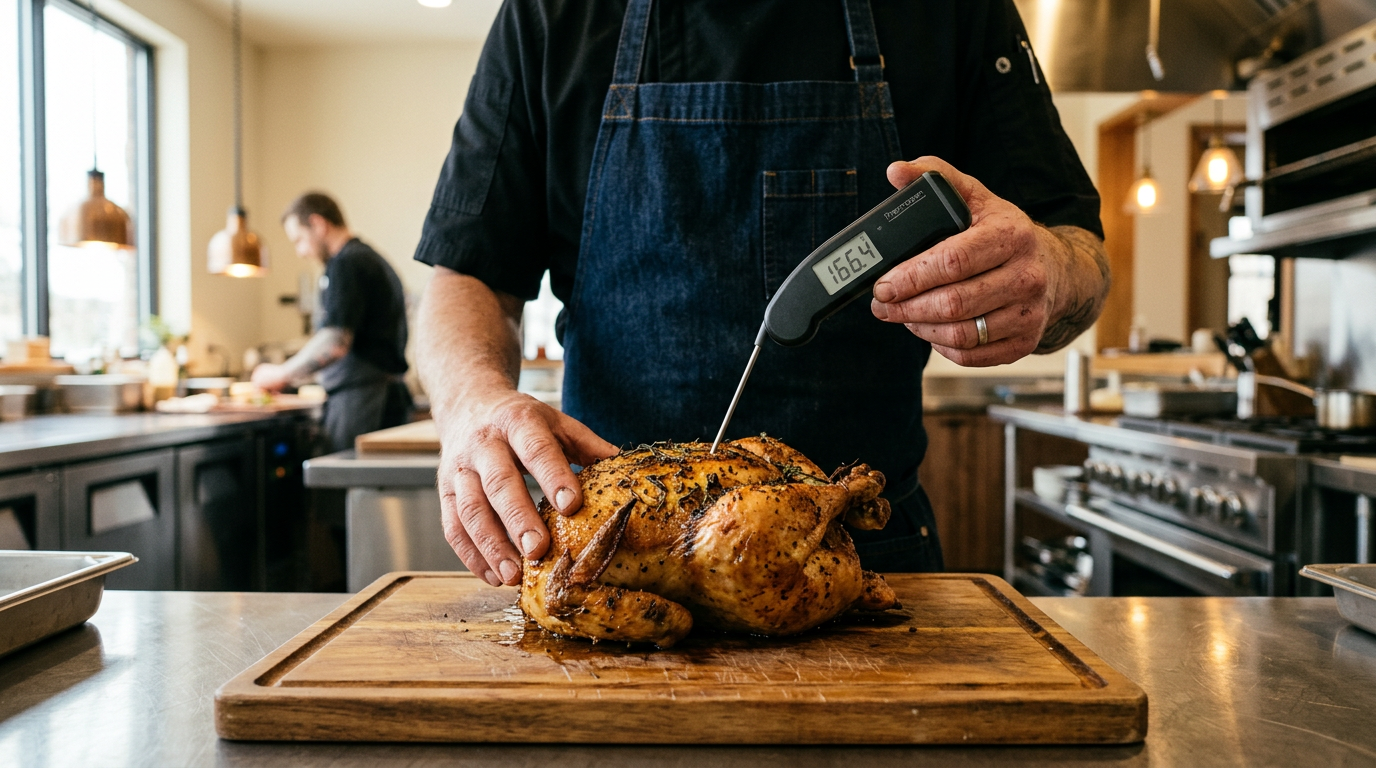
| Cooking | Pathogen survival | Poultry ≥165°F (74°C), Ground meat ≥155°F (68°C), Fish ≥145°F (63°C) | Probe thermometer check every batch | Continue cooking until required temperature reached |
| Hot Holding | Bacterial growth | ≥135°F (57°C) continuous | Temperature check every 2 hours | Reheat to 165°F (74°C) within 2 hours or discard |
| Cooling | Bacterial growth | 135°F→70°F in 2 hours, 70°F→41°F in 4 hours (6 hours total) | Check at 2-hour and 6-hour marks | If not met at 2-hour check, employ ice bath or blast chiller |
HACCP + AI = Safer, Smarter Kitchens
While HACCP keeps your kitchen safe, AI Chef Pro keeps it profitable. Recipe costing, menu engineering, and demand forecasting — 55+ tools.
Digital HACCP with AI
Technology transforms HACCP from a paper-heavy compliance burden into an intelligent food safety system. Digital monitoring eliminates transcription errors, provides real-time visibility, and generates instant reports for health inspectors. Modern restaurants increasingly adopt digital solutions that integrate seamlessly with HACCP requirements.
IoT Sensors enable continuous monitoring without manual checks. Wireless temperature sensors in walk-ins, reach-ins, and hot holding equipment transmit readings every few minutes to centralized dashboards. When temperatures approach critical limits, automated alerts notify designated staff immediately—before products exceed safety boundaries.
Automated Logging removes human error from record-keeping. Digital systems timestamp every reading automatically, creating tamper-resistant records that demonstrate compliance during inspections. Export functions generate reports in formats health departments prefer.
Predictive Analytics represent the next frontier in food safety technology. Machine learning algorithms analyze temperature patterns, equipment performance, and environmental factors to predict failures before they occur. A walk-in compressor showing degradation patterns triggers maintenance alerts before actual failure causes temperature exceedances.
Digital Records simplify every aspect of HACCP documentation. Cloud-based systems store records securely, enable multi-location access, and maintain audit trails. During health inspections, inspectors appreciate organized digital records over crumpled paper logs.
AI Chef Pro complements your HACCP implementation with comprehensive kitchen optimization tools. Beyond food safety, our 55+ AI-powered tools help with menu development, inventory management, staff scheduling, and cost optimization. The free tier provides 10 uses monthly—enough to explore how AI enhances your food safety and operational efficiency.
Frequently Asked Questions
Build a Safer, More Profitable Kitchen
HACCP protects your customers. AI Chef Pro protects your margins. Start with 10 free uses/month.
What is a HACCP plan?
Is a HACCP plan required for restaurants?
How do I create a HACCP plan?
What are critical control points in a restaurant?
How often should I update my HACCP plan?
Can AI help with HACCP compliance?
Conclusion: HACCP as Your Foundation for Success
In modern foodservice, HACCP isn’t optional—it’s essential. Customers expect safe food
Related Reading
- Restaurant Technology 2026: The Definitive Guide
- Smart Kitchen Technology for Commercial Kitchens
- Restaurant Food Waste: 12 AI Strategies
- Kitchen Display Systems (KDS) Guide
- Best Recipe Costing Software 2026
- AI Cooking Assistant for Professional Chefs
Discover more from AI Chef Pro Blog
Subscribe to get the latest posts sent to your email.