The restaurant industry is undergoing a quiet revolution. What started as a pragmatic response to rising real estate costs and shifting consumer habits has exploded into a multi-billion-dollar phenomenon reshaping how we think about food production, delivery, and brand building. But here’s the problem: if you’ve tried to research this space, you’ve likely encountered a confusing alphabet soup of terms—dark kitchen, ghost kitchen, cloud kitchen, virtual restaurant, virtual brand—used interchangeably by some sources and treated as distinct concepts by others. Some articles say they’re all the same thing. Others insist dark kitchens are European, ghost kitchens are American, and cloud kitchens are something else entirely. The inconsistency isn’t just annoying; it can cost you real money if you’re planning to launch in this space.
The confusion is understandable. These models share common DNA—kitchens designed for delivery rather than dine-in, optimized for third-party aggregators like DoorDash, Uber Eats, and Grubhub, and built on the premise that you don’t need a traditional storefront to run a successful food business. But the differences matter. The model you choose affects your startup costs, your operational complexity, your brand control, and ultimately your profitability. Get it wrong, and you could sink $100,000 into a facility that doesn’t match your goals. Get it right, and you can launch a food brand for a fraction of what a traditional restaurant requires.
The stakes are significant. The global virtual kitchen market is projected to grow from approximately $43.4 billion in 2023 to $74.6 billion by 2030, representing a compound annual growth rate (CAGR) of over 8%. This isn’t a niche trend—it’s a structural shift in how the food industry operates. Whether you’re an established restaurant owner looking to expand without the overhead of new locations, an entrepreneur seeking a lower-risk entry into foodservice, or a corporate entity exploring delivery-first concepts, understanding the distinctions between these models isn’t optional. It’s foundational.
This guide breaks down each model in detail, provides a clear comparison framework, walks you through a practical decision tree to help you choose the right fit, and explores how modern AI tools can support operations regardless of which model you select. By the end, you’ll have the clarity to make an informed decision—and the confidence to execute.
Power Any Kitchen Model with AI
Whether you run a dark kitchen, ghost kitchen, or cloud kitchen — AI Chef Pro gives you 55+ tools for menu development, food cost control, and recipe scaling. Start free.
Dark Kitchen Explained
The term dark kitchen originates from the European market, and it carries a specific meaning that distinguishes it from the other models in this space. A dark kitchen is a commercial cooking facility that is leased or operated by an established restaurant brand to fulfill delivery orders without any dine-in or front-of-house presence. The “dark” refers to the absence of customers physically visiting the location—the lights are on in the kitchen, but the “front” is effectively dark.
In practice, a dark kitchen operates as a satellite production facility for an existing brand. A well-known restaurant chain, for example, might open a dark kitchen in a residential area to expand its delivery radius without the cost of building out a full restaurant with seating. The brand, the menu, the recipes, and the customer experience are already established. The dark kitchen is purely a logistics play—an operational extension designed to capture demand in a new geographic zone.
Key characteristics of the dark kitchen model include:
- Leased or owned commercial kitchen space dedicated to a single brand or a closely related brand family.
- Existing brand identity is already recognized by consumers, reducing the need for marketing spend to build awareness.
- Full menu or a curated subset of the main restaurant’s offerings, prepared in a facility designed for delivery-optimized workflows.
- European terminology preference, though the model is now used globally. In the UK, continental Europe, and increasingly in North America, “dark kitchen” specifically refers to this brand-extension model.
From a financial perspective, dark kitchens typically require significant capital outlay. You’re either building out a leased commercial space from scratch or paying premium rents for turnkey kitchen facilities in high-demand areas. The advantage, however, is operational simplicity in one sense: you’re running one known brand with established recipes, supply chains, and quality standards. The challenge is that you’re bearing the full cost of the facility yourself, without sharing infrastructure or risk with other operators.
Examples of dark kitchen implementations include major fast-food and quick-service chains opening delivery-only locations in suburban markets, or established casual dining brands testing new cuisine concepts in dedicated kitchen spaces while leveraging their existing supply chains and operational expertise.
Ghost Kitchen Explained
Ghost kitchen is the term most commonly associated with the American iteration of the delivery-only concept, and it has evolved to encompass a broader range of operational models than the term “dark kitchen.” Where dark kitchens are typically extensions of existing brands, ghost kitchens are often independent ventures—new food businesses launched from scratch, with no prior restaurant presence and no physical storefront.
A ghost kitchen is essentially a delivery-only restaurant operation run by a single operator or team. The operator leases or owns a commercial kitchen space, develops their own menu, builds their own brand, and fulfills orders primarily through third-party delivery aggregators. There is no dine-in area, no walk-up counter, and often no visible storefront signage. The business exists primarily in the digital realm—on delivery apps, on social media, and in the minds of customers who discover the brand through their phones.
Key characteristics of the ghost kitchen model include:
- Independent operation with no connection to an existing restaurant brand. You are building something new from the ground up.
- No physical storefront—the kitchen may be in a commercial kitchen building, a converted warehouse space, or even a retrofitted retail location with no customer-facing element.
- Single brand focus (though some operators run multiple concepts from the same kitchen, these are typically managed as separate businesses).
- Full operational control over menu development, pricing, sourcing, branding, and customer service.
- Complete responsibility for startup costs, ongoing rent, equipment, staffing, and marketing.
The ghost kitchen model appeals to entrepreneurs who want to own their brand and their kitchen but aren’t ready for the capital commitment of a full restaurant. It offers creative freedom—you can develop any cuisine concept you can imagine—but it also places the full burden of brand building, customer acquisition, and operational management on your shoulders. Startup costs typically range from $25,000 to $80,000 depending on whether you’re leasing a turnkey kitchen space or building out from a raw commercial space, and you should budget an additional $10,000 to $30,000 for initial inventory, marketing, and working capital.
The ghost kitchen model is ideal for operators who have culinary expertise or a strong concept but lack the capital (or the desire) to open a traditional restaurant. It’s also a common stepping stone: many successful ghost kitchen operators eventually expand to multiple locations or transition to the cloud kitchen model as they scale.
Cloud Kitchen Explained
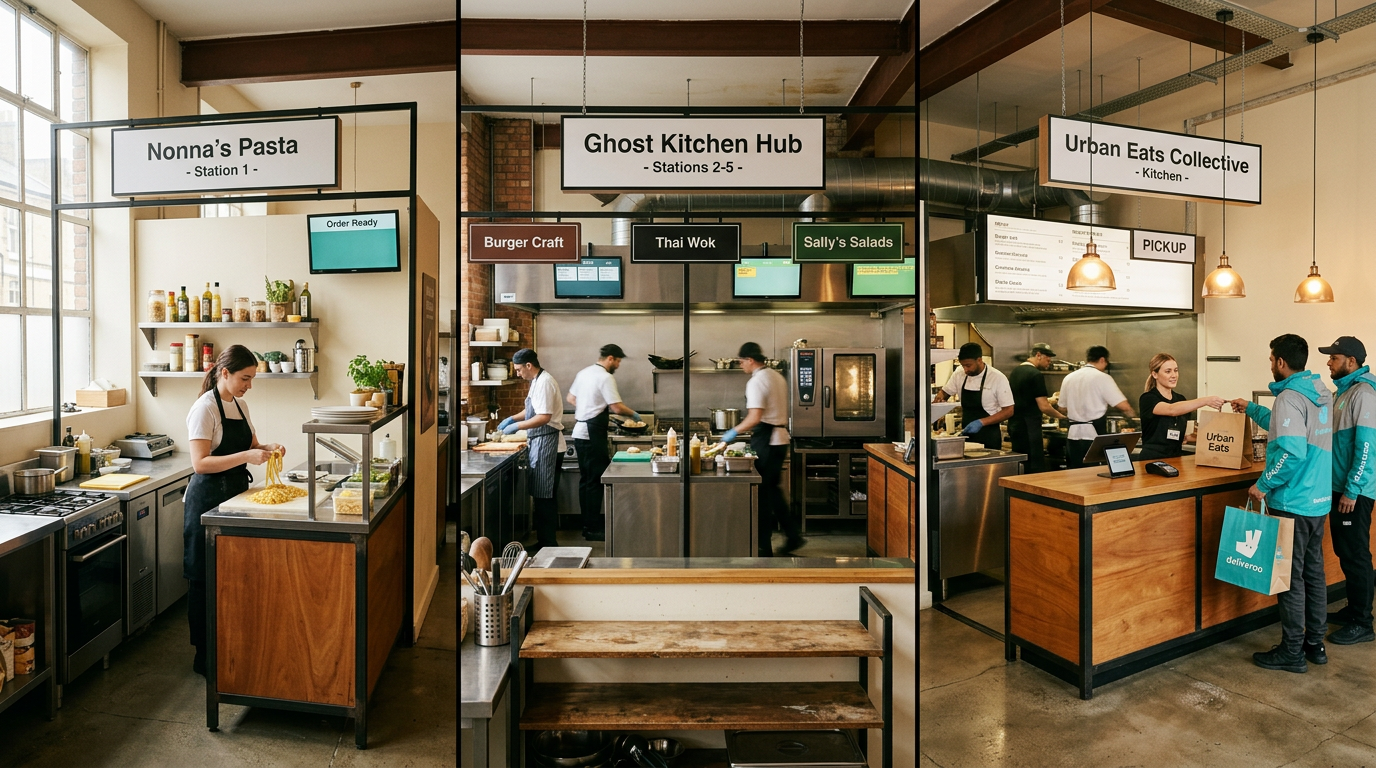
Cloud kitchen represents a distinct operational model that sits between the single-brand focus of the ghost kitchen and the brand-extension purpose of the dark kitchen. A cloud kitchen is a shared commercial kitchen facility where multiple independent food brands operate under one roof, each running their own delivery-only concept from the same shared infrastructure.
Think of a cloud kitchen as a co-working space for food brands. The facility provides the physical kitchen space, equipment, refrigeration, storage, utilities, and often basic infrastructure like Wi-Fi and cleaning services. Each tenant operates their own distinct brand—different name, different menu, different marketing—with complete independence over what they produce and how they price it. What they share is the facility itself, along with the operational overhead of maintaining it.
Key characteristics of the cloud kitchen model include:
- Shared facility model where multiple brands operate side by side in the same commercial kitchen space.
- Centralized infrastructure including cooking equipment, hood systems, walk-in coolers and freezers, dry storage, and often prep tables and packaging stations.
- Multiple brands under one roof, each run by a different operator or team, all sharing the same physical location but maintaining separate brand identities.
- Economies of scale in shared costs—rent, utilities, equipment maintenance, insurance, and sanitation are distributed among tenants.
- Aggregator-friendly operations optimized for high-volume delivery fulfillment, with dedicated staging areas for pickup by DoorDash, Uber Eats, and other platforms.
The cloud kitchen model has gained tremendous traction because it dramatically lowers the barrier to entry for food entrepreneurs. Rather than securing a standalone commercial lease (which can be prohibitively expensive in prime delivery zones), signing a multi-year equipment loan, and building out a kitchen from scratch, an operator can rent a station within an existing cloud kitchen facility for a fraction of that cost. Some cloud kitchens charge flat monthly rents per brand; others use a revenue-share model where operators pay a percentage of their sales.
This model is particularly attractive in high-density urban markets where commercial real estate costs make standalone kitchen leases economically unviable for most independent operators. The shared model also provides a built-in community of operators—often a mix of experienced restaurant professionals and first-time entrepreneurs—who can share insights, collaborate on sourcing, and even cross-promote between brands.
Examples of cloud kitchen operators include companies like Kitchen United, Zuul, and CloudKitchens (the company founded by Travis Kalanick, Uber’s former CEO), which build and operate large shared kitchen facilities in major metropolitan areas. These facilities can host anywhere from 5 to 20 or more distinct brands simultaneously, each running their own delivery-only operation.
Virtual Restaurant / Virtual Brand Explained
The virtual restaurant or virtual brand model represents the most abstract and, in many ways, the most innovative approach to the delivery-only space. A virtual restaurant is a brand-only concept—there is no dedicated kitchen, no leased facility in your name, and often no physical infrastructure owned by the brand operator. Instead, you create a food brand and partner with an existing kitchen (often a cloud kitchen or ghost kitchen facility) to produce the food.
In this model, your core asset is the brand itself—the concept, the menu, the visual identity, and the customer relationship. You handle menu development, brand marketing, menu engineering for profitability, and customer acquisition through delivery apps and social media. The actual food production is outsourced to a partner kitchen that prepares your menu alongside their own operations or alongside other virtual brands.
Key characteristics of the virtual brand model include:
- No kitchen ownership—you don’t lease, build, or equip a kitchen. You partner with an existing facility.
- Brand-focused operation where your primary investment is in concept development, branding, and marketing.
- Aggregator partnerships as the primary distribution channel, with your brand appearing on DoorDash, Uber Eats, Grubhub, and similar platforms.
- Lowest startup cost among all models, making it accessible to first-time entrepreneurs with limited capital.
- Maximum flexibility to test concepts, pivot cuisines, or sunset brands that don’t perform without significant financial exposure.
The virtual brand model is particularly well-suited for experienced foodservice operators who want to run multiple concepts without the overhead of multiple kitchen leases, or for brands looking to test market demand before committing to a dedicated facility. It’s also a popular model for existing restaurants seeking to expand their delivery footprint without investing in new kitchen equipment—a restaurant might partner with a ghost kitchen facility to launch a completely different cuisine concept (e.g., a taco brand launched by a pizza restaurant) under a new virtual brand identity.
From a financial perspective, virtual brand startup costs can be as low as $5,000 to $15,000, covering brand development, menu design, initial marketing, and aggregator setup fees. Your ongoing costs are typically a percentage of sales paid to the host kitchen (often 15% to 30% of revenue) plus your marketing spend and platform fees.
This model requires less capital but demands strong skills in brand development, digital marketing, and menu engineering. You are, in essence, a brand company that happens to sell food—your competitive advantage lies in concept differentiation and customer acquisition, not in kitchen operations.
Side-by-Side Comparison Table
The following HTML table provides a direct comparison across all four models across the dimensions that matter most when evaluating your options: definition, ownership structure, physical space requirements, brand setup, typical startup costs, expected profit margins, ideal use case, and real-world examples.
| Feature | Dark Kitchen | Ghost Kitchen | Cloud Kitchen | Virtual Brand |
|---|---|---|---|---|
| Definition | Leased commercial kitchen space operated by an existing restaurant brand to fulfill delivery orders | Independent, delivery-only restaurant operated by a single owner with no physical storefront | Shared commercial kitchen facility where multiple independent brands operate under one roof | Brand-only concept with no kitchen ownership; food produced by a partner facility |
| Ownership | Single brand (parent company) | Single operator / single brand | Multiple independent operators sharing facility infrastructure | Brand owner outsources production to partner kitchen |
| Space | Dedicated leased or owned kitchen facility | Dedicated kitchen space (leased or owned) | Shared kitchen space with multiple brands operating simultaneously | No dedicated space; uses partner kitchen’s capacity |
| Brands | One brand (extension of existing restaurant) | One brand per operation | Multiple brands (5–20+ per facility) | One or multiple brands, all produced externally |
| Startup Cost | $80,000 – $250,000+ | $25,000 – $80,000 | $15,000 – $60,000 per brand | $5,000 – $15,000 |
| Typical Margins | 15% – 25% net margin after rent and labor | 10% – 20% net margin | 12% – 22% net margin (lower rent burden) | 8% – 18% net margin (partner fees reduce margin) |
| Best For | Established restaurant brands expanding delivery radius | Independent entrepreneurs building a new brand from scratch | Operators wanting shared infrastructure and community at moderate cost | First-time entrepreneurs, brand testers, multi-concept creators |
| Examples | Domino’s delivery-only locations, McDonald’s expansion kitchens | Most independent delivery-only concepts on DoorDash | Kitchen United, CloudKitchens, Zuul | Many virtual brands on Uber Eats hosted in shared kitchens |
Building a Virtual Brand?
AI Chef Pro helps you create delivery-optimized menus, calculate food costs instantly, and develop recipes that travel well. 55+ AI tools from €25/month.
Which Model Should You Choose?
Choosing the right model isn’t about finding the “best” option—it’s about matching the model to your specific situation: your capital, your experience, your goals, and your risk tolerance. Here’s a practical decision framework to guide you:
Budget Under $25,000: Start with a Virtual Brand or Shared Cloud Kitchen
If your startup capital is under $25,000, your most viable paths are the virtual brand model or renting a station within a cloud kitchen. With a virtual brand, you invest primarily in brand development and marketing, outsourcing production to an existing facility. With a shared cloud kitchen, you benefit from infrastructure that would cost five times as much to build independently. Both options allow you to enter the market with minimal capital exposure while testing your concept with real customers.
Budget $25,000 – $80,000: Consider a Ghost Kitchen
If you have $25,000 to $80,000 to invest, the ghost kitchen model gives you the best balance of control and accessibility. You can lease a turnkey commercial kitchen space, develop your own brand and menu, and build your business without the overhead of a full restaurant. This is the sweet spot for independent operators who have a strong concept and are ready to commit to a single brand. You own everything—the brand, the kitchen, the customer relationships.
Budget $80,000+: Explore a Cloud Kitchen or Hybrid Dark Kitchen Model
With $80,000 or more, you have the capital to either secure a dedicated kitchen lease and build out a ghost kitchen operation, or to invest in a cloud kitchen facility if you plan to host multiple brands. If you’re an established restaurant brand looking to expand into new markets without the cost of full restaurant builds, a dark kitchen (dedicated facility under your brand) remains a powerful option. At this budget level, you also have the flexibility to run a hybrid model—operating your own primary brand from your own kitchen while hosting additional virtual brands to maximize facility utilization.
Existing Restaurant? Consider a Virtual Brand
If you already operate a traditional restaurant, you have infrastructure, staff, and operational expertise that many entrants in this space would envy. Rather than building a new kitchen, consider launching a virtual brand from your existing facility. You can test a new cuisine concept, reach new customer segments, or create a delivery-optimized brand that complements your dine-in operation—without any additional real estate costs.
Testing a Concept? Use a Shared Facility
If you’re not sure whether your concept will work, or if you’re an experienced operator looking to validate a new idea before committing to it fully, start in a shared cloud kitchen or as a virtual brand. These models allow you to test market response, iterate on your menu, and refine your brand positioning with minimal financial risk. If the concept takes off, you can then invest in a dedicated facility. If it doesn’t, you can pivot or exit without a major capital loss.
How AI Tools Help Any Virtual Kitchen Model
Regardless of which model you choose, the operational challenges of running a delivery-only food business are substantial. Recipe development, food cost control, menu engineering for profitability, inventory management, demand forecasting, and scaling operations across multiple brands all require precision, data, and ongoing optimization. This is where AI-powered tools become a strategic advantage rather than a luxury.
AI Chef Pro (available at https://aichef.pro/en) provides a suite of more than 55 AI-powered tools designed specifically for chefs, restaurant operators, and food entrepreneurs running virtual kitchen models. Here’s how these tools support each operational dimension:
- Recipe Development and Innovation: Generating new menu items, adapting existing recipes for delivery optimization (shelf life, packaging resilience, reheating performance), and creating seasonal rotations based on ingredient availability and cost trends.
- Food Cost Control and Optimization: Calculating precise ingredient costs per plate, identifying cost-saving substitutions without sacrificing quality, and modeling menu pricing to hit target profit margins in a competitive delivery market.
- Menu Engineering: Analyzing sales data, identifying high-margin versus low-margin items, and structuring menus to guide customers toward the most profitable combinations—critical in a delivery environment where platform fees and packaging costs eat into margins.
- Demand Forecasting and Scaling: Predicting order volume based on daypart, weather, local events, and promotional activity on delivery platforms, enabling better staffing and inventory planning.
- Brand and Marketing Support: Generating social media content, writing platform listings, and creating promotional copy tailored to each delivery aggregator’s audience.
The reality is that virtual kitchen operators compete
Not sure which kitchen model fits your plan?
AI Chef Pro has 55+ AI tools to model menu economics, delivery channels and multi-brand operations — test your concept before you commit a dollar.
Dark Kitchen vs Ghost Kitchen vs Cloud Kitchen: Quick Decision Guide
These three terms are frequently used interchangeably in the restaurant industry, but they represent distinct operational models with different business implications. Understanding the differences between dark kitchen vs ghost kitchen vs cloud kitchen is essential for operators looking to optimize their delivery-focused strategy, whether you’re a single brand experimenting with off-premises dining or a multi-brand enterprise building a scalable kitchen network.
- “If you are a single restaurant brand testing delivery-only expansion” → Ghost Kitchen
- “If you are a tech platform operating shared kitchen space for rent” → Cloud Kitchen
- “If you are a delivery-focused brand with no physical storefront” → Dark Kitchen
- “If you are running 3+ virtual brands from one location” → Multi-Brand Cloud Kitchen
- “If you are a traditional restaurant using off-hours for delivery-only brands” → Hybrid model
It’s worth noting that the terminology remains fluid across the industry. Some operators use these terms synonymously, particularly in regional markets where one model dominates. However, investors, real estate developers, and serious operators increasingly distinguish between them using the framework above. When researching dark kitchen cloud kitchen options for your business, clarify exactly which model a prospective partner or landlord is describing to avoid costly misunderstandings.
Side-by-Side Comparison: Dark vs Ghost vs Cloud Kitchen
While all three models share a focus on delivery-first operations, their structural differences impact everything from startup capital requirements to long-term scalability. The following comparison breaks down the key attributes across dark kitchen vs ghost kitchen vs cloud kitchen configurations.
| Attribute | Dark Kitchen | Ghost Kitchen | Cloud Kitchen |
|---|---|---|---|
| Primary Meaning | Delivery-only kitchen with no dine-in or storefront | Virtual brand operated from an existing kitchen (often a restaurant) | Shared or dedicated kitchen facility housing multiple virtual brands |
| Physical Customer Access | None — delivery only | None — delivery only | None — delivery only |
| Ownership Model | Brand-owned or leased facility | Typically brand-operated within existing infrastructure | Shared rental model or brand-operated multi-brand facility |
| Typical Size | 800-2,000 sq ft | 200-800 sq ft (shared space) | 2,000-10,000+ sq ft |
| Setup Cost (USD) | $50,000-$250,000 | $10,000-$50,000 | $100,000-$500,000+ |
| Monthly Operating Cost | $8,000-$25,000 | $2,000-$8,000 | $15,000-$60,000 |
| Number of Brands per Site | Typically 1-3 | Usually 1 | 3-20+ |
| Delivery Channels | Third-party platforms + own delivery | Third-party platforms primarily | Multi-platform + proprietary delivery network |
| Best For | Established delivery brands expanding footprint | Restaurants testing virtual brand concepts | Entrepreneurs, multi-brand operators, food hall operators |
| Main Risk | Platform dependency, high fixed costs | Brand cannibalization, kitchen capacity conflicts | Complexity management, tenant turnover |
The cloud kitchen model offers the highest ceiling for scale, particularly for operators managing multiple virtual brands or investors building portfolio companies. The ability to host diverse concepts under one roof—sharing infrastructure, staff, and delivery logistics—creates economic advantages that dark kitchen or ghost kitchen configurations cannot match. However, this scale comes with operational complexity: managing brand isolation, coordinating delivery windows across competing concepts, and maintaining quality control across a larger facility require sophisticated systems and experienced management teams.
For operators weighing the cloud kitchen vs ghost kitchen decision, the choice often comes down to growth ambitions versus operational tolerance. A dark kitchen suits established brands seeking geographic expansion without the overhead of full-service locations. A ghost kitchen provides a low-risk testing ground for new concepts. But if your strategy involves building a multi-brand delivery empire, the cloud kitchen infrastructure—despite its complexity—typically delivers the best long-term unit economics.
Frequently Asked Questions: Dark, Ghost and Cloud Kitchens
What is the difference between cloud kitchen and dark kitchen?
The primary difference between cloud kitchen and dark kitchen lies in operational scope. A dark kitchen is a delivery-only facility operated by a single brand, typically serving one cuisine concept. A cloud kitchen, by contrast, is a shared or multi-brand facility that houses multiple virtual brands under one roof, enabling operators to run diverse concepts from a single location and share infrastructure costs.
Are cloud kitchen and ghost kitchen the same thing?
While ghost kitchen vs cloud kitchen are related concepts, they are not identical. A ghost kitchen typically refers to a virtual brand operating from an existing restaurant kitchen—essentially a delivery-only concept added to an established operation. A cloud kitchen is a standalone facility, often purpose-built or retrofitted, that hosts multiple brands. Some operators use the terms interchangeably, but the distinction matters for investors and operators evaluating business models.
What are the different types of alternative kitchens?
The alternative kitchen landscape includes several models: dark kitchens (delivery-only, single-brand), ghost kitchens (virtual brands from existing restaurants), cloud kitchens (multi-brand shared facilities), micro-kitchens (compact delivery-only units under 500 sq ft), and hybrid models (combining delivery-only operations with limited dine-in or pickup). Each serves different market segments and operational goals within the broader alternative kitchens ecosystem.
Which is more profitable: dark kitchen, ghost kitchen, or cloud kitchen?
Profitability varies significantly based on scale, location, and brand portfolio. Ghost kitchens typically offer the lowest entry cost and fastest time to profitability for existing restaurants, while dark kitchens provide better margins for established delivery brands with volume. Cloud kitchens achieve the highest long-term profitability through multi-brand economics and shared overhead, but require larger capital investment and operational expertise. Tools like AI Chef Pro help operators model unit economics across each model to identify the most profitable approach for their specific concept and market.
What does a ghost kitchen offer customers?
A ghost kitchen offers customers access to restaurant-quality food exclusively through delivery, with no dine-in or pickup option. Customers typically discover ghost kitchen brands through third-party delivery platforms (DoorDash, Uber Eats, Grubhub) rather than through physical locations. The offering focuses on delivery-optimized menu items that travel well, with packaging designed to maintain food quality during transit.
What is the cloud kitchen concept in simple terms?
The cloud kitchen concept is essentially a shared commercial kitchen facility where multiple food brands operate side by side, each focused exclusively on delivery orders. Think of it as a food court without the dining area—multiple virtual restaurant brands sharing the same kitchen space, equipment, and sometimes staff, but maintaining separate menus, branding, and delivery operations. This model enables entrepreneurs to launch delivery-only brands with lower capital requirements while leveraging shared infrastructure.
Related Reading
- Ghost Kitchen Guide 2026: How to Start and Scale
- 7 Cloud Kitchen Business Models Compared
- Smart Kitchen Technology for Commercial Kitchens
- AI Menu Pricing Strategy
- AI Cooking Assistant for Professional Chefs
- Best AI Tools for Chefs 2026
Discover more from AI Chef Pro Blog
Subscribe to get the latest posts sent to your email.