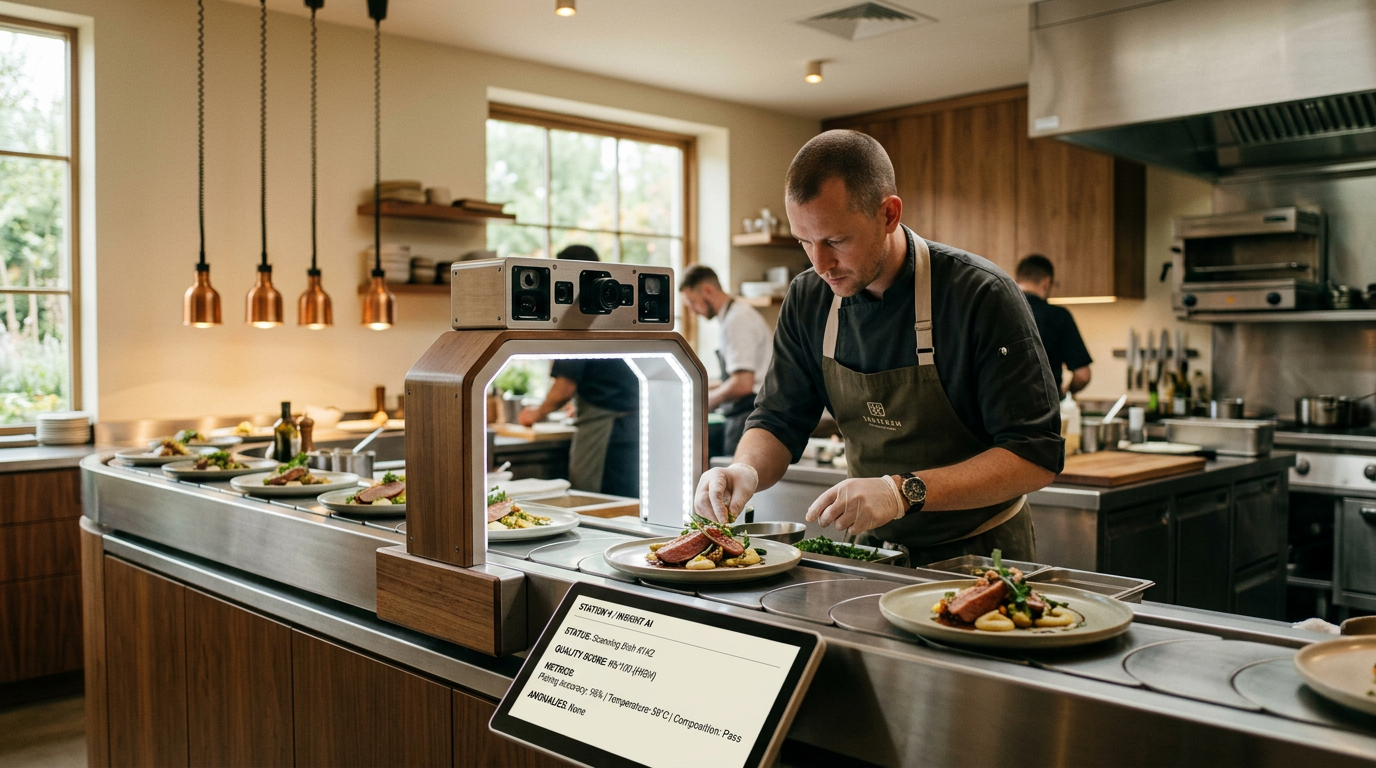

The restaurant industry is undergoing a technological revolution, and ai food quality control systems are at the forefront of this transformation. Machine vision and artificial intelligence are fundamentally changing how commercial kitchens approach quality assurance, creating unprecedented levels of consistency, efficiency, and food safety. From automated portion verification to real-time presentation scoring, these AI-powered solutions are helping restaurants reduce inconsistency by 40% and cut waste from quality rejects by 25%.
This comprehensive guide explores the cutting-edge world of ai food quality control, examining how computer vision and machine learning algorithms are being deployed in restaurant kitchens worldwide. Whether you’re a restaurant owner, executive chef, or hospitality professional, understanding these technologies is essential for staying competitive in today’s demanding market.
AI-Powered Kitchen Intelligence
AI Chef Pro offers 55+ AI tools to standardize recipes, optimize costs, and engineer menus. The perfect complement to machine vision quality systems.
What Is AI Food Quality Control?
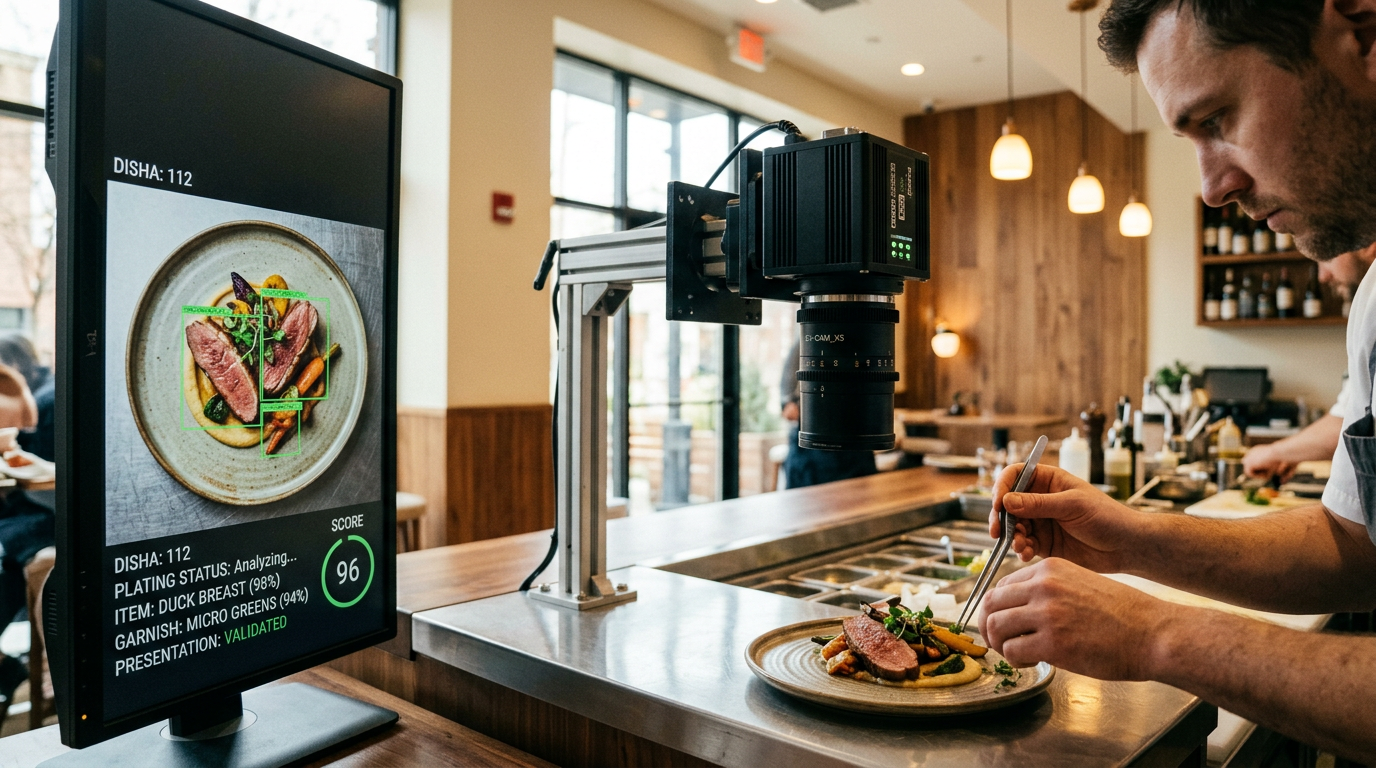
AI food quality control represents the convergence of computer vision technology and machine learning algorithms specifically designed to analyze and evaluate food products in commercial kitchen environments. This sophisticated approach goes far beyond traditional quality inspection methods, enabling automated, objective, and continuous assessment of food items throughout the entire preparation and service process.
At its core, ai food quality systems utilize high-resolution cameras positioned strategically throughout the kitchen to capture images and video of food items at various stages of preparation. These visual data points are then processed by machine learning models trained on thousands of images representing both acceptable and unacceptable food quality standards. The algorithms can evaluate multiple quality parameters simultaneously, including appearance, portion size, temperature, freshness indicators, and presentation consistency.
The deployment of these systems typically involves strategically placed cameras at critical quality control points, including:
- Plating stations – where final dish presentation is evaluated before service
- Receiving docks – where incoming ingredients are inspected for quality and compliance
- Storage areas – where freshness and proper storage conditions are monitored
- Pass-through windows – where completed orders are verified before delivery to customers
- Prep stations – where portion consistency is monitored during preparation
The real power of ai food quality control lies in its ability to provide consistent, objective assessments 24/7, eliminating the variability inherent in human inspection while capturing data that can be used for continuous improvement and trend analysis.
Key Applications of AI Food Quality in Restaurant Kitchens
The applications of ai food quality technology span virtually every aspect of food preparation and service. These systems are designed to address the most common quality control challenges faced by commercial kitchens, from ensuring portion consistency to preventing potentially dangerous contamination events.
Portion Consistency Verification
One of the most valuable applications of ai food quality systems is automated portion verification. Traditional manual portioning relies on staff training and supervision, resulting in significant variation—typically ±15% from target weights or sizes. AI-powered vision systems can achieve remarkable accuracy of ±2%, ensuring every customer receives consistent portions while controlling food costs.
These systems use advanced image analysis to measure portion sizes in real-time, alerting kitchen staff immediately when a portion falls outside acceptable parameters. This immediate feedback allows for instant correction rather than discovering quality issues after the dish has been served.
Plating Presentation Scoring and Standardization
Visual presentation significantly impacts customer perception and satisfaction, yet maintaining consistent plating across different shifts and staff members has traditionally been challenging. AI food quality systems can evaluate plating against predefined standards, scoring dishes on factors including:
- Garnish placement and freshness
- Sauce drizzle patterns and coverage
- Portion height and plate arrangement
- Color balance and visual appeal
- Cleanliness of plate edges
This scoring provides valuable feedback to kitchen staff, helping maintain the high presentation standards that customers expect while reducing the time required for training new team members on plating techniques.
Receiving Inspection and Freshness Verification
The quality of finished dishes begins with the ingredients that enter the kitchen. AI food quality systems deployed at receiving docks can automatically inspect incoming shipments, verifying freshness, color, size, and overall quality against specifications. This automated inspection ensures consistency in ingredient quality while reducing the time required for receiving procedures.
These systems can detect signs of spoilage, improper ripeness, or damage that might not be immediately apparent to human inspectors, preventing substandard ingredients from entering the kitchen and ultimately reaching customers.
Foreign Object Detection
Food safety is paramount in any foodservice operation, and ai food quality technology provides an additional layer of protection against foreign object contamination. Advanced machine vision systems can detect foreign objects including metal fragments, plastic pieces, hair, and other contaminants that could potentially end up in food products.
While metal detection and X-ray systems have been used in food manufacturing for years, ai food quality brings similar capabilities to the restaurant kitchen environment, providing real-time inspection at critical points in the preparation process.
Allergen Cross-Contamination Prevention
For customers with food allergies, cross-contamination can have serious health consequences. AI food quality systems can monitor for potential allergen cross-contamination by tracking the movement of ingredients and ensuring proper separation protocols are followed. These systems can alert staff when potential cross-contamination events occur, enabling immediate corrective action.
Shelf Life Prediction Based on Visual Analysis
Determining optimal ingredient usage and reducing waste requires accurate shelf life assessment. AI food quality systems can analyze visual indicators of freshness over time, building predictive models that estimate remaining shelf life based on observed conditions. This data enables better inventory management and reduces the significant financial and environmental impact of food waste.
How Machine Vision Works in Kitchens
Understanding the technical foundation of ai food quality systems helps restaurant operators evaluate potential solutions and plan successful implementations. The technology combines several sophisticated components working together to deliver accurate, real-time quality assessments.
Camera Systems form the visual foundation of these implementations. Modern ai food quality deployments typically use high-resolution industrial-grade cameras capable of capturing detailed images in varying lighting conditions. These cameras are designed to withstand the challenging kitchen environment, including heat, humidity, and frequent cleaning.
Edge Computing enables the real-time processing required for immediate feedback. Rather than sending all data to cloud servers for processing, edge computing systems process images locally at the camera location, reducing latency and enabling instant alerts when quality issues are detected.
Machine Learning Models provide the intelligence that makes ai food quality systems effective. These models are trained on extensive datasets containing thousands of images representing both acceptable and unacceptable food quality examples. The training process teaches the system to recognize the subtle visual patterns that indicate quality issues.
The training process involves several key steps:
- Collecting thousands of images representing various quality states
- Expert annotation of images to identify quality parameters
- Training deep learning models to recognize quality indicators
- Validating model performance against test datasets
- Continuous refinement as new data becomes available
Once deployed, ai food quality systems provide real-time feedback to kitchen staff through various interfaces, including visual displays at workstations, alerts on kitchen display systems (KDS), and mobile notifications for management. This immediate feedback enables instant correction rather than discovering quality issues after they impact customers.
Integration capabilities ensure ai food quality systems work seamlessly with existing kitchen technology. Most solutions offer APIs and integration modules that connect with POS systems, KDS platforms, inventory management systems, and enterprise reporting tools. This integration enables comprehensive data analysis and workflow automation.
Leading AI Food Quality Companies
The ai food quality market is experiencing significant growth, with numerous companies offering solutions tailored to different segments of the foodservice industry. Understanding the leading providers helps restaurant operators identify potential partners for implementation.
| Company | Specialization | Key Features |
|---|---|---|
| Agot AI | Drive-thru accuracy | Order verification, item detection, presentation scoring |
| Kitro | Waste monitoring | Food waste identification, portion analysis, sustainability tracking |
| Winnow | Waste identification | Waste analytics, inventory optimization, cost reduction |
| ImpactVision | Hyperspectral analysis | Freshness detection, quality grading, contamination identification |
| Apeel Sciences | Freshness solutions | Produce shelf-life extension, quality preservation |
Agot AI focuses specifically on quick-service restaurants, providing drive-thru accuracy solutions that verify orders are complete and correctly prepared before delivery. Their systems use computer vision to detect missing items, incorrect preparations, and presentation issues that could lead to customer dissatisfaction.
Kitro specializes in waste monitoring, helping restaurants identify and quantify food waste at various stages of preparation and service. Their AI-powered waste recognition system can categorize waste by type, enabling targeted reduction strategies.
Winnow offers comprehensive waste identification and analytics solutions that help commercial kitchens understand their waste patterns and implement effective reduction strategies. Their machine learning technology improves accuracy over time as the system learns from each waste event.
ImpactVision brings hyperspectral imaging technology to food quality assessment, enabling non-invasive analysis of food properties including freshness, composition, and potential contamination. This advanced technology provides deeper insights than traditional visible-light camera systems.
Apeel Sciences takes a different approach to freshness, developing plant-based coatings that extend the shelf life of produce by reducing moisture loss and oxidation. While not strictly a machine vision company, their technology complements ai food quality systems focused on freshness monitoring.
For restaurants seeking comprehensive AI capabilities, AI Chef Pro at https://aichef.pro/en offers a complementary suite of over 55 AI tools specifically designed for foodservice professionals. While specialized ai food quality companies focus on specific quality control functions, AI Chef Pro provides additional capabilities including recipe development, cost analysis, menu engineering, and operational optimization—making it an ideal complement to dedicated quality control systems.

ROI of AI Quality Control
Understanding the return on investment potential helps restaurant operators justify ai food quality implementations to stakeholders. The benefits extend across multiple areas of operation, creating compound returns that can significantly impact profitability.
Waste Reduction
AI food quality systems consistently deliver waste reduction of approximately 25% by identifying quality issues earlier in the preparation process. Rather than discovering problems at final inspection or, worse, after customer complaints, these systems enable immediate correction, preventing wasted ingredients and labor.
Consistency Improvement
The consistency improvements delivered by ai food quality technology are substantial, with many operations reporting 40% reduction in quality inconsistency. This improvement translates directly to customer satisfaction, as consistent quality builds trust and encourages repeat business.
Reduced Complimentary Items and Returns
Quality issues discovered after service often result in complimentary items, refunds, or customer complaints that damage reputation. By catching these issues before they reach customers, ai food quality systems significantly reduce the costs associated with quality failures, including direct costs of comps and indirect costs of lost customer lifetime value.
Faster Staff Training
Training new kitchen staff on quality standards traditionally requires extensive supervision and feedback. AI food quality systems accelerate this process by providing objective, immediate feedback on quality parameters. New team members can self-correct more quickly, reducing the time required to reach full productivity.
Health Inspection Confidence
Documented quality control processes demonstrate commitment to food safety during health inspections. Many restaurant operators find that ai food quality documentation provides valuable evidence of their food safety programs, potentially improving inspection outcomes and building inspector confidence.
Implementation Costs
AI food quality system costs vary significantly based on scale and sophistication, typically ranging from $500 to $5,000 per month for most restaurant implementations. This investment is often offset quickly by the combination of waste reduction, improved consistency, and reduced complaint-related costs.
| Benefit Category | Typical Impact | Value Consideration |
|---|---|---|
| Waste Reduction | 25% decrease | Direct ingredient cost savings |
| Consistency Improvement | 40% reduction in variation | Customer satisfaction and retention |
| Returns/Complaints | Significant reduction | Direct savings + reputation protection |
| Training Time | 30-50% reduction | Labor cost efficiency |
| Monthly Cost | $500-$5,000 | Scale-dependent investment |
Frequently Asked Questions About AI Food Quality Control
Ready for AI-Powered Quality?
Start with recipe standardization and cost optimization using AI Chef Pro. 55+ tools, free tier — 10 uses/month.
How accurate is AI food quality control compared to human inspection?
What hardware is required to implement AI food quality in my kitchen?
Can AI food quality systems integrate with my existing kitchen technology?
Leading Companies in AI Food Quality Control
The AI food quality control market has grown rapidly, with several companies pioneering solutions that address different aspects of kitchen quality management. Understanding the landscape helps restaurant operators choose the right partner for their specific needs.
Kitro (Switzerland) focuses on food waste prevention through AI-powered image recognition. Their system analyzes plate waste in real-time, identifying which items customers return most frequently. This data enables kitchens to adjust portion sizes and menu offerings, directly impacting both cost control and sustainability metrics. Kitro’s strength lies in its simplicity—installation requires minimal hardware, making it accessible for restaurants of all sizes.
Winnow (UK) takes a similar approach to waste reduction but with a stronger emphasis on commercial kitchen operations. Their AI-powered smart scales and camera systems track food waste across entire kitchen workflows, from prep to service. Winnow’s analytics platform provides actionable insights that help chefs make data-driven decisions about purchasing and production. The company works with major hospitality groups and has documented significant waste reduction for clients.
ImpactVision specializes in hyperspectral imaging for food quality assessment. Their technology goes beyond visible light, analyzing the chemical composition of food to detect freshness, ripeness, and potential contamination without physical contact. This approach is particularly valuable for receiving inspections, where staff must quickly assess the quality of incoming ingredients. ImpactVision serves both processors and foodservice operators.
Apeel Sciences takes a different approach by using AI to develop plant-based protective coatings that extend produce shelf life. While not a vision system, their technology addresses the root cause of food waste—spoilage—by creating an optimized barrier that keeps fresh produce looking and tasting better longer. Their AI research platform analyzes molecular combinations to develop tailored solutions for different produce types.
These companies demonstrate the diversity of approaches within AI food quality control. Some focus on detection and measurement, while others address the underlying factors that affect quality outcomes.
For restaurants seeking comprehensive AI support beyond vision-based quality control, AI Chef Pro offers a complementary suite of more than 55 AI tools specifically designed for foodservice operations. While not a machine vision system, AI Chef Pro addresses quality control from a different angle—standardizing recipes across locations, calculating precise food costs, and optimizing menu engineering for consistency and profitability. Their platform enables restaurants to maintain standardized quality regardless of which team member prepares each dish. The service offers a free tier with 10 uses monthly, making it accessible for independent operators looking to implement AI-assisted quality management without significant investment.
ROI of AI Quality Control
The financial case for AI quality control in restaurants is compelling, with documented returns across multiple operational metrics. Understanding these outcomes helps operators build business cases for implementation.
Research from industry implementations shows consistent results:
- 25% reduction in food waste through accurate portioning and better receiving decisions
- 40% improvement in dish consistency as AI ensures every plate meets established standards
- 30% fewer complaints and comps related to food quality issues
- Faster new-staff training as AI feedback provides immediate, objective guidance
- Improved health inspection scores through systematic documentation and detection of issues
Cost structures vary significantly based on technology sophistication and operation scale:
| Technology Level | Monthly Cost Range | Best For |
|---|---|---|
| Basic Camera + App | $500-1,000 | Independent restaurants, single location |
| Integrated ML System | $1,500-3,000 | Multi-unit operators, high-volume kitchens |
| Full Enterprise Platform | $3,000-5,000 | Chains, large institutional foodservice |
Most implementations achieve payback within 6-18 months, with the timeline depending on operation volume and existing quality control gaps. High-volume quick-service restaurants typically see faster returns due to the scale of their operations, while fine dining establishments may prioritize consistency and reputation benefits over pure cost savings.
The ROI calculation should include both direct savings (waste reduction, labor efficiency) and indirect benefits (customer satisfaction, reduced comps, improved reputation). Many operators find that the indirect benefits exceed direct cost savings in the first year.
Implementation Guide
Successfully implementing AI quality control requires a structured approach that aligns technology with operational realities. Rushing implementation typically results in poor adoption and diminished returns.
Step 1: Assess Quality Pain Points
Before selecting technology, identify your specific quality challenges. Common issues include inconsistent portion sizes, high plate-return rates, waste during receiving, or difficulty training new staff. Document current metrics where possible—knowing your baseline makes success measurement possible.
Step 2: Start with Highest-Impact Area
For most operations, the highest-impact starting point is either portioning (during prep) or receiving (at the dock). These areas generate immediate, measurable returns and create data that builds organizational confidence in AI-assisted quality management. Attempting to implement comprehensive quality control across all areas simultaneously typically overwhelms staff and delays results.
Step 3: Choose Technology Level
Match technology sophistication to your operational readiness:
- Basic camera systems work well for organizations new to AI—smartphone apps with cloud analysis provide accessible entry points
- Dedicated hardware with integrated ML suits operations ready for permanent installation and staff training
- Full enterprise platforms make sense for chains requiring multi-location standardization and centralized reporting
Starting simple allows you to demonstrate value before expanding investment.
Step 4: Train Staff on Feedback Interpretation
Technology only delivers value when staff understand and act on its output. Training should cover how to interpret quality scores, what actions to take when issues are detected, and how to use the system for continuous improvement. Emphasize that AI supplements human judgment rather than replacing it—staff remain responsible for final quality decisions.
Step 5: Iterate and Expand
Begin with one station or process area. Measure results, refine workflows, and build staff competence before expanding to additional areas. This approach minimizes disruption while building organizational confidence in AI-assisted quality management.
Most operations achieve full implementation within 3-6 months using this staged approach, with ongoing refinement continuing indefinitely as the system learns from your specific operational patterns.
Frequently Asked Questions
What is AI food quality control?
AI food quality control uses computer vision and machine learning algorithms to analyze food items for portion accuracy, visual presentation, freshness levels, and detection of foreign objects. These systems compare food items against established standards, providing immediate feedback to kitchen staff and generating data for continuous improvement. The technology addresses both aesthetic quality (how food looks) and functional quality (consistency across preparations).
How accurate is machine vision for food inspection?
Well-trained machine vision systems achieve 95-99% accuracy for specific inspection tasks, often exceeding human consistency. Accuracy depends on task complexity, training data quality, and environmental factors. Simple tasks like portion measurement typically show higher accuracy than nuanced quality assessments like doneness evaluation. Most systems improve over time as they accumulate operation-specific data, and they maintain consistency that human inspectors cannot sustain across long shifts.
How much does AI quality control cost for restaurants?
Restaurant AI quality control systems typically cost between $500-5,000 per month depending on technology sophistication and operation scale. Basic camera-based systems start around $500 monthly, while integrated machine learning platforms with dedicated hardware run $1,500-3,000. Enterprise solutions for chains exceed $3,000 monthly. Most implementations achieve ROI within 6-18 months through waste reduction, labor efficiency, and improved customer satisfaction.
Can AI replace human quality checks?
AI complements rather than replaces human quality checks. Machine vision excels at consistent, repetitive tasks like measuring portions and detecting visible defects—it maintains accuracy across long shifts without fatigue. However, humans remain essential for subjective quality assessments, creative presentation decisions, and handling edge cases that AI hasn’t encountered. The most effective approach combines AI’s consistency with human judgment, using technology to handle routine monitoring while staff focus on exception handling and continuous improvement.
What restaurants benefit most from AI quality control?
High-volume operations with strict consistency standards benefit most from AI quality control, particularly quick-service restaurants and multi-unit chains. These operations face the greatest challenges in maintaining consistent quality across many team members and shifts. However, AI quality control is increasingly relevant across all restaurant segments. Independent restaurants benefit from waste reduction and training support, while fine dining establishments use technology to protect their reputation for excellence.
Is AI food quality control the same as food safety?
While related, AI food quality control and food safety are distinct concepts. Quality control focuses on consistency and presentation—ensuring every dish meets your standards for appearance, portion size, and preparation accuracy. Food safety focuses on preventing foodborne illness through proper handling, temperature control, and contamination prevention. Some AI systems address both areas (detecting foreign objects while measuring portions), but they serve different operational purposes. Both benefit from AI implementation, but restaurants should clarify their primary objectives when selecting technology.
Conclusion
AI food quality control represents a fundamental shift in how restaurants approach consistency, waste reduction, and operational excellence. Machine vision technology has matured beyond experimental status, with proven implementations delivering measurable returns across operations of all sizes.
The evidence is clear: restaurants implementing AI quality control achieve 25% waste reduction, 40% improvement in dish consistency, and 30% fewer customer complaints. These aren’t theoretical projections—they reflect documented results from operations currently using these systems. The technology has reached a point where implementation risk is low while potential returns are substantial.
For restaurant operators, the question is no longer whether AI quality control makes sense—it’s where to start. The implementation guide above provides a practical roadmap: assess your pain points, begin with your highest-impact area, choose technology appropriate to your scale, train your team thoroughly, and expand gradually. Most operations see meaningful results within the first month and achieve full payback within 18 months.
Whether you operate a single location or manage a national chain, AI quality control offers a competitive advantage that compounds over time. Early adopters build operational habits and data assets that late movers struggle to replicate. The technology becomes more sophisticated and accessible each year, making now the ideal time to begin your AI quality journey.
To explore comprehensive AI tools that complement your quality control efforts—standardizing recipes, calculating food costs, and optimizing menu engineering—visit AI Chef Pro. Their platform offers a free tier with 10 uses monthly, allowing you to experience AI-assisted restaurant management without initial investment. Combine machine vision for visual quality control with AI Chef Pro’s operational tools to build a complete AI quality ecosystem for your operation.
Related Reading
- Restaurant Technology 2026: The Definitive Guide
- Smart Kitchen Technology for Commercial Kitchens
- Restaurant Food Waste: 12 AI Strategies
- Kitchen Display Systems (KDS) Guide
- Best Recipe Costing Software 2026
- AI Cooking Assistant for Professional Chefs
- HACCP Plan Template
- HACCP 7 Principles Guide
Discover more from AI Chef Pro Blog
Subscribe to get the latest posts sent to your email.